One of the most prolific actors of his generation, Whitmore's theatrical career was launched when twin knee injuries sidelined his college football career (he attended Yale on a sports scholarship and was coached by future President Gerald Ford). After a stint in the military during WWII, he landed on Broadway in Command Decision and won a Tony. The project took him to Hollywood, and though he lost his role in the film version to Van Johnson, he soon picked up his first Oscar nomination for his early film Battleground (his performance won the Golden Globe that year).
Whitmore was never out of work, appearing in countless films and television programs. He starred in several short-lived series in the 60s, and on film, appeared in a wide variety of genres. His contract to MGM placed him in the unlikely position of introducing the novelty song "Brush Up Your Shakespeare" in the film version of Kiss Me Kate, in a duet with another non-musical talent, Keenan Wynn:
In 1964, he took a rare starring role in Black Like Me, the filmed version of the non-fictional account of a white journalist who changed his skin pigment with medication and masqueraded as a black man in the south. The movie was his favorite film role:
His resonant voice and cinematic gravitas could not be buried under piles of make-up in the original sci-fi classic Planet of the Apes, in which he played the President of the Assembly. Recent audiences know him best for his soulful performance as "Brooks" in the prison drama The Shawshank Redemption, in which he played the librarian who could not face the outside world. This appearance late in his career propelled him to high-profile roles on television, including a three-episode story arc on The Practice, for which he won an Emmy in 1999. He later received another Emmy nod playing Josh Brolin's father on the political series Mr. Sterling.
As with so many actors, Whitmore was most proud of his stage career, to which he returned over and over. He became known as the King of the One-Man Shows for a trio of performances throughout the 70s. As Will Rogers in 1970:
His 1977 performance as Teddy Roosevelt was less successful, but he is most famously remembered as Harry Truman in Give 'em Hell, Harry, a stage performance which is preserved on film. It brought him a second Academy Award nomination in 1975, and placed him in the history books as the only solo-actor in a movie to receive an Oscar nomination.
He was diagnosed with lung cancer late last year, but continued to maintain a television presence as the spokesperson for Miracle-Gro plant food. He died this week at the age of 87.
I wrote recently of my Split Focus, and this week has been more of the same. I have returned to NC to rejoin rehearsals for Rosencrantz and Guildenstern Are Dead, which have been ongoing in my absence. There was certainly no need to suspend rehearsals while I was in DC, as my role is quite small. We are now nearing the end of our second week of rehearsal (out of only three and a half), and I have yet to rehearse any scene in which I speak. There aren't many of those, granted, but so far, I have been working on the "tragedian" scenes in which I take part. Limited action, no dialogue, and lots of what we used to call at The Shakespeare Theatre Co. "active listening." It's a fancy term for hanging around in the background and not looking dead.
The trip to DC was action-packed, to say the least. I returned for three days to help run the annual Liaison Committee Auditions, in which several hundred Equity and EMC (Equity Membership Candidate) actors presented their talents for several dozen theatre companies. My volunteer job, which I handled last year as well, was to coordinate the actors, gathering them into groups, giving a short orientation, and leading them to the slaughter. All with generosity of spirit and respect.
Why are you laughing?
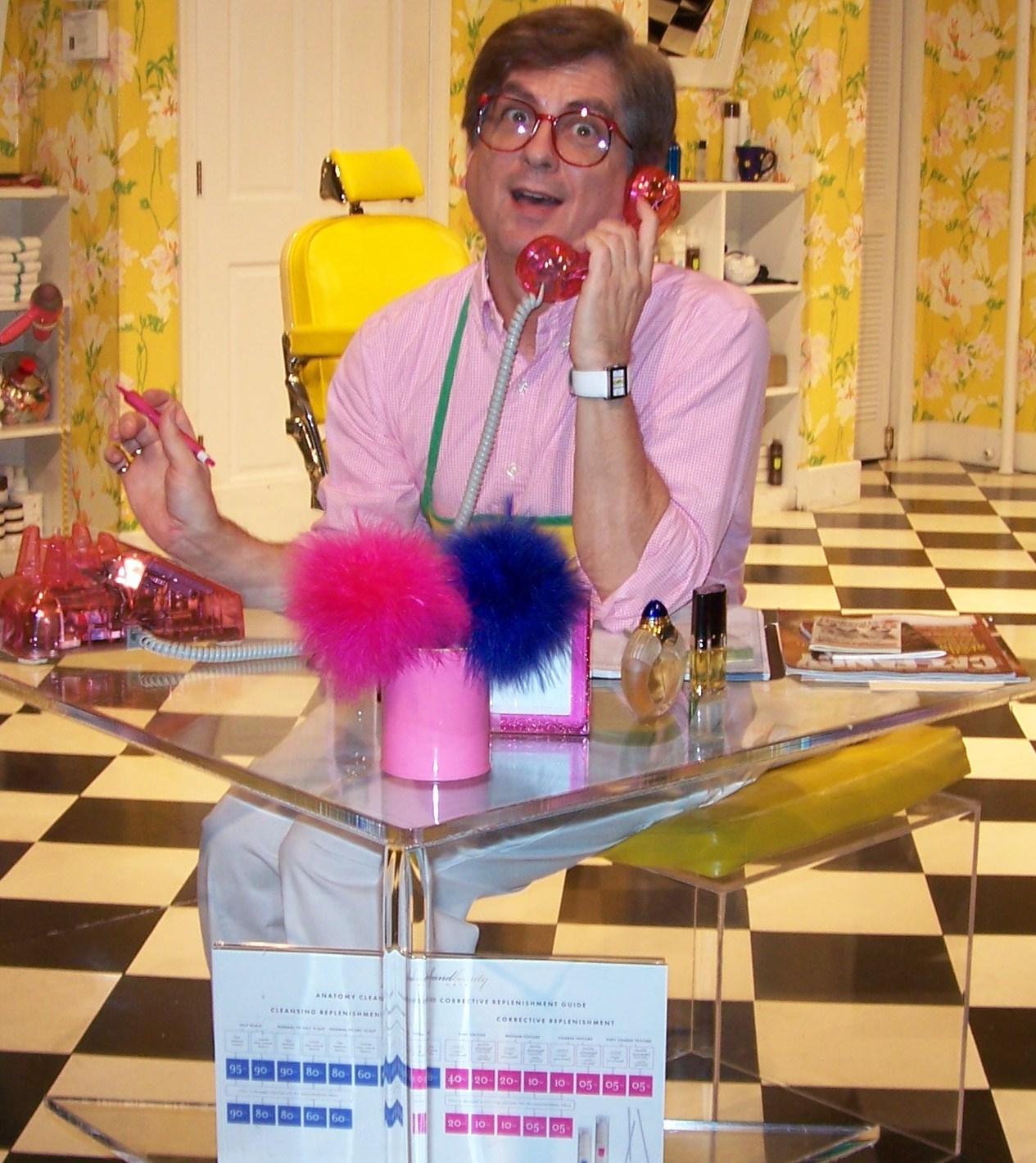
I took the opportunity to audition myself as well, with my new, though temporary, "Polonius look." This is a substantial departure from my normal self, and those who knew me were...um...surprised, to say the least. Oh well, maybe it will increase my chances of snagging a gig out of the audition. My three minutes went well, I thought, though only time will tell if the audition yields fruit. I did come away from the auditions a bit deflated, though not as a result of my work on The Day. With the childish naivete which only actors can muster in their adult years, I had hopes of being asked to return to the local production of Shear Madness again, having played in their "day company" the last two springs. Sadly, that will not be happening, and I was more disappointed than I had a right to be. In the past, there have been YEARS between my engagements with The Madness, so I really have no right to be surprised that I am being passed by this year. In addition, I had a remote hope that a buddy who now heads one of the nice summer stock theatres in the region might offer me some work this season, but that hope is dwindling as well.
Any wonder I'm having trouble focusing on the project at hand?
Regarding our Liaison Auditions, there is a musical component for those who wish to sing. It's hardly a full-fledged musical audition, but it reminds me of the most arresting "Audition Story" out there. I've already written of my admiration for the original production of A Chorus Line, which contains the single most dynamic opening sequence of any musical. The 1975 Tony Awards devoted their entire opening to it, and it contains all the performances which later became lore. It's a blurred copy included below, but even with poor quality, the excitement cannot be denied. The clip includes Donna McKecknie (in the red), who won the Tony, as well as Sammy Williams and Kelly Bishop ("I knew the routine when I was in front"), who also snagged awards. Keep an eye out for Priscilla Lopez (in the red jersey,dancing with her tongue), who lost her Tony bid to costar Bishop, but later won the award for A Day in Hollywood/A Night in the Ukraine. And if your eyes are sharp, you'll glimpse Wayne Cilento, ("What happens now...?"), who later became a Tony-winning choreographer (Tommy) and is currently represented on Broadway by Wicked. By the way, the director/choreographer who takes center stage in this sequence is Robert Lupone, Patti's brother. But you don't have to know any of these people to be fascinated by this dynamic clip.
So, in honor of all actors auditioning everywhere, here is this week's Dance Party:
Patti Lupone has always been a showstopper, and she proved it several weeks ago in the final weekend of her celebrated turn as Mama Rose. She got very mixed response to her actions. During her climactic song in Gypsy, really only a few minutes before the final curtain, she stopped everything to complain about an audience member who was taking pictures. This, of course, is a big no-no, and apparently she had had enough. There are folks out there who wonder what the hell she thought she might accomplish by halting her own performance to insist the poor schnook be removed. Others, including the audience in attendance that night, applauded her actions.
Well, I wouldn't have done it, but I'm not Patti Lupone trying to scale that monumental breakdown number, "Rose's Turn." And the fact that this was the day before the show's premature closing probably weighed heavily with her. Lupone fought long and hard to play Mama Rose on Broadway, including having to convince author and director Arthur Laurents, who resisted the idea for years. Lupone finally proved herself during the New York concert staging of the show several years ago, and Laurents himself directed her in the revival. The show won lots of Tonys, for Lupone's performance and those of her two co-stars. As I wrote previously, the show was scheduled to conclude when the stars' contracts were up in March, but the tanking economy took its toll, and the production instead closed two weeks ago. I have no doubt Lupone was deeply disturbed by this, and I can verify (as can any stage actor) that the final few performances one gives of a beloved role are precious and personally valuable. To have one of her last shows marred by flashing cameras was apparently too much for the diva.
Frankly, I run hot and cold on Lupone. I have never seen her on stage in a musical, but have seen her in two straight plays, one of which (Master Class) she improved simply by her presence in it. (I wrote about seeing that show here). It's hard to find a subtle moment in any Lupone performance, on stage or screen, but who cares? I believe she gives her all to whatever she attempts.
Now that Gypsy is history, Lupone is hitting the road in a concert which should be...um...well... quite something. If there is a male counterpoint to the histrionics of Lupone's performances, it's Mandy Patinkin. Remember his performance of "Buddy's Blues" in the Lincoln Center Follies concert? Yikes. Here's a quick song which is very indicative of his musical performances these days. Get this guy a Valium...
I loved Patinkin's work in Sunday in the Park with George, a performance, preserved on video,which continues to make me weep. Nowadays, though, his singing makes me wince.
Lupone and Patinkin, who won twin Tonys for their performances in Evita decades ago, are joining forces for a concert tour. That may be a truly frightening evening. I'm serious here. Take this guy:
...and team him up with this gal:
...and all I can say is, TAKE COVER.
In an irony which theatre folk really enjoy, the very moment Lupone was going off on that audience member for snapping pictures , someone else was illegally audio-taping her performance. It is that audio tape which steals this clip:
With Lupone and Patinkin on the road together, nobody's safe.
I've had only two rehearsals for Ros and Guil so far, but it is enough to reinforce a belief I have long held about Tom Stoppard. He uses too many words. Yes, I know, a stage actor who dislikes Stoppard? That would be almost as bad as disliking Shakespeare; my peers would never respect me again. So, I will fall a little short of claiming to dislike the playwright whose work I am now rehearsing. Perhaps I will fall in love with his esoteric wordplay as the process continues (but I have doubts. I have already played a much larger Stoppard role, Bernard Nightingale in Arcadia, and the experience failed to win me over). And I admit to being perplexed that I have these negative opinions, as Stoppard's Oscar-winning screenplay for Shakespeare in Love remains a particular favorite of mine.
Ah, well. My opinion of Stoppard's wordplay does not matter too much in the case of my current project, as I am not speaking any of his words. As Polonius, I am speaking only Shakespeare's lines(and not many of those). So, I've been thinking more about Hamlet than Rosencrantz and Guildenstern Are Dead, and as such, present this week's Dance Party.
There are lots and lots of Hamlets out there, but this one is probably the one most true to the original spirit of the tragedy. Feel free to sing along.
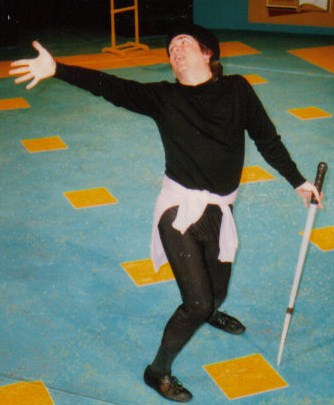
These pages have been dormant for several days, as I have been adjusting to the new gig and the new digs. I have relocated, for a while at least, to North Carolina, a direct result of a visit to Dear ol' Dad last April. While in the area back then, quite by chance, I attended an audition for the only Equity theatre in these parts, and landed a role in Rosencrantz and Guildenstern Are Dead, for which rehearsals began this week. (I have included the above picture merely for visual variety; I am playing neither Rosencrantz nor Guildenstern in the show.)
In addition, I have been busy scheduling several hundred actors for our upcoming annual DC Liaison Committee auditions, a task which has been an eye-opener for me. Though an actor myself, I never recognized the similarity of many of my peers to Scarlett O'Hara: they will lie, cheat, steal, or kill to secure an audition appointment.
I have many stories to tell and many observations to make. If I know me (and I think I do), I will have many conclusions to reach. Stay tuned.
...an occasional series mentioning current events which held my interest this week...
The Smithsonian's National Portrait Gallery hung its newest presidential portrait recently, and quickly found its caption in dispute. Every portrait allows 140 words, summing up the subject's presidency. The original caption included the phrase: "the attacks on September 11, 2001, that led to wars in Afghanistan and Iraq . . ." A senator from Vermont was not pleased with the inference that there was a causal relationship between 9/11 and the Iraqi quagmire into which President Bush engulfed the nation. "When President Bush and Vice President Cheney misled our nation into the war in Iraq, they certainly cited the attacks on September 11, along with the equally specious claim that Iraq possessed vast arsenals of weapons of mass destruction. The notion, however, that 9/11 and Iraq were linked, or that one 'led to' the other, has been widely and authoritatively debunked." The Smithsonian agreed, and changed the wording on the caption to read, ". . . Bush found his two terms in office instead marked by a series of cataclysmic events: the attacks on September 11, 2001; the wars in Afghanistan and Iraq; the devastation wrought by Hurricane Katrina; and a financial crisis during his last months in office." This adjustment sounds reasonable to me. Bush's tenure was indeed cataclysmic, and we will not be recovering from his presidency anytime soon.
The Obama Inauguration has stirred up a couple of brouhahas, one a lot nastier than the other. In his speech, the new president included "non-believers" in his description of the patchwork of America, and many right-wing black clergymen have protested. Though over 16 % of Americans describe themselves as "non-believers," those conservative men of God do not want these heretics included in any mention of American heritage. Of course, these are the same sort of bigots who raised a whole lot of hell, and a whole lot of money, to pass California's Prop 8, removing the marital rights of same-sex couples. Yet another example of how so many leaders of Organized Religion feel justified in trouncing the civil liberties of those who do not share their beliefs.
I wonder when it was, exactly, that Christianity became EXclusive, rather than INclusive...
I got a giggle over the revelation that classical performers Yo-Yo Ma and Itzhak Perlman had pulled a Milli-Vanilli at the Obama Inauguration; they had pre-recorded their piece and were just "string sync-ing" for the cameras. (It reminded me of the production of OpusI did several years ago; we did the same thing, but never hid the fact.) The frigid weather was blamed in this case, and everyone agreed that keeping the piano in tune would have been impossible under the circumstances. But then, why the charade? Why not just pipe the pre-recorded selection through the speakers without the pretence? Or use those jumbo screens to show a video of the performers recording the piece?
Aretha Franklin certainly was not lip sync-ing, but even she admits perhaps she ought to have been. She was quoted immediately following her performance that she was very disappointed in her own work. The cold took a toll on the Queen of Soul, and she took an unfortunate breath at the very top of her rendition of "America," right between syllables: "My count-(breath)-try 'tis of thee..." Sing it aloud yourself, and you'll discover the misfortune.
On the bright side, her performance seemed to be upstaged by her hat.
(update, 2/6/09: Aretha has made a quick trip to the studio to record a "preferred version" of her inaugural song, which will soon be available as an alternative to her live take)
I wrote a while ago about Jeremy Piven bolting from his Broadway commitment to Speed-the-Plow. More of the story has now come out. The show opened in early October to good reviews, but according to the producers, Piven immediately started making noise about leaving the show before its scheduled closing in late February. The production schedule was adjusted to accommodate Piven's attendance at the Golden Globes in Los Angeles. As soon as those plans were finalized, Piven informed the producers that he would not be returning to the show after the awards. Arrangements were made for William H. Macy to replace Piven during the show's final few months. Many weeks prior to his departure to attend the Golden Globes, with no notice whatsoever, Piven bolted from Speed-the-Plow, citing a dangerous level of mercury in his system. Too much sushi between shows or something. Macy was not available to take over the part that early, so the understudy played Piven's role while the producers scrambled for a higher profile replacement. Norbert Leo Butz, a Tony-winning Broadway favorite, assumed the role, giving several performances carrying the script. But the box office dropped dramatically in the absence of the Emmy-winning Piven.
This week, the show's producers filed a grievance against Piven with Actors Equity.
I don't get HBO, so I do not watch Piven's show Entourage, but I enjoyed him as a regular on Ellen Degeneres's sitcom a decade or so ago. But he's giving the "TV Star Turned Broadway Actor" group a bad name, if it ever had a good one (remember Kelsey Grammer's disastrous Macbeth?). Recently, Katie Holmes, Christina Applegate, and Jennifer Garner have all graced the New York boards, and have acquitted themselves well. I'm not the first person to guess Piven was unpleasantly surprised by the challenge of 8 shows a week, requiring vastly more energy and focus than a TV series. Kristen Chenoweth, one of the rare stars who moves easily from TV to stage, warned other film stars who consider hitting Broadway during their downtime that the stage will "kick your ass."
The story of Piven deserting his stage commitment is probably not getting much traction in middle America (you know, those people who think Muslims, Hindus, and non-believers should not be included in a presidential speech), but it's getting lots of attention among theatre folk. Here's an hilarious parody aimed directly at Piven, to the Pal Joey tune, "Zip."
What a week it's been, for the whole country, even the world, but especially for those of us who live in DC. An amazing, historic week, which deserves to be honored any way we can. It's time for a respectful, hopeful, and most of all, dignified tribute to a new era of competence and inspiration.
Well, you'll have to go someplace else for that. Instead, let's honor somebody else. Here's a guy of whom you may never have heard, until his death this week brought him back into the national spotlight. Everyone "of a certain age" has seen Bob May, though they may not have known it. Here he is:
Still don't recognize him? Here's a better shot:
He's the guy on the left.
The story goes that May was wandering around the studio one day when someone said, "Go over and see Irwin Allen. He needs somebody to wear a robot suit." That day, a star was born. Though May did not furnish the voice of Lost in Space's robot, he turned those accordion arms and claw hands, not to mention the bubble head, into an endearing character. After a year or so on the air, it was apparent that what was envisioned as an ensemble show had three break-out stars. Jonathan Harris's portrayal of Dr. Smith, originally a villainous saboteur whose actions caused the space travelers to veer hopelessly off-course, evolved into a masterfully comic performance. Billy Mumy, as Will Robinson, the youngest astronaut in history, provided Harris with a grounded counterweight. And Bob May's Robot (voiced by Dick Tufeld, who deserves equal credit) became the comic foil. The chemistry between the three performers was undeniable, and in its later years, the majority of episodes of Lost in Space centered around this trio.
So, with due respect for the momentous events of the week, and recognizing that monumental change is on the way for all of us, please enjoy this homage to Lost in Space:
 1921-2009


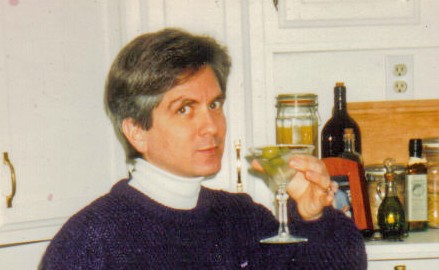


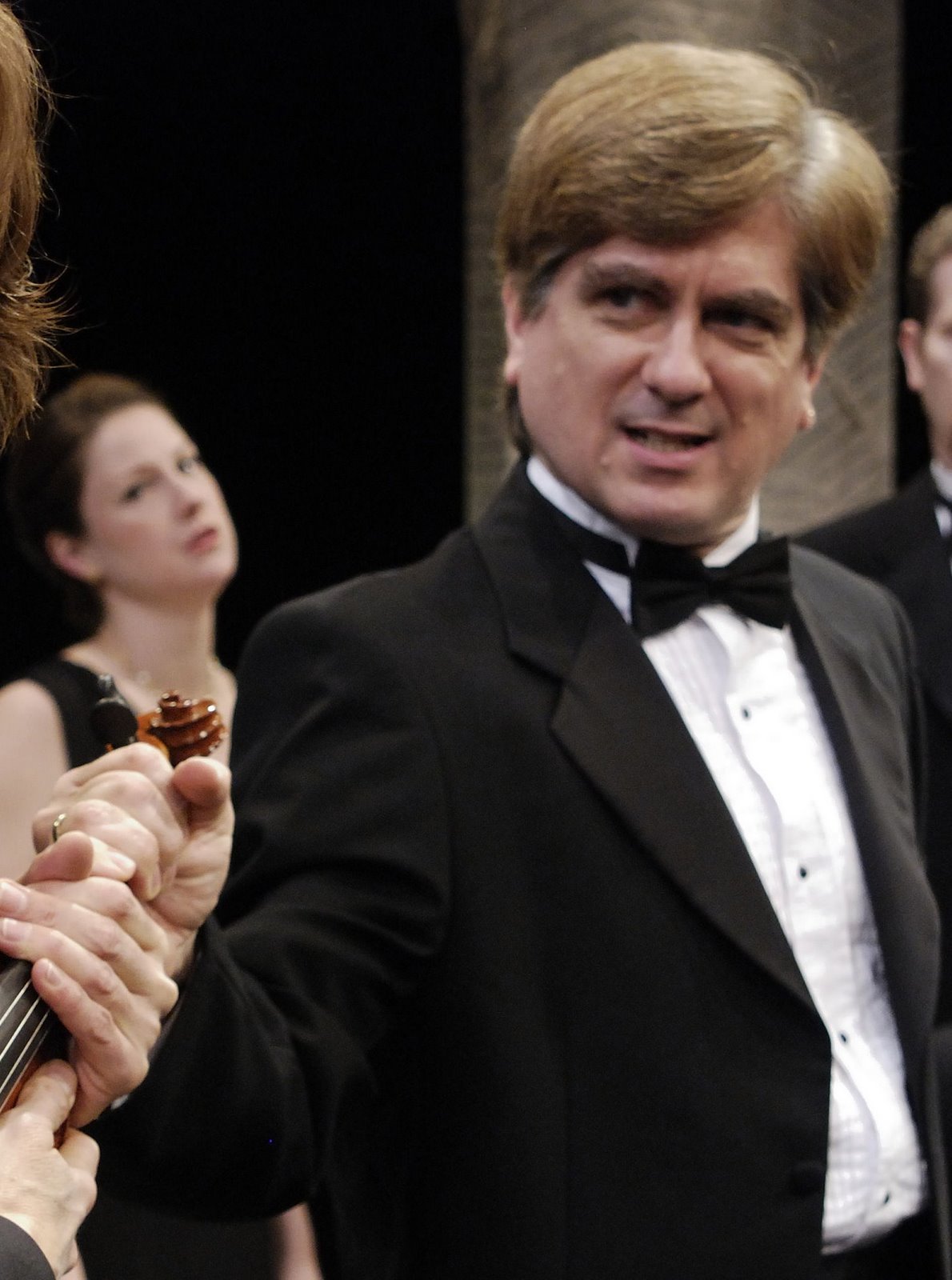
,+Olney+Theatre+Center,+2004.jpg)


,+Shakespeare+Theatre+Company,.jpg)

,+Warehouse+Theatre,+1999.jpg)
,+Are.jpg)
,+Everyman+Theatre,2002.jpg)
,+First+Nationa.jpg)
,+Shakespeare+Theatre+Company,.jpg)


,+Granada+Th.jpg)
,+Globe+Playhouse,.jpg)
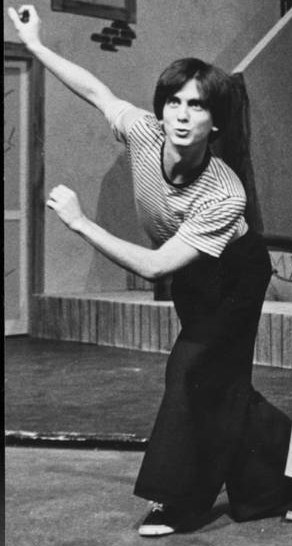
,+Valley+College,+1975.BMP)
,+CSUN,+1976.jpg)