Showing posts with label Titan Theatre. Show all posts

Sunday, November 12, 2017

Richard, Cubed

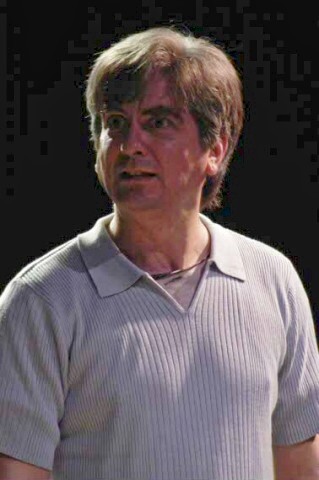
A typical rehearsal look.
Actors who perform the classics are likely, if they've been around long enough, to appear more than once in certain plays.  Two weeks ago, I closed Richard III for the third time.  I was always a bridesmaid in these productions; I hoped to play Richard himself for years, but the chance never came.  Instead, I've had to be satisfied by playing various supporting characters in various productions. 
Jack played R3, from his own adaptation, and
directed the thing too. I was thrilled to be
invited to play his Buckingham.

My first encounter with the hunchback who had misplaced his horse was back in <gulp> 1999. My buddy Jack Young, at the time the artistic director of the Warehouse Theatre in Greenville, SC, invited me to join his production of the play, in which he was to both star and direct.  It was a herculean task, in my opinion, but if anyone could accomplish it, Jack was the man.
This tableau, or a similar one, opens just about every production of Richard III, though Shakespeare did not write it.  In his original, the play opens with Richard alone onstage, lamenting his fate and revealing his plans to the audience. Modern directors are convinced this is a weak beginning, and wastes a chance to illustrate the arrogant power of the Yorks who have, seemingly, won the Wars of the Roses. So every production of R3 you are likely to see will begin with this family's revels (or procession or coronation or whatnot), followed by Shakespeare's original opening.
  
Christina Keefe, a great friend from grad school
suggested I play Buckingham. She played mad
Queen Margaret, a brute of a role which is
sometimes cut from American productions, as
she serves no dramatic purpose and is confusing
to viewers unfamiliar with the dynastic
entanglements of the Wars of the Roses.

My grad school comrade Christina Keefe, Jack's wife and the leading lady of his theatre, had suggested he hire me for the show.  I was told that my name first came up to play the small comic role of the Mayor of London; Christina wondered why Jack would waste me on such a minor character, considering he would have to hire me as an out of town actor, and provide lodging and transportation for me as well.


This gal played the Mayor, a role I was later to play. Twice.
They agreed I should play the much larger role of the Duke of Buckingham, Richard's co-conspirator and later, betrayer. Depending on the adaptation, Buckingham usually turns out to be the show's second male lead.


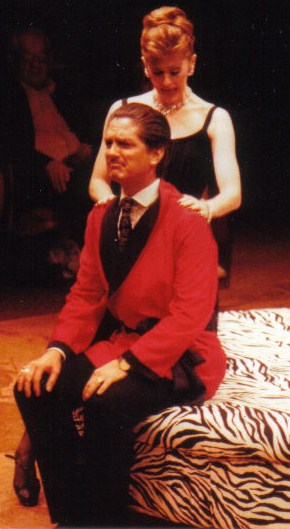
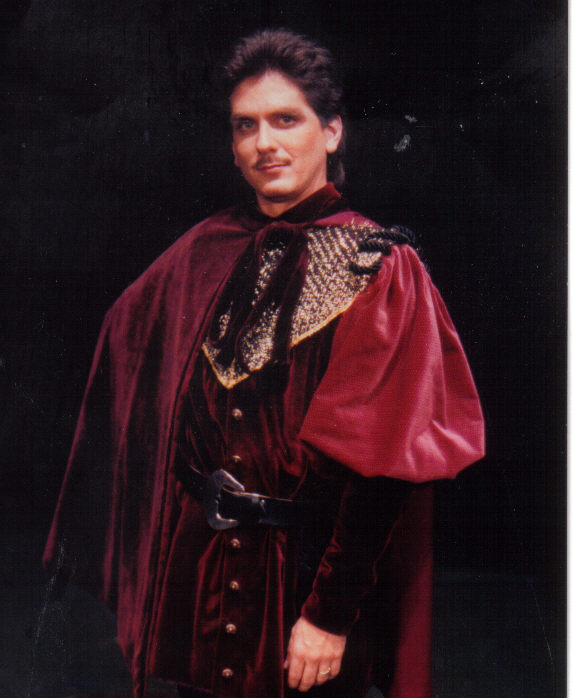
Buckingham ends the play being led to
his execution. This photo was on my
 Christmas Card that year.

I have to admit that I don't have many specific memories of the experience at The Warehouse. I recall I spent a lot of time working the text; Buckingham was the largest Shakespearean role I had played to date.  He is definitely one of those roles which I would like to attempt again, now that I'm more <ahem> seasoned.  
Our star was not the only one with a hump.  Our stage had one too. We played in-the-round, with a misshaped hill in the center as the defining scenic element. 

Fourteen years later, Richard III reentered my life. 
After a prelude lifted from Henry VI, Part III (a prequel of sorts to Richard III), my second R3 began with a procession of the royal family down the stairs of the playing space, through the audience . I'm up top, in the beard and white tie.
Richard's opening "Winter of our discontent..." speech was
delivered, in part, through a bullhorn as a political stump
speech. In all the productions of R3 I've seen, I don't believe
I've ever seen one which begins as Shakespeare intended: a
solitary figure limps onto a bare stage, turns to the crowd and
tells them his plan. Too dull for modern audiences I suppose.
Even Olivier began his iconic film version with pageantry.
And McKellen's film begins with a tank breaking through
a wall; his opening speech doesn't show up until scene 4.
I had only been in my New York apartment a few months when I responded to a casting call for Hudson Warehouse, a company which produced classic (mostly Shakespeare) shows outside in Riverside Park.  


I never really adjusted to the weather issues, but I have
to admit, when the sun is setting on your face, it gives
the performance a glow which I've never felt from
artificial lighting.
It's probably lucky that I had not, at the time, experienced how hot New York summers got, especially if you're dressed in business suits spouting classical text, but I had never spent a summer in NY, so I assumed hey, if Joe Papp can attract all that A-List talent to do Shakespeare in the Park every year, the climate must be tolerable.


The playing space used by Hudson Warehouse is huge, well-suited for big Shakespearean epics (if not for acoustics, which are as you might imagine). I wrote about trying to meet the challenges of this space here and here.


As the clueless Mayor of London.
Just as so many years earlier, it was the role of the Mayor for which I was initially engaged at Hudson Warehouse. Shortly before rehearsal began, an additional role became available, that of Richard's brother, the Duke of Clarence.  It was possible to play both roles, and it was a terrific pairing.  


Clarence is led to the Tower by
Brakenbury, a minor character whom I
was to play in my next R3. The irony of
this shot only became apparent recently;
I conquered this scene when I was
playing Clarence for HW, but in the
smaller role of Brakenbury for Titan,
I repeatedly fell short.
Clarence has a strong dramatic presence in the early scenes of R3, including a speech about a dream, full of imagery and dramatical moments.  After this speech, Clarence is murdered, but not without a fight (and plenty of blood. Hudson Warehouse loves to work with blood). I loved the fact that, in our version, Clarence did not simply accept his fate, but instead fought back as best he could. His slaughter was inevitable, and very fun to play.
The murder of Clarence is written to be performed offstage, but Hudson Warehouse had other ideas. During rehearsal, we were wondering how to get my lifeless corpse off the stage when I joked that I could simply be tossed over the wall. Everyone looked at each other, and a dynamic fight sequence was born. This became my favorite moment in the play.
After this very bloody scene, I cleaned up myself as best as possible in order to return to the stage as the Mayor, perhaps the only specifically comic role in Richard III.  After getting a few laughs in a few scenes, I donned the bloody t-shirt in which Clarence had been murdered in order to reappear as his ghost, haunting his brother.  The juxtaposition of these two roles, one dramatic and one comic, was great fun to play, making this my favorite overall experience with any of my R3s.
There were no artificial lights used outside at Hudson Warehouse, merely a few streetlamps of questionable efficiency.  As the sun set, the play reached the sequence in which Richard is haunted by the ghosts of all whom he has murdered. I made my ghostly entrance by climbing the wall over which I had been tossed, reappearing with bloody shirt and a score to settle.
My third go-round with Richard III ended only a few weeks ago.  
Let's Partaay! Titan's production also opened with the royals celebrating their success, before brother Richard hobbles on to spoil everyone's fun.
I have worked repeatedly with Titan Theatre in Queens since arriving in NY six years ago (in fact, they afforded me my NYC debut, I wrote about that here), so when artistic director Lenny asked me to join his production of Richard III, I agreed.  
This was my only R3 which used actual kids to play the
young Princes in the Tower (you know, the ones who get
murdered). On the wall, you can see the major motif of
Titan's R3: each time somebody bites the dust, our "hero"
paints a line to keep score.

I was once again to play the Mayor; this time the role was doubled with that of Brakenbury, a minor official in the royal court whose primary duties seemed to be keeping the keys to the Tower.  
I mentioned on social media that Brakenbury is the guy who is always standing next to the person who's talking. I did a lot of "active listening" in the role. I also disappointed myself greatly. My lack of focus in this character led to several <ahem> senior moments, during which my mouth refused to do what my brain instructed, and the scene had to be rescued by other actors. I have never had such trouble onstage before, and I remain perplexed as to why my brain built a wall around this particular moment.  It was embarrassing the first time it happened; when it happened a second time, I had officially humiliated myself.
This is a selfie I took in the dressing room, of
the Mayor. I had to take a selfie because there
was scant photographic evidence I was in this
production. It became a running gag that I did
not appear in any rehearsal photos nor any
promotional materials nor any Instagram
entries. So if I wanted a picture of myself
as the Mayor, I had to take it myself.
I brought a few new touches to the role of the Mayor, but overall, my performance in Titan's Richard III was not one to celebrate.  It was the most limited amount of stage time I had experienced since playing a nameless fishseller in Volpone at the Shakespeare Theatre Company back in 1996.  I had to admit that I was working my way DOWN the ladder of importance, role-wise, in this play: from the costarring villain Buckingham in my first R3, to the satisfying supporting role of Clarence in my second R3, to the most recent endeavor playing that guy who is always hanging around on the sidelines.
The Duke of Clarence pleads innocence, in Hudson Warehouse's Richard III (my second). I would welcome the chance to play this guy again, as well as the Duke of Buckingham (from my first R3). I'm afraid I have no desire to revisit my third R3, in which I was a major disappointment to myself.
Another backstage selfie: Lord Brakenbury.
We were not a good match.
After our final performance, most of the cast remained behind to help with the show's strike, but I slipped out into the rain, to take the 15 minute walk from the theatre to the subway station.  As I trudged along, getting wetter and wetter ("My kingdom for an umbrella!"), I had to admit this was an ignominious but fitting end to a theatrical experience in which I had disappointed myself so thoroughly.  Not all artistic endeavors can be personal triumphs, but when it's a personal failure, the aftertaste is sour.  It will be a while before I attempt my fourth Richard III.


Thursday, May 15, 2014

Choking The Fool

The reviews were stellar, with all of them saying
how lucky Queens was, to have Titan Theatre in
their midst. I was lucky, too, to have been a part
of this remarkable production.
The gent who afforded me my New York City debut, in Taming of the Shrew, spoke to me over a year ago about working with his company on their planned production of King Lear.  He wanted me to play the Fool, and from that moment a year ago, I worried about attempting this role.  The Fool, you see, is one of those ambiguous parts in Shakespeare which is completely open to interpretation... as opposed to, say, Malvolio in Twelfth Night (which is on my bucket list, just putting it out there...);  if the actor playing Malvolio just recites the words correctly, half his work is done.  But Lear's Fool is not so obvious.  I did a bit of research on the history of the character (not too much, I didn't want to spook myself), and it's been played in wildly different ways. 
Lear's Fool is wide open to the actor's interpretation, making it both exciting and worrisome to rehearse. Even women have played it. This picture is from the production by the Renaissance Shakespeare Company ("the OTHER RSC"), with Kenneth Branagh as Edgar. I saw this production, and wept when the Fool died.  The role was played by Emma Thompson, here seen in androgynous whiteface.  Scholars have surmised for years that the fact that the Fool and Lear's youngest daughter Cordelia never appear onstage together must mean that they were originally played by the same actor. Other research reflects that the role of the Fool was written for, and first played by, Robert Armin, who replaced Will Kempe as the resident comic actor in Shakespeare's company.  By the time King Lear premiered, Armin was 37, entirely too old to play Cordelia.
I found at least two modern productions in which the Fool was a British Music Hall performer, to which the Fool's various songs lend themselves.  In more than one production, the Fool is ultimately murdered by Lear himself, in a fit of madness.  I'm not sure how the text supports that, but it's happened. 
Lloyd Mulvey, as Oswald, was responsible for my death.
Lloyd is also the resident photographer for Titan, and
most of the shots on this page are his. But we have no
pix of the strangling of the Fool, since Lloyd did it. Not
really the time for a selfie. The violence surrounding my
death was rehearsed at our daily fight call, of course,
where it was called Choking The Fool.
The double entendre is evident.

What has concerned directors of Lear over the years is the Fool's sudden disappearance, without explanation, in the middle of the play.  In his final speech, Lear himself clears up the mystery by explaining his fool has been hanged, but there is no mention of exactly how or why the hanging might have taken place, or by whom.  There is no other mention of his disappearance.  It was decided in our production that I would be strangled and dragged offstage.

Tristan Colton swiped all the reviews as the
sociopathic Edmund. His famous speech
("Thou, Nature, art my goddess...") has been
butchered by every young classical actor.
Lenny moved it to the top of the show, giving
it even more importance. Tristan knocked it
all the way to Mets Stadium.

But I was never really concerned with how the Fool's life ended, I was more worried about giving life to the guy in the first place.  For a full year, each and every time I mentioned to somebody, ANYbody, that I was to play the Fool in King Lear, that person's face lit up.  "A great role!" or "Perfect for you!" or the like.  Nice, right?  The expectations of the Fool were very high, and even after a year of thought, I didn't know what the hell I was going to do with this part.
Michael Selkirk as the blinded Gloucester, being led, unknowingly, by his son Edgar. I spent some time onstage with Brendan Marshall-Rashid as he played that convincing beggar, Poor Tom; his was an extremely physical and satisfying portrayal. And I say that even when he had his clothes ON. I played Gloucester a year ago for Hudson Warehouse (go here for that report), but this is the remarkable thing about Shakespeare: never once did I think of how I played the role, I was so engulfed in creating my own character of the Fool. And Michael's performance as Gloucester was deservedly congratulated.
Director extraordinaire Lenny Banovez assembled a truly remarkable ensemble to play this Shakespearean classic.  He began, of course, with Lear himself. The role is one of those which is so substantial, and so iconic, and so very important to the success of the individual production, that the part is always cast first, and in advance. 
Kevin Beebee, on the left, has used his business
skills to help Titan grow fast and well.

You really cannot go into pre-production hoping to find your King Lear at an audition (Hamlet is another of those roles; because the entire play really revolves around these characters, it is impossible to build an ensemble to effectively tell the story without first knowing who will be at the center of it all.  This doesn't seem to be true with all Shakespeares. I think you can pre-plan Romeo and Juliet without knowing exactly who will be playing those title characters).
The relationship between Lear and his Fool is an important one, and through our rehearsal period, I think Terry and I developed a strong working bond. Here we are in rehearsal, with Brad Makarowski as Kent and Brendan Marshall-Rashid as Edgar.
I did not personally know our Lear, Terry Layman, before we began, but I had seen his work as Friar Laurence in Titan's production of Romeo and Juliet. (We almost worked together in that production, but that's another story altogether.) 

Lear surrounded by his daughters, played by Laura Frye,
Susan Maris, and Leah Gabriel. Fine actresses all, and they
actually looked like a family!
I was to learn, very quickly, in rehearsal that Terry was to be an outstanding Lear, and it was a privilege to stand next to him as he charted Lear's descent into madness. Lenny surrounded Terry with an exceptional ensemble. As Kent, the moral center of the play, Lenny cast Brad Makarowski, a talented and annoyingly tall actor with whom I shared several scenes. 
With Brad as the disguised Kent. Some of my favorite
moments were in this scene, in which Kent is in the stocks,
and the Fool advises him, through speech and song, that only
a knave would desert the king.


My first scene in King Lear opened with a speech to Kent, admonishing him that, if he insisted on following King Lear, he was himself a fool. The Fool's coxcomb, or hat, would traditionally have included bells, bright colors, or other signifiers of the Jester. Our version, with present day dress, could not include such a thing, so my coxcomb was just my hat. Unfortunately, the entire speech consisted of the Fool insisting that Kent take his coxcomb, or Fool's Hat, since he is becoming a fool himself. I tried to make this clear in the speech, but without the visual of a jester's hat, I'm afraid the audience did not follow.  Even successful performances have a failure or two, and this was one of mine.
Lenny did a fabulous job editing this monster of a script, which in its full form runs 4 hours or so.  Our cut ran only 2, yet told the full story with depth and nuance.  And it's a good thing the edit was so drastic, as we had only three or so weeks to rehearse the show.  We began, as so often happens, with the table reading on the first night.

Actors call this The First Day of School: the Table Read, or First Read Through. For me, it was the first time I met most of the cast; it is always an exciting rehearsal. This picture reminds me, though, of a pet peeve of mine regarding such rehearsals.  It has nothing to do with King Lear, particularly, but since this is my blog, I get to vent, right? You'll get a better view of my peeve in the picture below:
The Table Read, the first time the cast reads the script outloud. I can't count how many of these I have attended. The company sits around a table, at places assigned by either the director or the stage manager. From our assigned seats, we try to make preliminary connections with our fellow actors through the text. Without fail, actors who have significant interaction with other actors are placed next to each other, as above, with Lear and his three daughters. At this rehearsal, you will always find the Macbeths sitting next to each other, and Romeo and Juliet as well. The theory is that the actor can more easily make a connection to the actor sitting next to him. This is a false theory, at least at this early, script-reading stage. The actors who have the most important text together should be sitting ACROSS the table from each other, rather than side-by-side. Then, it's possible to glance quickly from the script to the actor and back again, with merely a flick of the eye.  But when actors are seated next to each other, it's necessary to twist the body 90 degrees to the side in order to look at each other, making it very difficult to glance up from the script to try to initiate a personal connection. I am apparently the only person in all of show business to take note of this constant failure of the First Read's seating chart.
Titan's King Lear was the troupe's inaugural production at their new home, the Queens Theatre, located in Corona Park, very near the stadium where the Mets play.  The park is a lovely one, and it's peppered with huge structures which are both attractive and desolate. 
These structures were constructed in 1964 to symbolize a modern future. Perhaps, then, it's fitting that Titan Theatre has moved into the neighborhood, as Titan appears to have a glowing future at the Queens Theatre.


Corona Park was the home of the 1964 New York World's Fair, and the structures which survive from that event have largely been abandoned.  Plans are afoot for a major rejuvenation of these artifacts, but for now, they remain both intriguing and a bit creepy.
This is my favorite picture on this page. The giant globe was constructed for the World's Fair and remains its most constant reminder. And there's our director Lenny Banovez, and his skateboard. I wish I had a picture of his skanky shoes, which I wore in the show.

Our theatre is nestled in the midst of the aging
monuments, above.

Our show was produced in the Studio Theatre of the building which houses a larger main stage.  It is a true Black Box, built as such, and it was a delight and a relief to be performing there.  This King Lear was my seventh production in the two years I have had a New York Branch, and the only one to be performed in a space originally designed to be a theatre. 
The intimacy of the Studio Theatre allowed
the audience to watch Lear's madness take
hold, up close and personal. When he drew
his last breath, holding his dead daughter,
there were tears. There were tears
backstage too, as we said goodbye to this
experience. We all knew how special it was.

It was very nice to have actual dressing rooms, an actual Green Room, and the like, but really, if a show is good, it doesn't much matter where it is performed.  And Titan's King Lear was very, very good, featuring a central performance which was majestic, funny, and ultimately heartbreaking. I was proud to be a part of it all.

Tuesday, June 12, 2012

Taming Of The Show

Seven weeks ago, give or take, I began work on the Titan Theatre production of The Taming of the Shrew.  It was early April when I auditioned for this production, which was to be performed in Queens, NY;  it was to be my New York City debut, though I didn't know it yet.  All I knew in April was that I liked the artistic director of this young company.  He had an enthusiasm which was refreshingly different from the attitude I had been encountering at other NY auditions. 
Director Lenny wore
the same jeans 18 days
in a row, until I called him
out. He changed jeans, which
he wore the next 18 days.
They were his wife's.

The lovely and talented Lenny Banovez seemed excited to be seeing an actor of my age, willing to work for subway fare.  The fact that I had no NYC credits, having only recently opened my NY Branch, didn't seem to bother him in the least. I liked Lenny for another reason, too:  his casting call asked that each actor prepare two monologues, and that one of them be a speech delivered by one of Shakespeare's clowns.  I LOVED that kind of specificity, this kid clearly knew what kind of production his Shrew was going to be, and what kind of actor was needed to fulfill his vision. 
My old buddy Jack Young trained many of
my Shrew castmates. I played Buckingham
to his Richard III 13 years ago.

Between the time of my initial audition and my callback, I did a bit of digging into Titan Theatre's website, and discovered that one of their earlier productions had been directed by my old friend, the lovely and talented Jack Young.  After I had completed my callback, during which Lenny offered me a place in his production, I mentioned I had worked with Jack years earlier.  Lenny's eyes lit up, and an immediate connection was formed.  I was soon to learn that many members of the Titan Theatre company had been trained by Jack.  Small world! 

Our rehearsal process was to be short and swift.  Our first read-through of the script was at NY's The Players Club, courtesy of one of the only other actors in the company of my generation, the lovely and talented Michael Selkirk, who is a member of this famous actors' club. It was an auspicious beginning, to first read our text at The Players Club, which had all the great thespians of yesteryear as members. 
The Players Club, the site of our first rehearsal.
That first rehearsal set the tone for our rehearsal period, not only because it was held at the first of SIX different spaces in which we rehearsed the show, but also because it was steamily hot. 
Romeo and Juliet has its balcony, while Shrew's most famous
sequence is surely the wooing scene, beautifully played by
Elizabeth Audley and Michael Poignand.

I don't recall ever NOT feeling overheated in any of our half-dozen rehearsal haunts, which was just as well, as the air-conditioning which was purported to cool our theatre really didn't.  But other than that mildly uncomfortable temperature issue, I had a ball with this production.  Lenny had cast the show very well, there didn't seem to be a weak link or a diva in the bunch. 

We had a lively run of only 12 performances, and they were not as well attended as one might have wished. 
Our deck set was simple but effective.
The theatre owners were so impressed,
they asked Titan to leave it intact, for later use.

The Secret Theatre, where we performed, seems slightly off the beaten path as it's in Long Island City, Queens.  Being a newcomer to the city, I had to ask around before I was informed that yes, this would count as my NYC debut (one Facebook wag informed me that yes, a production in Queens does count as my New York City debut...until I snagged a gig in Manhattan, in which case that would be counted as my New York City debut). 
Adam Van Wagoner and Laura Frye played
our younger lovers, Lucentio and Bianca.
Both were trained by my old friend Jack Young.

I couldn't have asked for a stronger production with which to get started in New York.  Just as strong word-of-mouth was spreading, we closed, which is always a bittersweet moment.
Marc LeVasseur as Hortensio.
We had lots of fun as Bianca's
futile suitors.

Titan Theatre operates under the AEA Showcase Code, which, like the old L.A. Waiver Code about which I've been writing lately, allows Equity members to appear without a full contract.  It's really the only way a fledgling company can get started these days, at least in New York. 
Corey Tazmania wins the award for the
Best Name in the cast. Her work as
Biondella was physically dynamic.

I'm hoping I have a future with Titan, though artistic director Lenny is heading to Milwaukee to work for at least a year; he plans to maintain a presence in New York as well, so stay tuned.  Meanwhile, I'm grateful to a company of actors who were gracious and welcoming to a newcomer.  Thanks to everyone for my share of the feast.
The highlight of my work as Gremio was surely the orange shirt I wore. It's actually mine, given as a gift from my Shear Madness buddy Matt Sawyer, right before he shipped out for military duty. I thought of him every time I donned it to play this silly character.  As for this pic itself, it really doesn't reflect the true goofiness of the role. I told others, I look like I just wandered in from The Three Sisters.