Confetti and balloons, cake and dancing, hilarious quips and bawdy bon mots. There's even a parlor game. Who wouldn't have fun at a festive celebration like this? Turns out, NOBODY has fun. Welcome to Harold's birthday party.
This poster for the 1970 film was
banned by many newspapers
across the country. A more subtle
poster replaced it (it's below)
One of the buzziest shows in New York this summer is a 50 year old play considered to be a ground-breaker, finally making its Broadway debut. The Boys in the Band opened in a tiny hole-in-the-wall performance space in Greenwich Village back in 1968; it ran over 1000 performances and put gay characters front and center before mainstream audiences. At its opening, the play was celebrated as the first realistic illustration of the modern gay lifestyle. About a year into its run, the show ran into some trouble.
A pre-Exorcist William Friedkin saw this original production, and signed on to direct the movie version, with one condition: that the full original cast recreate their roles on film. He needn't have made such a demand. No Hollywood agent or manager would have allowed a client to go anywhere near this thing, and even the New York actors involved were told playing gay would end their careers.
Michael hosts a party for Harold. These two thoroughly
nasty queens create the dramatic stimuli of the play.
In 1969, a group of ragtag drag queens, hustlers, and other gay undesirables were harassed by police during a raid on a dive bar called The Stonewall Inn. Several days of rioting ensued, and the modern gay rights movement was ignited. This movement encouraged homosexuals to be proud of their identities, rather than to be ashamed, and to this day, celebrations of homosexual and gender fluid identities all carry the label of PRIDE.
The Boys in Mart Crowley's play are anything but prideful. Quite the opposite, these nine characters are filled with self-hatred and shame regarding their sexuality. During a booze-filled evening right out of the Edward Albee playbook, they punish each other for their own feelings of self-loathing. (Though Michael never says it, he is playing "Get The Guests" better than Virginia Woolf''s George and Martha)
Is Boys in the Band an honest examination of a generation of
gay men forced to remain in the closet except in hidden bars,
bathhouses, and the occasional Saturday night birthday party?
Or does it offer a highly limited view of gay society in the late
60s, portraying gay men as psychologically damaged, haunted
and ashamed?
Gay activists such as the Mattachine Society, one of the earliest gay rights groups, disowned the bitchy, sad, and fairly unpleasant characters portrayed in The Boys in the Band. So our Boys became controversial not only in the mainstream, but also among the gay community; this controversy continues today.
I didn't know anything about this controversy when I first became aware of The Boys in the Band, when, at age 13, I opened the Sunday edition of The Atlanta Journal-Constitution, and saw this movie ad:
As a pre-teen in the Deep South, I had no knowledge of the provocative Off-Broadway play depicting homosexuals; I never even knew the Stonewall riots had happened. But something about this poster told me I needed to see this movie. It was rated R. I was not able to see the film until several years later, and it has remained my only exposure to The Boys in the Band until last week, when I saw it for the first time onstage.
The first thing I can report about the Broadway production of Boys in the Band is this: it's friggin' hilarious. Somehow, the same text which comes off as vicious on film becomes enjoyably flippant onstage, at least initially.
Director Joe Mantello is not stupid.If you have a specimen
like Matt Bomer in your gay play, you strip him to his
underwear as soon as possible. This first scene between
besties Donald and Michael plays like a dream,
endearing both men to us,until Parsons's Michael
picks up a gin bottle and turns into Mr. Hyde.
Congratulations in no small part must go to director Joe Mantello, who has guided his cast to mine the laughs, and they have struck gold. The first half of the show (in what used to be its first act; playwright Mart Crowley has wisely trimmed the play a bit and removed the intermission) feels like Terrence McNally wrote it. Jim Parsons as Michael, the leading character, knows his way around comedy, and his first scene, opposite Matt Bomer, is full of laughs.
Robin de Jesus as flameboy Emory, Michael
Benjamin Washington as token black Bernard,and
Andrew Rannells as promiscuous Larry, all add to
the festive atmosphere of the first half. This party
would have been such fun, if the host hadn't
torpedoed his own event by showing that queers
are not just self-hating, they're also self-
destructive.
We like these men immediately, and that fond feeling extends to the other Boys, as Andrew Rannells, Robin de Jesus, and Tuc Watkins join the party. I was joyfully able to put aside my distaste for this text and start to recognize that perhaps the original play can be treated simply as a period piece. Except it can't. Many gay men of the generation depicted in this play have accused the playwright of displaying some very nasty stereotypes, as if all gay men of the period felt the same self-loathing expressed by the play's lead character, Michael. There is a seminal quote from Michael which is difficult to defend: "If only we could learn to stop hating ourselves so much." This is an exclamation difficult to justify, and one which I have trouble overlooking.
Once Michael (Jim Parsons) picks up that gin bottle, he turns from a charming and witty host into a vicious annihilator. He slings racial, ethnic, and anti-Semitic slurs at his guests, and conducts a party game aimed to humiliate the players. This sudden shift in character was very difficult to accept from Parsons, who did not handle this arc as well as the originator of the role, Kenneth Nelson. When the party is finally wrecked and done, Michael himself has a breakdown. As he recovers himself, he utters the sentiment which has alienated large portions of the gay population for decades; "If only we could stop hating ourselves so much."
Leonard Frey and Kenneth Nelson, as Harold and Michael,
delivered two indelible performances in the film, pretty much
steamrolling the other actors; it's hard to remember much
about any of the others.
Michael indeed seems to be a self-hating homo, and I have no problem with such a character being portrayed onstage, we've seen many of them over the years. But he doesn't speak only of himself; he doesn't say "If only I could learn to stop hating MYself so much." He says "We" and "OURselves," suggesting to the world that all gay men despise themselves. This is not true today, nor was it true in 1968.
"These are really Harold's friends," our host Michael explains before the birthday party begins. Really? We'll have to take that as a leap of faith, as there is scarce evidence that anybody has a friend in this room. I keep wondering, what is it that holds this group together? There doesn't seem to be much actual friendship apparent, in fact quite the opposite, as the evening progresses. And once the host turns from hospitable to hostile, why oh why do all these guys stay?? It takes a huge leap of logic to accept that all these guys sit still and take the abuse Michael dishes out. I wonder if playwright Crowley was attempting to show that gays tend to form their own ad hoc families, and will take all sorts of crap from them? Crowley's contemporary Terrence McNally (they are only 3 years apart in age) did exactly that 25 years later. McNally wrote his own version of Boys in the Band; Love! Valour! Compassion! succeeded in showing a group of 8 gay men gathering in celebration, and while there is PLENTY of queeny bitch-talk in that play, there is never any doubt that the group loves each other. I'm not sure the boys in Crowley's band even like each other very much.
I have huge respect for these two actors. I've seen Zachary Quinto onstage in The Glass Menagerie, and he's got the
goods. Jim Parsons has won multiple Emmys and even better, appears to be an actor of intelligence and gentility. As with all the actors in this production, they are conducting their careers as out gay men. So I'm disappointed to report that their performances are the least convincing in the play.
Though the performances surrounding them cannot be faulted, I'm sorry to say that I was disappointed in the work of stars Jim Parsons and Zachary Quinto. Parsons has a congenial quality which simply cannot sustain the vicious behavior of his character Michael. And Quinto's entrance late in the play actually saps the energy in the room.
Birthday boy Harold (Quinto) meets his "gift," the hustler called Cowboy. This is Harold's entrance into the play; we've been hearing about this character for almost an hour, and he arrives just after a climactic moment of physical violence which has shocked the audience. Structurally, these early moments are needed to re-center the energy of the play, and set it off into its new, darker direction. It's a very tricky moment, it's where the intermission used to be. Quinto's languid, reptilian way of moving and speaking does not give the play the new boost it needs, in fact it seems a lot of the energy already created by the other actors is sucked out of the room when Quinto takes over.
The real surprise in the second part of this play comes from one of my favorite stage actors, Andrew Rannells.
He is playing Larry, a role which was quite forgettable in the film, one half of the only gay couple in the piece. Larry is the guy who picks up a different trick every night and has no desire to settle into a hetero-normative relationship.
Tuc Watkins makes his Broadway debut in the role of the
straight-appearing Hank. Tuc is proof that many so-called
"soap studs" are gay; he spent years as the resident hunk on One Life to Live. His performance here is grounded and
honest.
But he has reluctantly fallen for the conservative Hank, a school teacher with kids who has recently left his wife but is looking to replace that marriage with a similar one with a same sex partner.
This subplot is dull as toast in the film, I'm sorry to say, but in this production, Rannells's sparkle moves it front and center. The sequence in which these two mismatched lovers declare their commitment to each other is, for me, the highlight of the show's second half. A word should be said about Charlie Carver as Cowboy, who appears to be making his professional stage debut in this production. I remember this kid from Desperate Housewives, and apparently he's maintained a lively career in TV/film (it has helped that he has an identical twin, they have often worked together).
Charlie Carver came out publicly several years ago, and has an interesting story. His parents divorced when he was quite young, and he only found out later that the split was due to his father's homosexuality. His own coming out must have been fraught with extra baggage.
Carver's role of the hustler is pretty one-note, though you can feel the audience turn against Michael when he makes snide comments about this poor kid's lack of intelligence. But Carver's final moments onstage are pretty poignant. As they are leaving, Harold asks his hooker how he is in bed. "I try to be a little affectionate," he replies. "It helps me feel less like a whore."
The Boys in the Band is going to carry its legacy as a groundbreaking play despite the debate regarding its central theme. This Broadway production is a worthy revival of this problematic piece. I can't help but think about those actors in the original production, back in 1968. We now know that five of them were gay, all of whom died during the Aids epidemic. The original director and producer were also taken.
Ironically, Robert La Tourneaux's performance as the hustler Cowboy was prophetic. He had turned to prostitution when he died. Leonard Frey (left) had a more successful career, capped with an Oscar nomination as Motel the Tailor in Fiddler on the Roof. They both died of AIDS.
Kenneth Nelson (left) was the original (and unforgettable) Michael. He had already created some theatrical history by appearing as The Boy in the original production of The Fantasticks. His post-Band career was definitely affected by his association with The Boys. He also died of Aids. Cliff Gorman (right) gave a very brave performance as the flamboyant Emory. Gorman was straight, and went on to win the Tony playing Lenny Bruce in Lenny.
These are the last surviving members of the original production (at least, we assume so, as nobody can find the black guy). They escaped the Aids epidemic, they are both straight. Peter White (right) went on to play Linc Tyler on All My Children, off and on, for 30 years. Lawrence Luckinbill (left) maintains an active film/TV career, and married into Hollywood royalty to boot (he's husband to Lucie Arnaz).
If you've gotten this far, you're clearly interested in this landmark play; there is a fascinating documentary, made in 2011, which explores the various reactions to The Boys in the Band when it first arrived on the scene. It's worth checking out, if only to hear how the play affected some younger playwrights such as Tony Kushner while it infuriated some of Crowley's contemporaries, such as Edward Albee. Here's the trailer for that documentary:
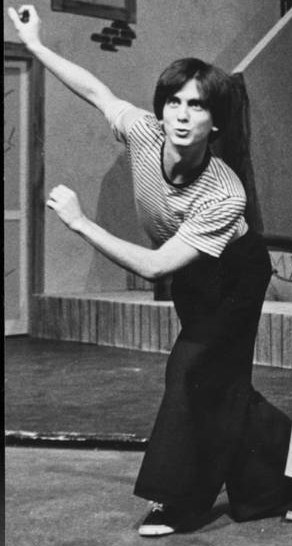
The Robber Bridegroom, CSUN, 1978.
I still have this shirt.
I've been feeling a bit nostalgic for my old undergraduate college days, for a couple of reasons. Cal State Northridge's Department of Theatre celebrated its 60th anniversary a few weeks ago, and a big party was held. I couldn't attend; I'm afraid the days of my making frequent return trips to L.A. are behind me now, my finances just won't support such things. But thanks to the glories of Facebook, I was treated to many photos of the event, and it surely seemed "my generation" of alumni (who attended the college during the latter 70s and earlyish 80s) dominated the proceedings. We certainly felt "dominant" while we were there back then.
Broadway heartthrob Steven Pasquale has been playing the title role in The Robber Bridegroom in a major Off-Broadway revival. It closed this weekend.
By coincidence or providence, the weekend before this big event occurred, I snagged a ticket to the Off-Broadway revival of a barely-remembered musical from the 70s, The Robber Bridegroom.
The musicians in this revival are not hidden in the pit. Here's
Banjo-Boy Mike, center stage with the star.
I have an acquaintance in the cast, a young gent who played guitar for a production of Man of La Mancha in which I appeared in Virginia years ago (see a pic from that production in a moment). Michael Rosengarten has since graduated to the big time, playing and singing all over New York City, and he is a central part of the onstage band accompanying this new Bridegroom.
Our Robber Bridegroom, with a cast of about two dozen, plus a bluegrass band uptop.
The "Story Theatre" style of the piece kept the full cast on
stage throughout the show, as the actors created the
atmosphere. Note my superb presence at the left. We call
that "active listening."
The show itself brought back many memories. I appeared in a college production of the piece, during my final year at CSUN (hence the heightened nostalgia I've been feeling lately). The Robber Bridegroom has had a unique history. It was developed in the early 70s during a musical theatre workshop, where John Houseman snagged the piece for his fledgling group of Julliard grads, The Acting Company.
Fresh out of Julliard, Patti Lupone landed her
first Tony nod for her 2 week Broadway run in The Robber Bridegroom. That's fellow alum
Kevin Kline with her. Whatever happened to
those two?
They ran the show for two weeks on Broadway before setting out on a national tour. (Can we imagine such a thing happening today?) This first cast included Patti Lupone and Kevin Kline; Lupone actually earned a Tony nomination for her performance in the two week gig. The tour was such a success that another production was created, which reopened on Broadway the following season. Though the runs were barely a year apart, the show was now considered a revival (has there been another musical which was revived only a year after its first production?).
Barry Bostwick won the Tony playing
Jamie Lockhart, while the original
Robber Bridegroom, Kevin Kline, was
stuck on tour.
The national tour was still going strong, so the show was recast and the new leading man, Barry Bostwick, won the Tony. It is this cast which recorded the "original Broadway recording," though it in fact was not the original cast (Patti, Kevin, et. al., were still on the road).
This "Original Cast Recording" really isn't one, but it's the only one out there, so far. The Off-Broadway revival which just closed is set to release a new recording, which may renew interest in this very accessible score. It's a cinch to sing, and the show itself is catnip to any hammy actor.
I didn't know any of this history when The Robber Bridegroom was announced as the big fall musical at CSUN in 1978. This was toward the end of my college career, during which I made many close friends and learned a little bit about the Theatre as well.
No, it's not Frau Blucher, it's Maryellen
Clemons, who guided our production. I
did 3 musicals for her at CSUN, but she
never gave me a chance at a substantive
role.
I'm sure those years will occupy a few chapters in my memoirs, and the director of this production of Bridegroom will probably get a footnote. When she died a long while ago, I wrote about the director of Bridegroom, MaryEllen Clemons, with whom I had an oddly difficult relationship (go here for that memory). Suffice it to say that whenever I auditioned for a MaryEllen musical, she trusted me enough to place me in the ensemble, but never gave me the chance to audition for a leading (or even supporting) role. The Robber Bridegroom was no exception. As I recall, the audition process for this show was lengthy, going on for weeks on end, and I auditioned exactly once for it, during the initial call.
This cast was packed with
my good friends,
including these two,
Valerie and
Claudia.
My great buddy Judy was MaryEllen's assistant director, and she later reported to me that, each time the auditionees were cut from consideration, I remained in the pile of actors to keep. Yet the director never called me back for an actual role, in fact I forgot all about the show until the cast list went up and I was on it. In the ensemble, natch.
Maryellen cast the strongest ensemble I saw in any musical during my time in college. Most of us had played leading roles in other musicals, in fact, during our rehearsal period, I was in performance off-campus, playing the Dick Van Dyke role in Bye Bye Birdie.
Jenny and Ronnie were good friends of mine, and very close to each other. I'm frankly surprised MaryEllen allowed them to choreograph several numbers, including the hysterical highpoint of our second act, "Goodbye, Salome."
Everybody knows the chorus of a musical does a lot of the work, and ours even more so. We remained onstage throughout the show, singing back-up and moving various planks, barrels, and stools around the raked stage to create the world of the play. It's the usual concept for this show and it worked like gangbusters.
This is a typical moment in our production, hauling planks around the stage to reset the scene. This caused us some trouble at early blocking rehearsals. We would call it quits for the evening, then when we returned the next night, everything had been struck, since our theatre was used as a classroom during the day. We could never remember where the hell all the planks and barrels were, or even where WE were, when we picked up the action, so we'd have to retrace our steps by starting over.
MaryEllen had cast the ensemble with actors who had played larger roles, so the background players of this show were very, very alive.
In the midst of such a strong cast, it must be said that our show
was stolen by these two first-class musical clowns. John
Dantona as hapless thief Little Harp, and my best buddy
Claudia DeCea as wicked stepmother Salome, were pure gold.
I recall being told by an audience member that he had returned to see the show multiple times, each time keeping an eye on one or another of the ensemble members, just to enjoy the individuality we were each bringing to these background roles.
In the revival, Leslie Kritzer as Salome is a human firecracker. Leading man Steven Pasquale (in the vest) throws himself into this show with huge abandon. They both won Lucille Lortel Awards for their performances.
My buddy Susie Kaufman as simpleton Airie.
The revival handed this role to a large black
ensemble man, who plopped a silly blond wig
onto his head to play the role. It was a hoot.
The Off-Broadway revival of the show maintained the concept of the ensemble creating the world of the play. The Laura Pels Theater is considerably smaller than the house we played in at CSUN (well it would be, wouldn't it?) and the cast was less than half the size of our college production (well, that's understandable too, isn't it?). The writers of The Robber Bridegroom were involved in this revival, trimming it down a bit so it now fits into the 90-minute, intermissionless formula current theatre-goers seem to prefer. Alfred Uhry, the lyricist and librettist, was a youngster when he adapted this American fairy tale into a musical; he went on to write a little thing called Driving Miss Daisy and to win a little thing called the Pulitzer. (He's won two Tonys and an Oscar as well.) So surely he knows what he's doing, but I still blame him for removing, in the current incarnation, my big scene:
In the original two act version, an early scene takes place at an inn and includes a duplicitous Landlord, who sets up a wealthy farmer to be robbed. I played that Landlord, so I waited with eager anticipation for the scene to be played in the revival. I waited in vain: it was cut. It must be admitted, though, that the scene wasn't really needed, so perhaps this guy Uhry knows what he's doing.
The Robber Bridegroom revival closed this weekend (it was always meant to be a limited run), so it's appropriate that this week's Dance Party come from the score. There are lots of clips out there of various regional productions of the show, as well as high school, college, and community theater versions.
This is not The Robber Bridegroom. Years ago, I played
Sancho Panza in Man of La Mancha in VA, and this guy
(with the guitar) opened the show with impressive string
skills and tenor notes in the sky. Mike Rosengarten always
finds a way to grab attention! He's out of work today, but not
for long, I'm sure.
It seems the show is better known in the regions than in New York. All those clips are grainy and pretty much unwatchable. Sadly, the two years in which the show was nominated for Tony Awards occurred before it became traditional to showcase numbers from the nominated musicals on the broadcast; thus, there are no network quality clips of the show out there. But our gal pal Patti Lupone saves the day. She introduced one of the few ballads in the Bridegroom score, and still sings it on occasion. One such occasion gives us this week's Dance Party.
Our leading lady Cindy had a glorious voice and deliciously offbeat comic timing which served the piece well. This quiet moment between our lovers led to "Sleepy Man," my favorite song in The Robber Bridegroom.
At a recent benefit, Patti and Kevin
recreated this moment from the
original.
I love this simple song, which holds a special place in my memory. Back in my CSUN days, though I did my share of musicals, I did not consider myself much of a singer; this song proved to myself that I could deliver harmony, which was a bit frightening to me back then (I still remember my notes!)
Lupone sings "Sleepy Man" to Kline in the original.
The men were the only ensemble members singing backup to this song, and the richness of the harmony comes through nicely with only the gents singing. It comes at one of the very few quiet moments in an otherwise raucous show, as our heroine sings to her sleeping lover while removing the disguise which fuels the mistaken-identity plotline. This one's for the gang who created the Natchez Trace at CSUN, so many years ago. Enjoy.
The producers of the musical Something Rotten! (and according to the program, there are about 112 of them) gambled big with their show, and it looks like it has worked out for them. I saw the show many months ago, during its preview period, when its future was far from secure.
Brad Oscar's soothsayer (left) predicts the Next Big Thing: the Musical. This sequence occurs about 20 minutes into the first act; the resulting song stops the show cold. I've truly never witnessed a standing ovation for a musical number in the middle of Act One, but apparently it's become a usual occurrence in Something Rotten!. An abbreviated version of the song was presented at the Tonys, but the full effect of this showstopper can only be witnessed in the theatre. (Another of the show's songs was featured a few weeks ago in these pages, go here if interested.)
The show was originally scheduled to premiere in Seattle, where the creators planned to work out any kinks and then, if all went well, move to New York.
Brian d'Arcy James as Nick Bottom.
When the show's Seattle engagement
disappeared, James chose to withdraw
from Hamilton, where he was playing
George III, in order to lead this cast.
Those plans went out the window when a theatre suddenly became available on Broadway; noting the absence of a breakout new musical, they bypassed that out-of-town tryout and opened cold in New York. This took some major stones, as Something Rotten! is that rare musical which is brand new. It's not based on any existing work which might provide a pre-sold audience, it was cooked up from scratch.
The Bottom Brothers want to be on top. Something Rotten! is at its best when it's sending up the theatrical culture which it also celebrates. Shakespeare and musicals take the brunt of the kidding. There is a plot here, concerning two brothers who scheme to create something new while in the shadow of that Elizabethan horndog, the Bard.
Because nobody had ever heard of this thing, tickets were available for a song during the preview period, so I picked one up. They were offering seats to their first few previews for only 20 bucks; I can no longer afford to attend Broadway shows, even ones on the half-price board, but this was too good to pass up. I saw the show's 3rd public performance, which included scenery bumping into itself and a couple of mangled lines.
John Cariani and Kate Reinders play roles meant to provide
some romance. I recognized Cariani from his many TV
appearances, notably a recurring role of a forensics nerd in the Law and Order franchise. He is also a playwright; his Almost, Maine has become one of the most frequently
produced plays in recent years.
In one scene a platform slid in from stage left (it's called a wagon, but it isn't one, it's simply a flat platform that moves). Clearly it was supposed to land center stage and stop, but it hooked itself onto a standing flat and was stuck. There were a table and chairs on the wagon, where our two heroes were to play their next, interior scene.
Heidi Blickenstaff plays Bea Bottom (the show is peppered with names like that). She's perhaps the only true belter on Broadway today (ok, there are a couple of screamers over at Wicked, but is that belting?). Heidi first caught my attention years ago when I attended the abysmal Addams Family musical during the final week of a very tired run. She was a replacement for Mrs Beineke, and stole the show from stars Roger Rees and Brooke Shields. She is Something Rotten's voice of reason, and she gets to do a little Shakespearean crossdressing as well.
Brian d'Arcy James and John Cariani simply glanced at each other, shrugged, and moved the furniture off the platform and placed it on the flat stage where it was supposed to land.
Christian Borle won the Tony
playing Shakespeare as an
ego-driven rock star. He was
the show's only Tony winner.
Of course, anytime something like this happens, the audience eats it up, particularly if the actors handle it with humor and professionalism (as these guys did). They were faced, however, with the problem of what to do with this furniture once the scene was over, since the wagon could not return to the stage to remove it. James took the lead and, while continuing the dialogue of the scene, simply slid the table, then each chair, off-stage. Thunderous applause.
In a fairly convoluted plot twist, Shakespeare disguises himself as an itinerant player and auditions for the Bottom Brothers' show. At the preview I attended, Christian Borle mangled his "audition speech" pretty badly, but gamely went back to correct himself with the ad lib "Let me do this again. I really want this job." The house roared approval
Who cares about such mistakes, particularly at a preview? Our audience surely didn't. Despite the various mishaps, the cast was clearly having a ball, so we did too. Something Rotten! is not the greatest musical out there (it runs out of steam a bit in Act Two), but is certainly great fun and deserves a long, healthy run.




,+Olney+Theatre+Center,+2004.jpg)


,+Shakespeare+Theatre+Company,.jpg)

,+Warehouse+Theatre,+1999.jpg)
,+Are.jpg)
,+Everyman+Theatre,2002.jpg)
,+First+Nationa.jpg)
,+Shakespeare+Theatre+Company,.jpg)


,+Granada+Th.jpg)
,+Globe+Playhouse,.jpg)
,+Valley+College,+1975.BMP)
,+CSUN,+1976.jpg)