Saturday, March 21, 2015

Friday Dance Party: Strike A (Final) Pose

Two pop culture phenoms intersected this week to inspire this week's Dance Party.
Nobody in their right mind would suggest these two women resemble each other.  Except those dreamers over at Glee.
Well, okay, here is one instance when Madonna
does resemble Lynch. She recently took a topple
during a live performance in Britain; Lynch is a
bit of a klutz herself.
Madonna's "Vogue" turned 25 years old on Friday, the same day Glee ended its 6 season run. I must first point out that I am not, nor ever have been, a slavish devotee to Madonna, though I have admired her work ethic, and her business sense, over the years.  For decades she's been known as the woman who can, quite cagily, reinvent herself with new images.  That rare ability has kept her on the A list of recording celebrities while other performers' careers wane and fizzle.
It was during Madonna's fling with Warren Beatty that she appeared in his film Dick Tracy and began her Marilyn Monroe period. While portraying mob moll Breathless Mahoney, she was prompted by Beatty to examine her character's inner thoughts/desires.  A list of celebrities was already percolating in her mind when Madonna became aware of the newest dance craze in hip gay nightclubs.  She married the two concepts, and "Vogue" was born.  It hit #1 around the world.
Glee was unable to repeatedly reinvent itself like Madonna, so after an opening season which dominated pop culture for a time, the show slid into irrelevance pretty quickly. 
I claim to have ignored Glee since its first season, but the
Dance Party in these pages begs to differ: the show has
provided 3 previous entrees.  When juvenile male lead Corey
Monteith OD'd, I wrote a little obit here.

I watched the show during that first season, but must confess that I abandoned it thereafter;  I was too frustrated by the wildly fluctuating quality of the show, where one episode would be clever and heartbending and true, and the next would sink like a boot in quicksand.  But there were enough "Gleeks" out there to sustain a run of 6 seasons.
After its first season, Lea Michele and Matthew Morrison were invited back to their Broadway roots to perform at the Tony Awards.  Michele was an alum of Spring Awakening, and Morrison had a slew of White Way Credits.  I included his Tony performance here.
Glee had its share of compelling characters, most of them teenagers who were treated as outcasts by  their peers, but the single Emmy winner among the regular cast was Jane Lynch. 
Turns out Jane Lynch CAN sing, and
CAN resemble Madonna. After this
breakout episode, Jane sang quite a
few times on Glee. She also headlined
the Annie revival on Broadway, and now
that the show is done, she is constructing
a cabaret act. I toasted Lynch on her
birthday a while back, here.
As she was playing the in-house antagonist, it seemed inappropriate that her character break into song, so for the majority of the first season, Jane's Coach Sylvester remained musically mute.  Then an episode came around which featured the music of Madonna, and Glee took a chance that Jane Lynch could carry a tune.
Glee's finale spent a lot of time in Flashback Mode, but as far as I could tell, all the material was new except for this poignant moment. They included the first, and best, sequence which defined the show. In this pivotal scene from the pilot, the original Glee club perform "Don't Stop Believin' " in an empty theatre;  it is the first time we see these kids triumph.  The recording of this song became a substantial hit during season one, and it has special significance as it showcases the late Corey Monteith.
As I mentioned, the series finale of Glee was broadcast on Friday;  I succumbed to the temptation to tune in.  I was lost only a bit of the time, as the creators wisely chose to focus the finale on the original members of the glee club, those same characters which had drawn the audience to the show in the first place. They shamelessly pulled at the heartstrings, showing us "before and after" portraits of these folks;  it was a fitting end to the series.
I suspect that most of Glee's large cast will sink into obscurity soon enough, but a few of them are already making waves on their own. Lea Michele is rumored to be returning to the stage in the first major revival of Funny Girl, and Amber Riley is touring with BeyoncĂ© (just as her character announced in the "flash forward" segment of the finale). Chris Colfer has already written and produced a well-received indie film, and Matthew Morrison is in previews on Broadway playing J.M.Barry in the musical version of Finding Neverland.  And Jane Lynch is hitting the road with her new cabaret act.
But back to this week's Dance Party, which features Jane Lynch performing the Madonna smash "Vogue."  I do not know if this is a true, frame-by-frame recreation of Madonna's video, but who cares?  It's great fun.  Like Rita Hayworth, she gives good face.

Friday, February 6, 2015

Friday Dance Party: Joel and Me

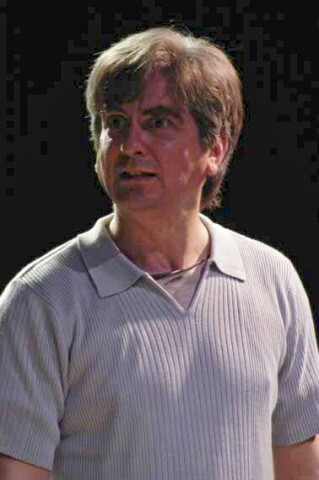
He has a few years on me (about 25) and I have a few inches on him (about 7), but still, it must be said: Joel Grey and I are practically twins. 
Joel Grey has always been on my radar, but the rest of the world sort of forgot him until last week when, at the age of 82, he came out. His popularity is unlikely to diminish due to this non-news, though I have read the obligatory whining from a few cranks who complain that he should have revealed his sexuality decades ago, at the height of his fame. My feeling is that, as long as his being closeted hurts no one, he should remain there until he feels secure enough to throw open the door.
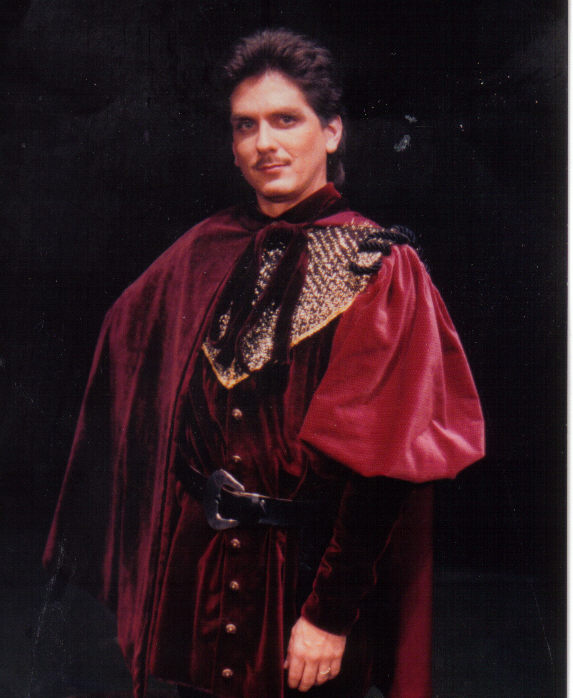
Like most of the world, I first became aware of Grey from his Tony/Oscar winning turn(s) as the Emcee in Cabaret.  I've written several times about my fascination with this musical, and with this character, which was on my bucket list before they invented that term.  I was lucky to scratch the role off that list around 1990.
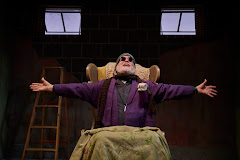
Joel Grey's Emcee, with his "Two Ladies"

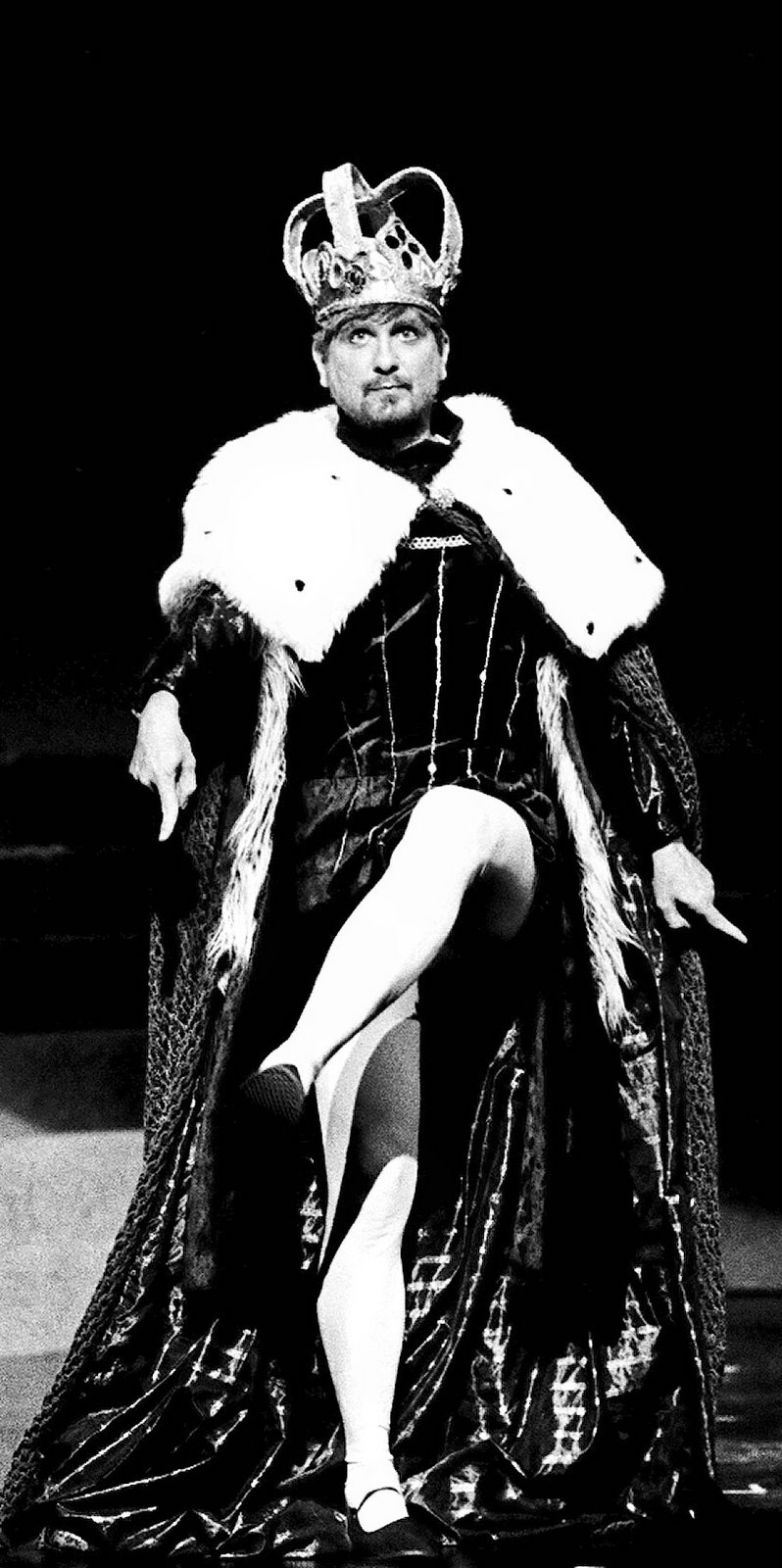
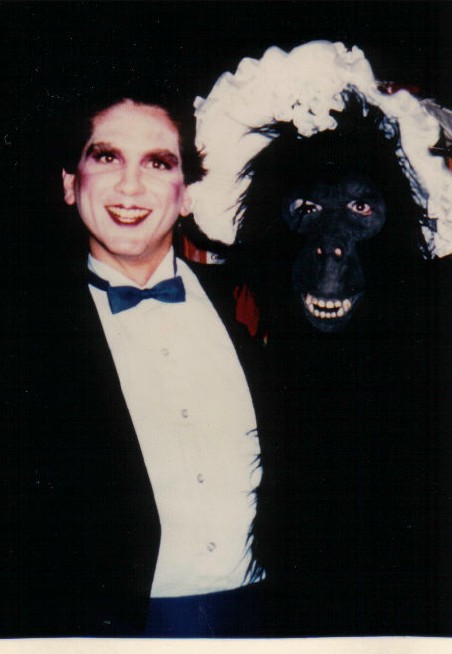
My Emcee, with my "Two Ladies."  One can hardly tell us apart.
Here's Grey in the drag which opens the
second act of Cabaret.
But I had already seen Grey live onstage twice before I played the role he created.  I wrote a long while ago about seeing Joel play John Adams in 1776 in summer stock, a performance which placed that role on my bucket list as well.   

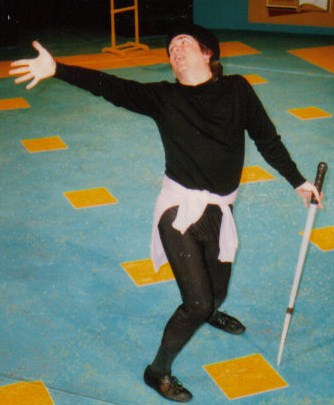
As specified in the script, my Emcee also
opened act 2 in drag. Twins, right?
After Grey's success in Cabaret, he headlined a couple of musicals which were not big hits. His 1975 flop Goodtime Charley attempted to musicalize (get this) the story of Joan of Arc, as seen through the eyes of the dauphin of France who later becomes Charles VII. Maybe this would have made an effective opera, but as a musical comedy, not so much.

Goodtime Charley must have been a
hoot. The opening number is sung by
warrior king Henry V of England and
Queen Isabella of Bavaria. And Ann
Reinking as Joan of Arc? Wow. The
production folded after a few months
when Grey left to make a movie.
Just like everybody else, I missed Grey in Goodtime Charley, but I did catch his next stinker. 

The Grand Tour concerned a Polish Jew escaping Nazi occupied France and had the bad luck to open the same season as Sweeney Todd, Best Little Whorehouse in Texas, and They're Playing Our Song. Hard to believe I chose to see Grand Tour instead of those other shows, but I was so enamored of Joel Grey back then, I did (you guessed it, I wrote a bit about seeing it here).    
At least once, I played a role before Joel did. In grad school, I played Moonface Martin in Anything Goes. Sadly, I have no pictures of that show, you'll have to take my word for it that I stole the thing. Only a few years ago, Grey played the same part in the Broadway revival starring Sutton Foster. He turned 80 years old during the run.
Joel Grey's several flops following Cabaret suggests a point I realized a while ago.  Though he certainly has the talent and the charisma to headline a show, he is most successful "in support."  Over the years he has succeeded in roles such as the Wizard in Wicked, Amos in Chicago, and the aforementioned Moonface in Anything Goes.  But when he is handed a starring role, such as in Goodtime Charley or The Grand Tour, he's less effective. This is another area in which he and I are similar.  I'm much better in support, too.
These days, the Emcee is considered the leading male role in Cabaret, but when Joel won the Tony (and then the Oscar) for it, the part was considered supporting.
This week's Dance Party illustrates the point.  We both played the title role in  George M!, which attempted to musicalize the life of showman George M. Cohan.  (Beware of any show title with an exclamation point, it usually means it's trying too hard.)  George M! was another attempt to place Joel Grey in a leading musical role, with minimal success.  It SHOULD have worked like gangbusters, as Grey was at the height of his hoofing and belting powers and was a great choice to play Cohan. But the character himself was a selfish megalomaniac who trashed his marriage while bullying his way to Broadway.  In the 1910s, he did all he could to squelch the formation of a stage actors union (the union which became Actors Equity).  Joel did his best to give this bulldozer some charm, but to little avail.  
ABC produced a 1-hour
version of George M!, which
only proved that the role was
chilly and unlikeable. Here are
Nanette Fabray and Jack
Cassidy as Cohan's parents.

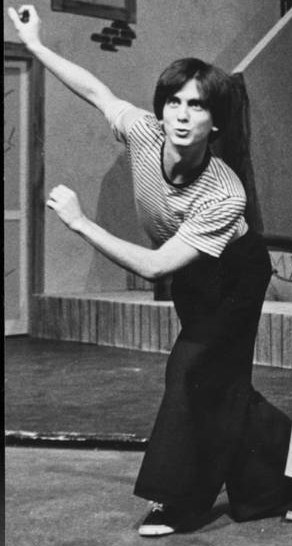
And I didn't do any better.  Back in 1983, I played George M! in dinner theatre.  I could act the part fairly well, being chilly and unlikeable myself, but my singing was suspicious and my dancing was downright dreadful. Ah, well, Joel recovered from the failure of George M!, and I suppose I did too. See how we're practically twins?
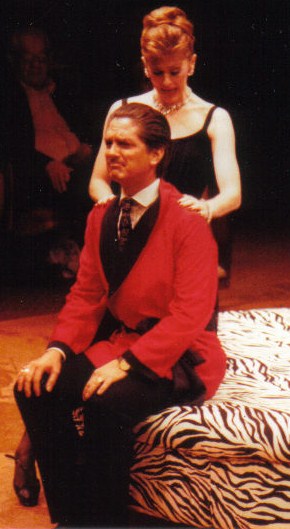
Here is my George M! with my stage parents. I don't remember their names, which surely protects their reputations. My performance had nothing going for it other than a rather generalized enthusiasm.
Our Dance Party comes from the Tony Awards, as so many of them do.  The clip includes a medley of a few of the songs from George M!, which is appropriate I suppose.  The show's score contains about a dozen medleys, as the writers attempted to include about a thousand of Cohan's songs (he was nothing if not prolific).  We may roll our eyes at the Over-The-Top presentational style which Joel brings to this clip, but it demonstrates the ultimate song-and-dance man which Grey has always been.  Again, practically twins.

Friday, July 18, 2014

Friday Dance Party: That Existential Problem In Tights

She swore like a sailor, had a voice like a cab driver, and charged through life mowing down anything in her way.  Through it all, she remained a class act.

Elaine Stritch
1925-2014
Even after two Tony nods, Stritch found her career
dangerously dry in the mid-60s. She tended bar to
support herself (appropriately, at Elaine's in NY),
and made sure to get some press for it.


The recording session for the cast album of
Company was preserved in a documentary, which
showed Stritch struggling to nail "Ladies Who
Lunch" at the end of a grueling day. The producers
were smart to spring for a second session, which
she attended in full make-up, ready to perform that
night's show.

I first became aware of Stritch when I listened to the original cast album of Company. Who the hell was that brassy woman with the bass voice shouting about ladies who lunch?  Hers was the 11:00 number, and is, with the possible exception of "Being Alive," the most famous song from the show.  And Elaine's rendition is considered the definitive version.

Her first Tony nod came for Inge's Bus Stop, in
which she played acerbic cafe owner Grace. The
film version was only loosely based on the play,
and Stritch's role went to Eileen Heckart. 35 years
later, Elaine returned the insult, and replaced
Heckart as Wilma Bern on One Life To Live.
Our heroine escaped a priviledged but emotionally distant childhood as soon as she could;  she moved to New York from her upscale Detroit suburb before her 18th birthday.  She tells this story and many more in her acclaimed one-woman performance, Elaine Stritch At Liberty

Stritch toured the country as the lead in Call Me Madam, and together with her success "in support" in Pal Joey, it was time for a starring role in a musical on Broadway.  That role was in Goldilocks, an unsuccessful parody of the silent film era.  The project brought Elaine to the attention of Noel Coward, above, who fell in love with her dry style and wrote a new show for her. Sail Away provided our gal with her second Tony nomination, (and first in a musical).  Her competition was so fierce that she lost the award to two others, the only time the Best Actress in a Musical has ended in a tie.  Both Diahann Carroll, for No Strings, and Anna Maria Alberghetti, for Carnival, took home the trophy.
She spent some time in drama school, but it was only a few years until she began her Broadway career.  She made a splash in a revival of Pal Joey, playing a reporter who interviews the star and delivers "Zip," the kind of comic song for which Stritch became well known. 
Everyone was sure Elaine would finally
win her Tony when her performance as
Joanne in Company became the talk of
the town. She lost it to hoofer Helen
Gallagher in No, No, Nanette.

She was at her best in this kind of number, telling a story or making a list;  all her signature songs are in this vein.  A straight-out love ballad was not her strong suit, but give her a tale to tell, and she was in her element.
The only time I saw Elaine Stritch in person was in this revival of A Delicate Balance, in which she stole the show from some very accomplished actors.  It's true that she is more famously remembered for her musical roles, but her performance as Claire was one of the most memorable I have ever seen. She was again nominated for the Tony, and would have won it, if Zoe Caldwell hadn't swept into town and flattened the competition as Maria Callas in Master Class.
Elaine was nominated for the Tony five times during her career, finally winning for her one-woman show, At Liberty
Elaine's lone Tony was for
her solo show, in a category
which no longer exists.

Back in 1996, she told 60 Minutes that, if a performer believes she deserves the Tony, she does not have to win it.  Many years later, she had changed her mind.  Talking to the New York Times, Stritch recently confessed to a deep disappointment that she had not been rewarded for her lifetime of theatrical work sooner.  I agree with her.
After the Broadway run of Company, Elaine took the show to the West End, where she was so well received, she stayed. In London she had great success with Small Craft Warnings, by Tennessee Williams, and with The Gingerbread Lady, by Neil Simon (the latter would eventually end up as the film Only When I Laugh, with Marsha Mason taking the part created by Stritch). The Brits seemed to accept our gal's dry, deadpan delivery better than Americans, at least in the 70s. Her biggest UK success was as the star of the Britcom Two's Company, above, which earned Elaine a BAFTA nod. The show ran four seasons.
The first of Elaine's 3 Emmys was earned for this portrayal of
a feminist attorney defending Felicity Huffman (before she
became a Desperate Housewife), on Law and Order.
Though primarily known for her stage work, our gal had some success on screen, both large and small. 
Despite 6 decades on stage, Stritch only
became a national celebrity as this
recurring character on 30 Rock.

She appeared in the 1950s melodrama A Farewell to Arms, and she starred in a sitcom in the early 60s which was based on the stage play My Sister Eileen.  The majority of her screen fame, though, came late in her life, as she turned in hilarious performances as mouthy maternal figures. 
As Mia Farrow's mother in Woody Allen's
September, there was legitimate Oscar buzz.

She played Dyan Cannon's mother (Out To Sea), Winona Ryder's grandmother (Autumn in New York), and Jane Fonda's mother-in-law (Monster-In-Law).  Most famously, she played Alec Baldwin's mother in several episodes of TVs 30 Rock, earning five Emmy nominations for her performances in that sitcom, and winning in 2007.
The sheer longevity of Elaine Stritch's career means that she lost a few choice roles along the way.  She was in the very first Honeymooners sketch, above, before the thing became a full show.  She played upstairs neighbor Trixie.  Jackie Gleason recognized at once that Elaine's comic expertise would upset the balance of the show, and she was replaced.  Even more famously, Stritch auditioned for, and lost, the role in The Golden Girls which ultimately went to Bea Arthur.  If she had landed that role, the entire trajectory of her career would have been altered.
We are very glad Elaine Stritch continued to perform later in life.  Let's get to this week's clips! 
Our gal was known as a leading interpreter of Sondheim's
work. "Ladies Who Lunch" and "Broadway Baby" were both
signature tunes for Stritch. If she had been in the original
production of A Little Night Music, "Liaisons" might have
become another.

Yes, there are two, but this first one is quite short.  The most recent revival of A Little Night Music starred Catherine Zeta-Jones (who won the Tony) and Angela Lansbury.  When those stars departed, the producers stumbled upon a plan to keep the show running a while longer.  Bernadette Peters and Elaine Stritch assumed the mother/daughter roles in the show.  Here is about a minute of Stritch's performance as aging courtesan Madame Armfeldt;  the song illustrates Elaine's expertise with the "memory song," in which she can captivate an audience simply by telling a story.  The song was originated by the great Hermione Gingold:


The above performance was the last she was to give on Broadway, but she didn't give up. 
This recent documentary chronicles our star's
final few years in NY, in which she struggles
with memory loss and balance issues.

Elaine's last New York appearance was a week's engagement at her favorite cabaret, the Cafe Carlyle (I wrote about that here). She lived there, too;  she confessed to 60 Minutes that she began living in hotels when her diabetes became so severe, she needed to have someone within reach at all times.  When her health finally became so poor that even hotel staffers were not enough, Elaine left New York and returned to her hometown. She was only there a year or so before her death last week.

What a career our gal had. This week's Dance Party showcases Elaine Stritch's fine comic style, singing a Rodgers and Hart classic from A Connecticut Yankee.  Years ago, Danny Kaye's wife and beard, Sylvia Fine Kaye, hosted a series of programs for television, documenting some of musical theatre's enduring treasures.  This song is one.  This performer is another.

Friday, July 11, 2014

Friday Dance Party: Dancing At The Prom

This week's Dance Party returns to its original roots: dance!
The BBC Proms is a summer concert series which has been a mainstay for the Brits since (get this) 1895.  Obviously, in those days, the only way to enjoy these musical dates was to attend them (often as a "prommer," a slang term loosely translated as a standing room ticket, or if you prefer the classical term, a groundling).  The Proms eventually found their way to radio and, naturally, to television.  Though most of the concerts showcase classical works, the Proms nowadays are likely to include popular music and showtunes.
Anna-Jane Casey's career includes several years in Cats,
Starlight Express, and Billy Elliot in the West End, as well
as numerous appearances in London's Chicago and the
Forbidden Broadway series.
Our star today is Anna-Jane Casey, and if you've never heard of her, you're not alone.  I had to research her myself.  While a busy actress in musicals in Britain, she is totally unknown elsewhere.  This week's Dance Party proves she is a talented and engaging musical theatre performer.

For our source material, who better than a Broadway legend?
Jerry Herman, here flanked by his original Mame and Dolly, has more than a few Tonys, including awards for his scores to both Hello, Dolly! and La Cage Aux Folles.  Speaking of the latter, La Cage not only won the Best Musical prize for its original production (beating out that year's Pulitzer Prize winner Sunday in the Park with George), the show also won the Best Revival Tony for both its returns to Broadway.  This week's Dance Party does not come from any of those shows.
Jerry Herman provides this week's Dance Party, from his score to Mack & Mabel.  Herman turned 83 years old last week, so it's understandable that his musical career these days consists only of revivals and various revues and tributes containing his existing material. Jerry's songs have graced the Dance Party a few times over the years.
Angela Lansbury and Bea Arthur both won Tonys for these performances in Mame. Their big duet, "Bosom Buddies", has appeared twice in these pages. Go here to see them recreate the song at a Tony Award show, and go here for the rendition which appears in the disastrous film version of the show. Neither Lansbury nor Arthur appear in this week's Dance Party.

This is Karen Morrow, a leading interpreter of Jerry Herman's tunes.  She does not appear in this week's Dance Party either, but she did, here, when she belted the only memorable song to survive the train wreck which was Herman's Dear World.
This is Douglas Hodge, who does not appear in this week's Dance Party. When California's Prop 8 was making news, I took the opportunity to showcase the most recent revival of La Cage Aux Folles, for which Hodge won a Tony.
This is Tommy Tune, who also does not appear in this week's Dance Party. But when he did, his tribute included a video retrospective of his career which is really fun to watch.  And by coincidence, it features the same song which is showcased this week.
The BBC Proms are broadcast for the Brits to enjoy every summer, and every once in a while, a clip makes its way over the pond for the Yanks to enjoy.  "The Proms," by the way, is shorthand for "Promenade Concerts," a slang term also adopted by American high schools for their annual spring dance. This week's Dance Party is the grand finale to one of the BBC Proms, and features my favorite style of dance, the tap. Happy Birthday, Jerry Herman! 

Friday, July 4, 2014

Friday Dance Party: Here's To The Lady Who's Staunch

This weekend, as we celebrate that revolutionary spirit of which so many Americans are proud, the Dance Party celebrates one of the true oddballs of the American musical theatre. 
Christine Ebersole as Little Edie Beale, in Grey Gardens.  There are many, many musicals out there based on films, but this appears to be the only one based on a documentary.
Grey Gardens, the musical, premiered Off-Broadway in early 2006 and despite lukewarm critical reception, transferred to Broadway later that year.  Two of the show's three Tony Awards are showcased in the clip below, as our star, Christine Ebersole, won for her performance, as did William Ivey Long for his costumes (the production's third Tony was won by Mary-Louise Wilson as Big Edie).
Though the musical as a whole was not enthusiastically received, the production at Playwright's Horizon transferred to Broadway on the strength of the two leading performances. Christine Ebersole and Mary-Louise Wilson dominated the second act of the musical, which was a recreation of the original documentary.  The first act was a flashback to the period when the Beales were High Society, and includes portrayals of Jacqueline Bouvier (later Kennedy), her sister Lee, and the young Joseph Kennedy.  Ebersole and Wilson both won Tonys for their work in Grey Gardens.
The musical chronicles the dysfunctional relationship between two society mavens, mother and daughter, both named Edith Bouvier Beale.  They were Jackie Kennedy's aunt and cousin, so when their reclusive lifestyle and dilapidated living conditions were reported by the National Inquirer in the early 1970s, they received national attention.  Grey Gardens became a documentary film in 1975 and has since gained cult status. 
 
The Beales are catnip to actresses. This 2009 TV film won the Emmy, as did Jessica Lange as Big Edie and Ken Howard as Phelan Beale, the patriarch who deserted his family and set their downward spiral in motion.

The actual Beales in the documentary. Frankly, the film
was difficult for me to get through (it took me 3 sittings,
and the thing is only 90 minutes long). I found these
women to be far more than merely eccentric, but
possibly delusional, with no ability to recognize
their true circumstances. Very hard to watch.

This week's star, Christine Ebersole, was already a Tony winner when she won again for Grey Gardens (her first award came for the revival of 42nd Street). 
Christine Ebersole (with the flowers) has had a long and varied career on stage and screen.  Here she plays a supporting role in Amadeus; she had a brief moment in Tootsie as well as many other films.  Her TV work includes a stint on One Life To Live, which earned an Emmy nomination.  She is currently in the cast of the TBS sitcom Sullivan and Son.
The inspiration for the song which was featured at the 2007 Tony Awards, and is this week's Dance Party, comes directly from the original documentary film.  As a preamble, take a look at this very short clip from the original, in which Little Edie explains the reasoning behind her "costume for today."

And now enjoy Ebersole's performance of the song which sprang from that brief encounter with Little Edie.  Yep, that costume is indeed revolutionary, but the real attraction of this clip is the quietly compelling performance of our star.

Friday, June 20, 2014

Friday Dance Party: A Tapestry Of Rich And Royal Hue

Last week's Dance Party was inspired by the rather sad Tony losses of Tyne Daly and her Broadway show.  This week, then, it's only fair to celebrate one of the winners.
Jessie Mueller won the Tony last week, playing Carole King in Beautiful, which has supplanted Jersey Boys as Broadway's top jukebox musical. After a tryout in San Francisco, the show opened in New York in January; the reviews were fairly mixed, but Mueller's notices were glowing. Word of mouth was good, and the show eventually entered the Million Dollar Club (those shows which routinely gross over a million bucks a week).  Mueller's win as Best Actress in a Musical was assured when it was decided that Audra McDonald's performance was in a play, rather than a musical. 
I saw Jessie Mueller in her Broadway debut, less than three years ago, and since then, she has proven herself a substantial talent. 
Jessie won the Jeff Award (Chicago's
Tony) for She Loves Me, in a category in
which she was competing against her own
performance as Adelaide in Guys and Dolls.

She was already one of the leading ladies of the Chicago theatre scene (though success in the regions does not automatically mean equal success in New York) when she was pegged to play a supporting role in the revamped On A Clear Day You Can See Forever.
I saw Mueller's Broadway debut right before it closed. This revival of On A Clear Day... changed kooky protagonist Daisy into kooky gay boy David, who was the reincarnation of a female big band singer. Harry Connick, Jr. fell in love with her, but not him. The show was a major disappointment, but our Jessie emerged smelling like a rose, and earned a Tony nod to boot. I wrote about seeing this show here.
I also saw this performance, with Mueller unrecognizable as
the mysterious lady from Ceylon. The gent playing her twin
brother is Andy Karl, currently flexing his muscles as
Broadway's Rocky. I wrote about seeing this revival of The
Mystery of Edwin Drood here.
Our heroine's next Broadway gig was another revival, The Mystery of Edwin Drood.  Following that limited engagement, she replaced Kelli O'Hara in Nice Work If You Can Get It.  In less than a year, she had three starring roles on Broadway.  This gal has been going places. 
Doesn't Matthew Broderick always look tired these days? But Jessie had another success, finishing out the run of Nice Work If You Can Get It. It was an ironic move for her, as one of her costars, Judy Kaye, had won the very Tony Award for which Mueller had been nominated earlier in the season for On A Clear Day. In another karmic twist, Jessie was replacing original leading lady Kelli O'Hara. A year later, the two of them would be competing for the Tony for Best Actress in a Musical.  O'Hara's show, The Bridges of Madison County, had already closed when Mueller won the award for Beautiful.
Last summer, NY's Shakespeare in the Park produced a dressed-down revival of Into The Woods, based on a recent British rethink. Here's Mueller as a decidedly dowdy Cinderella. The show did not make an anticipated move to Broadway, freeing our gal to feel the earth move under her feet as Carole King.
Jessie Mueller's current performance as Carole King has elevated her to the top tier of Broadway Leading Ladies, only a few years after arriving in New York. I have not seen Beautiful, but it would appear to have a long life, as long as Mueller stays with it. The show got even more publicity this week, when King's former husband and writing partner Gerry Goffin died.  Most of the songs in the score of Beautiful are written by the duo, including this week's Dance Party.
The buzz surrounding Beautiful: the Carole King Musical was strengthened by King herself, who rather coquettishly refused to see this musical depiction of her early life and career.  She even made the rounds of the talk shows, singing WITH the actress portraying her, but still claimed seeing the show would bring up too many sorrowful memories. She finally attended a performance in April, and surprised the cast onstage during the curtain call.  The crowd, and the cast, went wild. They launched into an impromptu rendition of "You've Got A Friend", which isn't even in the musical. It was a publicist's wet dream come true, as all the major news outlets covered the story. Box office receipts rose, and the show earned 7 Tony nominations.
This week's Dance Party comes from a performance given for the Today Show audience, and includes Mueller as King as well as actresses portraying the Shirelles. 
With the release of Tapestry,
King was no longer considered a songwriter in the back-
ground, she was now in the spotlight. The album spent 15
weeks at #1, and remained on Billboard's 200 chart for 40
years. The influence this album had on pop culture cannot be
overstated. Like other seminal records like Abbey Road,
Purple Rain, and Thriller, Tapestry will endure.

I have a lot of respect for Carole King, whose music became part of my life when her album Tapestry was released in 1971.  On it, she sang so many of the songs she had written for others;  the album was a smash and a defining moment of her career.  Apparently, Beautiful reveals the difficult time she had as an artist in the 50s and 60s, even as she was penning hit songs for the leading singers of the day.  I hope I can see the show before Mueller inevitably moves on, particularly since I have a personal connection to one of the performers.
Several years ago, I played Jacob (the father) in a DC production of Joseph and the Amazing Technicolor Dreamcoat. The gent who played Joseph is the guy on the right, above, currently in the cast of Beautiful, playing one of the Drifters. I love the fact that Alan and his cohorts are joining the protest against the recent decision to dispense with the Tony for Sound Designers. It's no coincidence that the most recent Sound Design Award (and perhaps the final such award) was won by the sound designer of Beautiful.
So, at long last, please enjoy this week's Dance Party: