Friday, July 6, 2012

Friday Dance Party: The Gentle Sitcom

This was a week full of incident, including the fourth of July, of course, and two trips to Arena Stage in DC to see some theatrical offerings.  And for a holiday week in the midst of summer, there were several newsy items of note. 
I think one of these Big Bang Boys discovered
something important to science. I didn't get
the full story.
The boys on the Big Bang Theory, or boys like them, discovered some atomic thingy which now explains the universe.  An at-home HIV test was approved, which will allow people who are too embarrassed to ask for such a test from their doctor,  to determine if they carry the virus.

The week began, as they so often do, on Monday, which happened to be my birthday. 
It wasn't one of those biggies, but I still received buttloads of salutations, thank you social media. Just as I was reveling in the realization that hundreds of people were taking the time to press some buttons on my behalf, my day was hijacked by this guy:
Don't look so cute and innocent. You know what you did.
Now, I have admired Anderson Cooper forever, and I am very pleased that he publicly acknowledged what everybody already knew, but really, on MY birthday? You couldn't have done it on TUESDAY? Well, his announcement was welcome, whenever it came, and his low keyed eloquence in explaining his reasons for remaining silent for so long rang true to me. There was a lively discussion on Monday regarding the fact that perhaps Coop (he likes me to call him Coop) should have come out a long time ago, but whatev. I believe him when he says that he remained discreet about his personal life in order to keep himself from being the Subject of the Story. 
Anderson Cooper and his flame dame Kathy Griffin are appointment television for me on New Year's Eve.
There were, however, some very shrewd decisions made about the timing of all this. The email in which Coop verified his sexuality was dropped on what is known in PR circles as "Take Out The Trash Day." 
Coop's news dropped on a day when
news is not a top priority. My birthday.

These are days which surround a national holiday, when the general public is concerned with things other than current events, and when difficult news is often announced, in hopes that the majority of Americans are too busy to make much fuss. But my overall point here, Coop, is that there are several Take Out The Trash Days this week, since Independence day fell on Wednesday. Did you have to pick my birthday?
OK, I kinda forgive you.
Since Anderson Cooper so rarely sings or dances, I was forced to turn to some sad news this week to inspire this week's Dance Party.

Andy Griffith
1926-2012
Everybody knows by now that Griffith died this week from a heart attack.  He was one of the most recognizable figures ever to come out of television, which is where he made his mark in two long-running series.  Griffith started his career as a singer, and made the move to stand-up comedy with a monologue about being a hick. 
Griffith, directed by Elia Kazan, held his own
opposite Patricia Neal. For a while, he was considered
a successor to Brando.

Film roles followed, including a strong dramatic turn in A Face In The Crowd, and a career-changing role in No Time For Sergeants, which Andy played on Broadway and on film.  He was pegged to star in his own comedy series by way of a back-door pilot episode of The Danny Thomas Show. 
Danny Thomas was stranded in Mayberry, and served up a pilot for The Andy Griffith Show.
To my own disappointment, I must confess that I was not a fan of The Andy Griffith Show when it first aired in the 60s. 
I couldn't stand these "gentle sitcoms." Give
me the sophistication of That Girl.

It was part of a generation of gentle sitcoms which peppered the landscape at that time (My Three Sons, Family Affair, Ozzie and Harriet, and a bit later, The Doris Day Show, were all part of that genre, as were the Paul Henning programs like The Beverly Hillbillies and its descendants).  I was more excited by modern-seeming sitcoms of the time, like Bewitched, That Girl, and later, the MTM stable of shows.  I thought these shows were more sophisticated with their humor, a claim which I'm not sure holds true in retrospect. 

The show's progeny included a sequel,
Mayberry RFD, and this spinoff, Gomer Pyle.
The latter took place on a Marine training base
during the 60s, but never mentioned Vietnam.

There is another reason I tended to avoid the "ruralcoms" of the day.  In the 60s, I spent significant time in a small town in the North Carolina mountains, where the fictional Mayberry was located.  My parents were born and raised in Hendersonville, which was exponentially larger than Mayberry, but had similarities to that small town. 
Not Mayberry, this is Hendersonville, where I spent many summers during the late 60s. There is a similarity.
I spent many summer weeks in Hendersonville; long afternoons on the front porch swing, drinking my Aunt Millie's sweet tea, were very similar to the activities portrayed on The Andy Griffith Show. I was being raised in Atlanta, whose inhabitants considered themselves much more cosmopolitan than other southerners, especially the "hicks" (as I thought of them) who populated Mayberry, NC. 
I appreciate Griffith's supporting cast
now, though at the time, I missed
their chemistry.

I did begin to enjoy Andy Griffith's show much later, in reruns, when the chemistry among the cast was evident to me, and the gentle humor of the show, though cornpone, had its own charm.  This week's clip comes from one of the many scenes which included a song.  As I've noted before in these pages, when sitcoms of the day starred someone who was also known as a singer, those talents were put to use. 
Don Knotts won 5 Emmys for the show.

It's interesting to note that Don Knotts, as Andy's sidekick, sings quite well in this and other clips from the series.  But if memory serves, there were at least a couple of episodes along the line which centered on Barney Fife's inability to carry a tune.  Whatever, we don't expect that kind of consistency from these shows. 

And the contributions of Andy Griffith to this series were substantial.  His decision to place himself in the central paternal role, and surround himself with more comedic characters, meant that he robbed himself of many of the laughs, but in doing so, he created a lasting legacy of gentle homespun humor.


Friday, June 29, 2012

Friday Dance Party: Excellent Excrement

Our stars sing about their favorite diagnostic tool: stool.
With all the hoopla this week, regarding health care, it's only fitting that this week's Dance Party take place in a hospital. 
Musical episodes of non-musical series usually
don't work. This one did.

It comes from the musical episode of one of the most underrated  sitcoms of the last decade (though not by me), Scrubs.  It is actually the second time that particular episode has provided content for these pages, go here to see the big opening number, and a discussion of the Very Special Musical Episode of TV programs to which we are sometimes subjected.
The most famous of these Musical Episodes is probably this one, which has been recreated by amateur groups and, as you can see, released on the big screen for Sing-A-Longs.
But this is a fun little number, written (as all the songs in the show were) by the gents who won the Tony for Avenue Q. 
Stephanie D'Abruzzo needs a CAT scan.

Our female observer also comes from Avenue Q, and is having some head trauma, which explains why she believes everyone around her is singing.
The big Opening Number can be seen here.
Maybe they can't sing, but at least
the Scrubs gang looks like they are
having fun, unlike other casts inflicted
with musical episodes.

Clear?  Who cares?  Enjoy this week's Dance Party, in honor of the recent Supreme Court decision, which perhaps has all medical personnel singing and dancing.  Or not.

Monday, June 25, 2012

My Waiver Games, Part I: Theatre Of The Absurd

In a week or so, I will begin work on a show in New York produced under the Equity Showcase Code, more on that in a later post.  But the prospect of showcasing my work under this code reminds me a lot of what used to be called "Waiver Theater" in Los Angeles. 

Both codes were invented by the stage actors' union at the request of its members, who wanted a way to show off their stage talents without being cast in a show which had, you know, a real paying contract. I worked more than once under the Waiver code in LA, back when there were tiny theaters all over the place using it. Equity has since changed the name of that code, and has clarified its rules, as the thing was egregiously abused for years. Back in the day, a Waiver show might run for months and months, with the producers raking in the dough from the box office, while the actors worked for free.
The Odyssey Theatre Ensemble ran a production of Steven Berkoff's Kvetch for 8 years without paying an actor.


I think the code is now called the "99-Seat contract" , as it can only be used in a theater seating 99 people or less, and the union finally realized that "waiver theater" left the impression that Equity was waiving all its rules and regulations, which it was not.  
The only performing gig from which I have ever been fired was here, at the Ebony Showcase Theatre.
They ran a production of Norman, Is That You?, off and on, for years under the Waiver Code.
No actor was ever paid.
I did six shows in waiver houses when I was living in LA, and those memories are coming back to me, as I prepare to spend the summer working under New York's version of that old Work-For-Free code. 


My first experience with the species was when I was only 18 or so.  During my first year of college at California State University, Northridge, I began auditioning for on campus shows.  I had some luck with student productions, landing in an original one-act right away. 
Charlie Martin-Smith played Toad in American
Graffiti.
He cast me in my first show in college.
The show was being directed by one of CSUN's celebrity students, Charlie Martin-Smith (you'd remember him from American Graffiti).  I was going to spend most of my college years appearing in student-driven productions, as the faculty directors were never sure what to do with me. 

At any rate, after finishing my CSUN debut performance in Have You Ever Seen A Panda? (yep, that was the name of the thing), I heard about an audition for a Waiver theatre in Chatsworth, CA, one of the burghs close to Northridge in the San Fernando Valley section of L.A.  The group was called the Valley Theatre of the Performing Arts, a high-falutin' name for a company which operated out of a building which looked like it had been converted from a two-car garage.


Somebody else's Interview.
The only reason this group caught my eye was the fact that they were casting a show I was very interested in, a one-act called Interview, by French absurdist Jean-Claude Van Itallie.  My California high school, Kennedy High in Granada Hills, had done a version of the show the year before I arrived there;  I had seen pictures of that production and was intrigued. With nothing else on my plate on campus, I auditioned and was accepted into the production.  The show actually included two one-acts by Van Itallie, the aforementioned Interview, and a companion piece called TV.  In the first play, eight actors played either job interviewers or interviewees, and the point was to illustrate the facelessness of corporate America, and the futility of trying to maintain humanity in the workplace.  In TV, three of us (including me) played employees of a television network whose sole job was to watch TV.  The other cast members enacted the shows we were watching;  ultimately, the audience was to be confused about which was which.  Both these pieces, as I said, were part of the absurdist theatrical movement, so they were not written in a realistic, linear fashion (but both their themes are even more relevant today, I think).


The cast performed in both one-acts, under the umbrella title America, Hurrah!  The show was an off-night production, which meant we were to perform only on Tuesdays.  Still, as a Waiver production, this was considered to be professional, and I was quite full of myself for having landed the gig.

Very soon after we started rehearsal, my acting class at CSUN received a one-day audition workshop run by Bruce Halverson, who was the newest faculty member and a real go-getter in the department.
Bruce Halverson now heads the South Carolina
Governor's School of the Arts.

I had a great time during his workshop, and after class, he approached me. He was in the midst of auditions for the main stage production he was directing, the Feydeau farce A Flea In Her Ear.  He wanted to make sure I was planning to audition.  The show conflicted with my measly little one-night-a-week Waiver production, so I had to rather sheepishly decline.  Bruce was a little startled that I would choose to do a couple of unknown one-acts out in Chatsworth, rather than appear on CSUN's main stage, but he certainly was not going to insist that I dump the off-campus gig.

Bruce had me in mind for the snotty butler in Flea In Her Ear.
My buddy Brad played it instead.

I've made some lousy choices in my theatrical career, and that was one of them.  I didn't have any guarantee that I would have been cast in Bruce's A Flea In Her Ear, but in retrospect, I think he was very interested in using me.
I eventually worked with Bruce on his
own show, Great American Travelin'
and Medicine Show.
Bruce turned out to be one of the very few CSUN faculty members who had any value, and I was lucky enough to work with him a couple of years later in another play, but still, when I saw his hilarious show, I regretted not trying to be a part of it.  That's not the only reason I regretted my decision.

A few weeks after my workshop with Bruce, we opened America, Hurrah!, to an almost empty house. 

The playwright's name was misspelled in the program. "Van Itallie" became "Van Itallic." A Freudian slip, or just lousy producing?

We rarely had more than a dozen people attend any of our shows (why anyone thought people would go to the theatre on a Tuesday night in Chatsworth, of all places, to see a couple of avant garde plays, is anybody's guess).  Our show was scheduled to run several months, ending in the summer.  But one Tuesday, only about 4 weeks into the run (which meant, after only four performances, I'll remind you), we arrived at the theatre to be told that tonight would be our last night.  The producers were shutting down the off-night show, and didn't care to give the actors any advance notice.
This illustrates one of the major flaws in what was known as the Waiver Theater Code:  the producers could do such things without regard to the actors.  They were not getting paid, so giving the cast a week's closing notice was unnecessary. 

America, Hurrah! closed while A Flea In Her Ear was still in  rehearsal, so I spent some time kicking myself for making the wrong choice, especially after the latter show opened on campus and was a substantial success.

In the four years I attended Cal State, Northridge, I was to perform in two more off-campus productions following America, Hurrah!, though neither of those productions was produced under the Waiver Code.  But only a few months after graduating, I was invited to join another Waiver Theatre production, one which remains one of my fondest memories.  Stay tuned for Part II of my Waiver Games.


Friday, June 22, 2012

Friday Dance Party: Meryl At The Palace

It's been close to four years since the Friday Dance Party first appeared in these pages, and I astonish myself that I have yet to celebrate the finest actress of our time with her own party. 

I will fix that today, on the occasion of Meryl Streep's 63rd birthday. (SIXTY THIRD???? You gotta be kidding me.)  Our Meryl has delivered more than a few musical items over the years, but she is certainly not known as a musical star. She is, though, considered the most accomplished actress in the English language, and I second that emotion.
Streep has the ability to take a seemingly one-note character, and bring tremendous depth, as here, in The Devil Wears Prada.
Streep has been popping up on media outlets a bit this week, to celebrate a birthday not her own. 
This week, Streep and Kevin Kline read Romeo and Juliet,
as a fundraiser for their alma mater, NY Shakespeare Festival.

The Delacorte Theatre in Central Park turns 50 years old this week, and as it has been home to the New York Shakespeare Festival all that time, famous alumni have been interviewed to mark the event.  Meryl has appeared in a handful of plays there over the years, and in fact made a splashing debut right out of Yale with a season which included Henry V, Measure for Measure, and a year later, Taming of the Shrew.
As Isabella in Measure for Measure,
with Lenny Baker and her partner at
the time, John Cazale. They were
together until his death from cancer.

Joe Papp was no fool, and our gal was never asked to play Witch #3 or Cleopatra's handmaiden.  She was given leading roles right off the bat.  Well, if you were Joe Papp, wouldn't you have done the same?
As Mother Courage

To her credit, Meryl has returned to the stage on occasion, especially in recent years;  she headed a starry cast in The Cherry Orchard a few years ago, and parts of her performance as Mother Courage, opposite Kevin Kline, are preserved in the documentary Theatre of War.  But everyone considers her a film star, having delivered dozens of unforgettable screen performances.  Her first feature film was Julia, in which she played a 3-minute scene opposite Jane Fonda. 
This brief moment in Julia made Hollywood take notice. She even makes Jane Fonda look good.
(I am not a fan of Jane Fonda's work, though she isn't half bad in Julia, I have to admit.) Anyway, nobody knew who Meryl Streep was at the time, but a year later, she had an Oscar nomination (for The Deerhunter) and an Emmy award (for Holocaust.) 

In Kramer vs. Kramer, she beat
co-star Jane Alexander to win her
first Oscar.
Our Meryl was on her way, and soon won her first Oscar for one of the title characters in Kramer vs. Kramer.  It was her performance playing eenie, meenie, miney, moe in Sophie's Choice which solidified her reputation as a phenomenal actress.  I've only seen the film once, but portions of her work are indelibly imprinted on my memory. 
A Cry in the Dark gave birth to a
catch phrase:
"A dingo took my baby!"

She won the Oscar, of course, and proceeded to deliver a series of leading performances which were all award worthy.  During this period of about 5-8 years, though, her continually stellar work received somewhat of a backlash, at least among unknowledgeable cretins.  Her film roles during this period often (though certainly not always) required her mastering an accent of some kind, and for a little while, there were those who rolled their eyes whenever Streep's name was mentioned.  They thought, incorrectly, that her work was always dependent on an accent.  Truly, she is gifted when it comes to accent work, beginning with Sophie's Choice, where she delivered a Polish accent in both English and German. 
Streep had unmistakable, highly
sexual chemistry with Kurt Russell
in Silkwood. And her rendition of
Amazing Grace is truly haunting.

We also heard her mastery of such dialects as British (The French Lieutenant's Woman), Dutch (Out of Africa), Australian (A Cry in the Dark), Italian (Bridges of Madison County), and American Southern (Silkwood).  By recreating vocal inflection, timbre, and rhythm, she convinced us she was Julia Child and Margaret Thatcher, two women whose own voices we know very well.

Streep continues to deliver top-notch performances in all genres with all kinds of accents, or lack thereof. 
An atrocious attempt to turn Roseanne
Barr into a film actress failed. Streep
is the only thing watchable in She-Devil.

Today's clip features an accent of sorts, if there is such a thing as a "smartly precocious little girl" accent.  As I mentioned, Meryl has a bit of experience with musical projects, and has sung convincingly in Postcards From the Edge, A Prairie Home Companion, and Mamma Mia (Streep was even good in that last piece of dreck, which now holds the distinction of having made more money, world-wide, than any other movie musical in history. Ick.) 
Another example of Meryl's early work
can be seen in this video.
Streep's work in comedy is sometimes overlooked, but she is a skilled comedic actress. In Death Becomes Her, she was paired with Goldie Hawn.
Very early in her career, Joe Papp put our gal in the title role of a new musical called Alice At The Palace.  The concept here seemed a good one:  to turn the Alice in Wonderland books into a Music Hall presentation.  The result is abysmal, in my opinion.  I've dragged myself through the entire DVD of this thing; the fact that PBS filmed it mystifies me.  Papp made a huge error in assigning this project to composer Elizabeth Swados, and don't get me started on her. 
After the success of this unlikely hit, Swados
has delivered a string of unlikeable musicals.
Alice at the Palace is no exception.

I saw her Broadway productions of Runaways (which I wrote about here) and Doonesbury (which I wrote about here), and came to the conclusion long ago that her music is atonal, rhythmically inept, and pretty much unbearable.  You can't wait to see the clip now, can you?

You'll recognize the scene, which appears in any and all Alice adaptations.  It's the Tea Party Scene, and to help get through the number, enjoy Meryl's smooth work, and that of her cohorts. 

The Mad Hatter is being played by Richard Cox, whom you probably won't recognize, but you will surely recognize the gent playing the March Hare.  It's Mark Linn-Baker, who would go on to sitcom fame in Perfect Strangers.  And if you don't recognize the short guy playing the Dormouse, well, I wish you would.  It's the fabulous Michael Jeter, who is sadly gone now but who got his own Dance Party here, which I insist you visit.

Finally, here's this week's Dance Party, starring the incomparable Meryl Streep, before anybody knew who she was.  Happy Birthday!


Tuesday, June 19, 2012

Waiver Games, Part II: It Makes The Magic Happen


...second in a series regarding my experiences in Los Angeles Waiver Theaters, go here for part one...
During my senior year at Cal State Northridge I performed in a modern version of the ancient Roman comedy The Menaechmi.  The text had already served as source material for Shakespeare's Comedy of Errors and Rogers' & Hart's The Boys From Syracuse;  at CSUN, the piece was adapted for children and became The Twins. 
This college performance in The Twins was the antecedent of
my performance as Otto in Poof!.

I had a ball playing a bumbling sidekick to the villain of the piece.  My friend Ronnie Sperling was one of the stars of the show, and though we had both been performing throughout our college careers, this was one of the only times we worked closely together. 
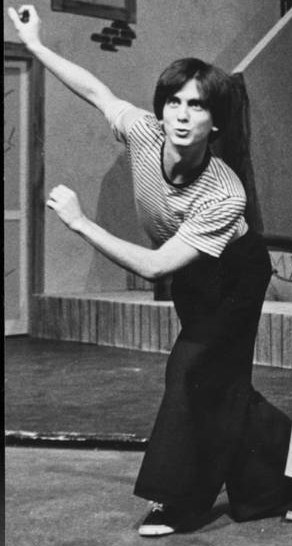
Ronnie's in the red shirt, I'm on the floor in stripes.
I believe my performance in The Twins led directly to my second Waiver Theater production.
Our Roman
farce had
 Greek dancing.
Ronnie was involved with an off-campus performing company called the Camille Ensemble;  they were soon to acquire a children's theatre branch called the Prosody Players.  That offshoot was run by one of the finest human beings I have ever known, Kenny Michelson.  I did not know Kenny at this time, though I had worked with his sister Lisa at CSUN. 
Lisa Michelson (on the far left) and I knocked 'em dead in CSUN's Jesus Christ Superstar. She sang solo on "Could We Start Again Please," while I (on the far right) wowed the crowd as the Second Leper.

Poof was the second production
by Kenny's Prosody Players.

Shortly after I graduated, Kenny called me out of the blue, and asked if I would be interested in appearing in a new musical for kids, called Poof! . This phone call began one of the most enjoyable and rewarding theatrical experiences I have ever had.

Kenny and his partner had written Poof! for several particular actors, one of whom, my college chum John Dantona, was to play the role of Otto, the wizard's hapless apprentice. 
I directed John at CSUN, as El Gallo
in The Fantasticks.

If I remember correctly, John had lots on his plate at the time, and had to decline the production, and Ronnie, who was to play one of the comic roles in the show, suggested me as a replacement.  Poof! was a delightful little show, concerning the sprightly spirit that lives inside every magician's hat which makes "the magic happen."  The score was a perky gem, and I was blessed with what would probably be considered the 11 o'clock number, if one-hour children's shows had such things. 
This is a screen grab from a home movie made of
the original Poof! That's me in my big number.
The show was performed at The Company Theatre, one of the leading Waiver houses at the time, and we ran several months, on weekend days, and the occasional Friday night.
One of several raves we received from the critics.
We were all young and enthusiastic and grateful to be working in a professional setting; the show was a hoot, and performing in it provided a much needed respite for me.  After graduation from CSUN, I had allowed myself to be persuaded by convention and my parents that I needed a full-time job.  I was perfectly happy to continue my part-time work in the Sears Complaint Dept, but that was not going to cut it with the folks.  So, I allowed my father to put in a good word for me at Lockheed, where he was a pretty big muckity-muck.  I landed in an entry level, salaried position which most MBA grads would have killed to have, but I hated it from the first day.  Full time office work was just not my bag, but thankfully, I had my theatrical life at night to keep me sane.  For the first months of my gig at Lockheed, Poof! provided relief from the office doldrums.
I kept my double life secret from Lockheed, until this review popped up in the daily newspaper.
I was very sorry to see Poof! close.  The show itself went on to have several more productions without my involvement, but it holds a very special place in my heart. 
Tommy Tune, eat your heart out.

It was the only time I actually created a role in a brand new show in a Waiver Production.  I always thought the piece deserved a long life, and it probably would have had one, had tragedy not struck.  After surviving some severe health crises, Kenny stopped one night along the freeway, to help a stranded motorist.  Another car struck them from behind, and Kenny was killed.  It was a terrible tragedy which may not have happened had not Kenny been the caring and compassionate man he was. 
Kenny's sister Lisa, second from left, starred in
the second production of Poof!. In a terrible
bit of irony, she was also killed in a car crash.

I loved being in Poof! for many reasons, most importantly because it gave me the opportunity to meet and become friends with Kenny Michelson.  In spite of all his troubles, he remained a most enthusiastic, gentle, and optimistic soul.  It's been over 30 years since we worked together, and I still miss him.

My next foray into Waiver Theatre gave me the chance to work with my best friend, who remains so to this day.  Come back for Part III of The Waiver Games...