Friday, June 10, 2011

Friday Dance Party: Tell Me All Your Secrets (And I'll Tell You Most of Mine)


There have been several deaths recently from the music world, and regular visitors to these pages know the weekly Dance Party is often inspired by dead people. This week is no exception.

Andrew Gold
1951-2011

He was destined for a musical career, as he sprang from one of Hollywood's best known musical marriages. His father was composer Ernest Gold, who scored It's A Mad Mad Mad Mad World, On The Beach, and Exodus, for which he won the Oscar. His mother was (and is) Marni Nixon, who was, in the 50s, the Go-To Gal whenever a movie star was cast in a musical but could not hit the notes (we heard her cover for Natalie Wood in West Side Story, for Deborah Kerr in The King And I, and for Audrey Hepburn in My Fair Lady). So it was no surprise that Andrew went into the family business, and he became well-known as a studio musician. He played various instruments on recordings by James Taylor, Paul McCartney, Ringo Starr, Celine Dion, John Lennon, Carly Simon, Wynona Judd, Trisha Yearwood, The Eagles, Loudon Wainwright III, and Cher. His guitar work contributed to Linda Ronstadt's first hit album, "Heart Like A Wheel," and he played all the instruments behind Art Garfunkle's version of "I Only Have Eyes For You," which hit #1 in Britain.
He had some success as a solo performer as well, reaching #7 in 1977 with "Lonely Boy." That tune was later used as one of the background songs in Boogie Nights:


Gold's most recognizable work was re-recorded by Cynthia Fee when it was snagged as the theme song for a decidedly estrogentric sitcom of the 80s:

In 1992, he sang one of the greatest, but most overlooked, TV theme songs, which provides this week's Dance Party. Mad About You was the brain child of comedian Paul Reiser (who actually co-wrote the title number, and played piano on the recording). It concerned a young married couple negotiating the trials of marriage and career in New York. The show was one of the workhorses for NBC throughout the 90s, receiving lots of Emmy love for star Helen Hunt (who won four years in a row as Best Actress in a Comedy Series), as well as providing Guest Performance Awards to Carl Reiner, Carol Burnett, Mel Brooks (3 years running) and Cyndi Lauper (twice running). But Mad About You' s light touch with comedy was overshadowed by the gigantic gorilla which was Seinfeld, and is largely dismissed today. That's a shame, as it was, at least until that final season, a fine example of character-based comedic writing and performing.

And its theme song, "The Final Frontier," remains one of my favorites. Andrew Gold recorded the tune, which was used under the show's credits for several years, until jazz great Anita Baker recorded a new version. Click the link for this week's Dance Party, which has Gold performing the theme song from Mad About You at a live concert. He died this week at the age of 59.

Friday, June 3, 2011

Friday Dance Party: A Hickey From Kenickie

Grease has been on my mind this week, initiated I'm sure by the death of Jeff Conaway (I wrote about that yesterday). What a long, lucrative life this piece of mediocrity has had. Yes, I confess to being an anti-fan of Grease. I hate the underlying theme of the show, that acceptance can only be gained by subverting your own personality and going along with the crowd. It's a lousy lesson which is being taught in junior highs and high schools, community theaters, colleges, and everywhere else Grease is produced. Yuck.

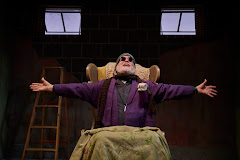
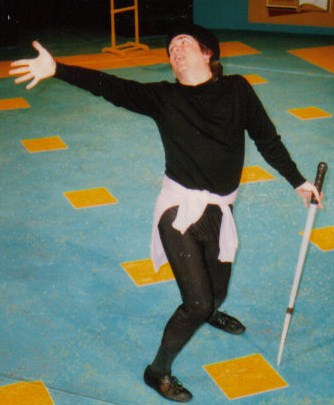
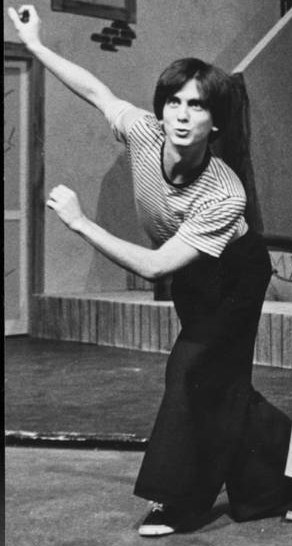
I should have a soft spot for the piece, as it was my appearance in it which earned my Equity Card. The production was at the Lagoon Opera House, located in an amusement park outside Salt Lake City. My best friend was attending the University of Utah, earning her MFA in Directing, and she had asked me to come up from L.A. to appear in her Masters Thesis production of The Night Thoreau Spent in Jail (at left). I came up a few months early to hang out with my friend at the same time that the Lagoon folks lost an actor for their summer stock company. As soon as you could say Ra-ma la-ma la-ma / ka ding-a de ding de dong / shoo-bop sha wad-da wad-da / yipp-it-y boom de boom / chang chang chang-it-ty chang shoo-bop / dip da-dip da-dip doo-wop da doo-bee doob / Boog-e-dy boog-e-dy boog-e-dy boog-e-dy shoo-by doo-wop she-bop / sha-na-na-na-na-na-na-na yip-pit-ty boom de boom / a wop ba-ba lu-mop a wop bam boom, I had a gig. (And aren't those lyrics which would make even Noel Coward proud?)

I disliked the show even then, but could not turn down the job playing Teen Angel and Johnny Casino. I did learn how much fun the show was to do, it's just not all that much fun to watch.

But I'm clearly in the minority on that one, since Grease will be turning 40 years old next year, and is still being revived constantly. That first New York production ran years and years, and when it closed, it was the longest running musical in Broadway history. It has since been surpassed, of course, but it currently ranks as #13. And that movie! I only saw it once, but again, I know I'm in the minority; there is a whole generation who grew up with repeated viewings of Grease. It has a distasteful moral: Are you being bullied in school? The way to solve that problem is to put on some leather and start smoking. Despite the film's cast being ludicrously old to play high school students (Stockard Channing? A teenager? Really?), Grease the movie was a smash, and surpassed The Sound of Music as the most successful movie musical of all time, a position it still holds in America (Momma Mia! was the bigger hit internationally).

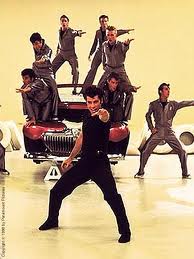
This week's Dance Party must have depressed poor Jeff Conaway, who is playing second fiddle to John Travolta in this clip. I mentioned yesterday that Jeff had to watch his former understudy take his role in the movie; that disappointment must have been multiplied when the decision was made to give this number, "Greased Lightnin'" to Travolta (in the stage version, the song is always sung by Conaway's character Kenickie). It's also worth noting that these lyrics, which are pretty raunchy in places, have since been sanitized by the authors in order to make the show more attractive to high schools and conservative groups. In fact, the whole show has a tamer version available for licensing, a version which has removed all smoking, drinking, and lewd slang, as well as the subplot regarding a pregnancy scare.

But here, from the film, is the original version, in which our heroic hoodlums hope their new hot rod will get them "lots of tit" and predict "the girls'll cream." Classy.

Thursday, June 2, 2011

Inflated Egobits


Both these guys had it made, but were undone by self-absorption and substance abuse. And an attitude that, despite their success, they were entitled to something even better.


Joseph Brooks

1938-2011


There are hit songs, and there are smash hit songs. Once or twice in a generation, there is a song so huge it becomes a world-wide phenomenon. Brooks is responsible for one of those phenoms, the 1977 mega-hit "You Light Up My Life." For composing this treacly bit of saccharine, he won the Oscar, the Grammy, the Golden Globe, and sat atop the Billboard charts for 10 weeks. The song turned singer Debby Boone into one of the most famous One-Hit Wonders, and the film which featured the tune returned a 400% profit on its modest budget. It was undoubtedly the high point of Brooks's career, which was filled with self-obsession and hubris.

Our hero had a thriving career as a composer for commercials in the 60s (he called them "50-second hits"), and was responsible for brain-clogging jingles for Pepsi, Geritol, American Airlines, Dial Soap, Dr. Pepper, and Maxwell House coffee. He won a whopping 21 Clio Awards for his commercial work before he turned his attentions to the big screen. The films he wrote and produced, including You Light Up My Life, If Ever I Saw You Again ( in which he also starred), and Invitation to the Wedding, were universally trashed by the critics.

Brooks was known for possessing the biggest ego in Hollywood, and he took that ego to Broadway in 2005 with In My Life, surely one of the most bizarre musicals ever to hit New York (he produced the show with his own money, and wrote the music, the lyrics, the book, and directed the thing, too). In it, God sang Brooks's Volkswagon jingle.

The higher they are, the harder they fall, and Brooks dropped like a stone. He had a stroke in 2009, but that did not stop him from luring dozens of hopeful starlets to his Manhattan apartment and raping them. Allegedly. He was facing criminal charges for these acts when he killed himself last week.


Jeff Conaway


1950-2011


This guy had a charmed career which he trashed with pills and booze and the belief he was more talented than he was. At the age of 10, he accompanied his actress mother to an audition for All The Way Home; she was rejected, but Jeff was cast, and made his Broadway debut opposite Colleen Dewhurst, Arthur Hill, and Lillian Gish. Throughout his childhood, he modeled and appeared in commercials. Later, he dropped out of NYU to return to Broadway as an understudy in the original 1971 production of Grease. He graduated to the leading role of Danny Zuko when original star Barry Bostwick left the production.

Conaway's career peaked in the late 70s. In 1978, he was cast in the film version of Grease, but was relegated to a supporting role. The leading part went to John Travolta, who was in the midst of his emergence as a superstar; I wonder how Jeff felt about this casting development. He knew Travolta from their Broadway days, when John, who was playing the role of Doody at the time, was Jeff's understudy. Now, the tables had been reversed. Travolta first gained national attention in the sitcom Welcome Back Kotter, and graduated to film stardom with Saturday Night Fever. But in 1978, Conaway's career went in the opposite direction. His big break in films (Grease) was followed by a supporting role in a sitcom. Three months after Grease opened, Taxi premiered on ABC, and was a substantive hit. In that ensemble piece, Jeff played a perpetually unemployed actor moonlighting as a cabbie.


It was during this period that Conaway's drug use began to affect his work. He left the sitcom after a few years, publicly proclaiming his dissatisfaction with his character's lack of development. Other sources revealed that he had been fired from the show; writer Sam Simon later told the story of Jeff's being found high and incapacitated in his dressing room on a night of taping. He was quickly written out of the episode, with his dialogue going to Danny DeVito and Christopher Lloyd. Nobody's irreplaceable.


In the years from 1978-82, Jeff Conaway was on top of the world, but he was unable or unwilling to fulfill the promise he showed with his performances in Grease and Taxi. In subsequent years, he spent time on Babylon 5 and The Young and the Restless, but his descent into substance abuse made him difficult to hire. He recently appeared on reality television's Celebrity Rehab. Well, at least he recognized he had a serious problem, but what kind of egotistical personality does it take, to publicly promote one's attempts at recovery?

Conaway apparently relapsed in recent months, and had been hospitalized in a medically-induced coma until his plug was pulled last week.

Friday, May 27, 2011

Friday Dance Party: Sondheim, Side By Side


Stephen Sondheim may indeed be a Broadway Baby, but he is finding a high-profile second home on a couple of DC stages these days. This isn't the first time Sondheim Mania has gripped the city; back in 2002, the Kennedy Center spent the summer producing a festival of his work, including six homegrown, fully staged productions (I wrote about them here), plus an import in Japanese. Currently, KenCen is making national news with its starry revival of Follies, which I caught at a preview last week. They've spared no expense: the budget for this giant hovers around 7.3 million dollars, which places it in the local books as the most expensive show ever produced in the DC area.

Well, you can't really do Follies on a shoestring. Eric Shaeffer is at the helm; he is commonly acknowledged to be a primo director of Sondheim's work, and even founded a theatre based on the master. Eric's production of Passion, which I've heard was the first regional appearance of that problematic show after its Broadway run, was so successful that it attracted Sondheim's personal attention.


Schaeffer must have spent much of his Follies budget on the talent onstage. Bernadette Peters, who is legitimately known as a premier Sondheim interpreter, was still finding her way when I saw her last week. The reviews have pointed out that she is physically miscast as the frumpy housewife from Texas, and I won't quibble with that. But she nails her character's big aria, Losing My Mind, and from where I was sitting, she was taking that song literally. Peters was playing her role as if she were actually going nuts.

Broadway pros Jan Maxwell and Danny Burstein are tearing up their roles, and I won't be surprised if they both land Helen Hayes awards for these performances. The various pastiche numbers which make Follies such fun were handled with a varying degree of success, at least during previews. I was not familiar with the French actress named Regine (who, according to her bio, invented the discotheque), but her novelty number, "Ah, Paree," was indecipherable. Linda Lavin powered through "Broadway Baby," and Terri White and the gals stopped the show with "Who's That Woman?".
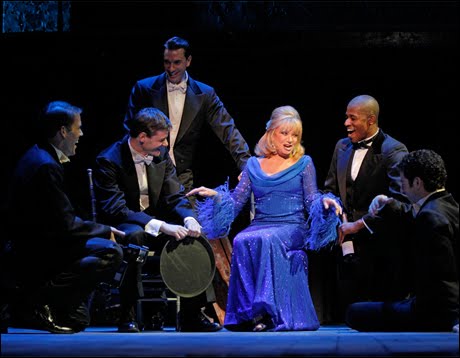
I've been curious about Elaine Paige for decades. She is the British Patti Lupone, having played Evita, Reno Sweeney, and Norma Desmond, to great acclaim in London. I imagine it was a bit of a coup to get her on this side of the Atlantic to play a role which, let's face it, consists of a couple of wisecracks and one solo. But what a song: "I'm Still Here" is an anthem of show biz survival designed to bring the crowd to its feet. Ms. Paige is getting some flack from the critics for her conversational attack on this number, but I actually enjoyed that slant.

Overall, though, her interpretation did not excite me nearly as much as the rendition my friend Sherri Edelen is offering across the river at Signature Theatre. In the revue Side By Side By Sondheim, Sherri is taking the roof off the joint with her gutsy performance of "I'm Still Here," a song she is really too young to be singing. But with a musical revue, we don't care about such things, and The Sig's production is really a winner.

I have been a fan of Side By Side By Sondheim since I saw the original production on Broadway (I wrote about that here), and I was thoroughly entertained by Siggie's current offering. Director Matt Gardiner has tweaked the narration of the show quite a lot, all to the good (though that crack about Doogie Houser creaks a bit). In the original, there is a narrator with a podium, guiding the audience through this examination of Sondheim's early works. When I saw Hermione Gingold handle that chore, I was entranced. But that was a special case; usually the narrator comes off as a bit of an interruption. So, Gardiner was wise to drop that character, and give his new narration to the cast and musicians. And what a team they are. I'm not surprised that Sherri blew me away, she always does, but she is joined by a couple of out-of-towners who are also superb. Matthew Scott and Nancy Anderson round out the trio of performers who make great impressions, both singly and in groups. Oh, I might quibble with the necessity of hearing both "Marry Me A Little" and the song which replaced it in Company, "Being Alive," though Scott does a swell job with both ballads. The slot in act II in which he sings the latter is usually occupied by "Could I Leave You?", the number which Jan Maxwell is hitting out of the park over at KenCen. But everyone has their favorite Sondheim songs, and I suppose in a revue such as SxSxS, the director has some leeway with the song choices.

So, it's been a Sondheim-centric couple of weeks for me, which inspired this week's Dance Party. The late great Dorothy Loudon is our star (she appeared on a previous Dance Party here), and around the 3 minute mark, you start to realize what a terrific talent she was. I love the fact that something so simple as teaming these two songs together can bring down the house at Carnegie Hall, where this clip was filmed. Loudon, by the way, never created a Sondheim role, but she took over for Angela Lansbury in the original Sweeney Todd, and subsequently became one of the go-to stars whenever there was a tribute to the composer's work. She certainly has a handle on these two songs:

Saturday, May 21, 2011

Rapture Day Obits


All three of these folks will be remembered for their creative contributions to various plays, musicals, and sitcoms.


Pam Gems
1925-2011


She was a prolific writer of original plays and adaptations of European classics, and is best remembered for her various biographical works for the stage. The RSC produced her first important work, Queen Christina, in 1977. Soon after, she penned what would become her most successful piece, Piaf. It was a play with music concerning the tortured life of Edith Piaf, the French songbird; star Jane Lapotaire had a great success in the role, playing in London before transferring to Broadway in 1981. Lapotaire won the Tony, though Gems was overlooked. Piaf has had several revivals since then, including a recent showing for which star Elena Roger won London's Olivier Award. In the original Broadway production, a young Jean Smart played Marlene Dietrich; Gems would return to Broadway more than a decade later with Marlene, which would earn her a Tony nod (as well as one for star Sian Phillips, who commissioned the piece from Gems as a vehicle for herself). Pam also received a Tony nomination for Stanley, which concerned the English painter Stanley Spencer. As happened frequently in her career, Gems's work provided greater success for the actors appearing in her plays than for herself; Antony Sher received kudos on both sides of the Atlantic playing Stanley (the show has the ignominious honor of being the final production ever produced by Circle in the Square Theatre, which folded when the show closed).

Other personalities which received the Pam Gems treatment included Mad King Ludwig II, Queen Guinevere, Admiral Lord Nelson, and actresses Mrs. Patrick Campbell and Ethel Merman. She died this week at the age of 85.


Russell Warner


1936-2011


He had an active career as a music director, arranger, and composer, but his lasting fame will be as an "orchestrational historian." OK, I made that term up, but it fits our gent to a tee. Musical charts for the orchestrations for many shows produced before 1940 are incomplete or have totally disappeared. Organizations such as the City Center Encores series, and recording labels such as PS Classics, recognize the importance of preserving these classic shows, but how to do so, when the original charts are incomplete or completely absent? Russell Warner to the rescue. According to everyone who knows about such things, Warner had the ability to recreate orchestrations in the style of the original artists. Civilians, and even most of us in the biz, may never have heard of Hans Spialek, Frank Saddler, or Robert Russell Bennett, but they were responsible for the orchestrations for classic early shows by the likes of Irving Berlin, Cole Porter, George M. Cohan, Richard Rodgers, and the Gershwins. Our hero had the ability to recreate missing passages from the shows of these greats, in the very style of the individual orchestrators attached to the projects. Lady Be Good, Very Good Eddie, Little Johnny Jones, Fine and Dandy, Sweet Adeline,and many other shows benefited from Warner's recreated orchestrations. He had a particular affinity for Jerome Kern's work, and participated in the landmark 1988 recording of Show Boat, which included, for the first time, all of the music which was played on opening night in 1927 for that groundbreaking musical; the recording, on three discs, is considered one of the finest recreations of original show music ever assembled. Russell's love of Kern resulted in his writing a piano concerto, called Kerncerto, which premiered at Carnegie Hall, played by the New York Pops. In 1998, he scored a ballet for the Pacific Northwest Ballet Company called Silver Lining, using Jerome Kern tunes, which is still in the company's repertoire. In addition to his restoration work, he worked extensively in regional theatre (for DC's Arena Stage, he orchestrated Animal Crackers and Cocoanuts) and on Broadway (Shenandoah). He also spent four years conducting the Coffee Club Orchestra for Garrison Keillor's A Prairie Home Companion. Later this year, PS Classics will release a new studio recording of the fully restored score to the Gershwins' 1930 hit Strike Up The Band, which will be dedicated to Russell Warner, who died last month at the age of 74.

Here's a lucky guy who made a fortune, literally, by writing a single episode of a single television series:


Sol Saks


1910-2011


The majority of this writer's career was spent in radio, penning episodes for Ozzie and Harriet and Baby Snooks. In early television, he found work with the sitcoms My Favorite Husband and I Married Joan. But it was his lifting of the scenarios of two feature films which would make his fortune.

Both I Married a Witch and Bell, Book, and Candle concerned beautiful young witches romantically involved with mortal men. Saks took this basic idea and, in 1964, wrote the pilot episode for one of the most successful sitcoms of the decade:


The series which he created ran 8 years, and was the breakout hit among several supernatural-tinged sitcoms which premiered the same season (The Addams Family and The Munsters also premiered in 1964, though each lasted only two years). Bewitched landed at #2 in the ratings for its first season, and remained in the top 20 for five years. Even as the show slipped to a dismal #72 in its final year, Saks was crying all the way to the bank. As creator of the series, he received a piece of the show's profit throughout its run and syndication (it can still be seen in reruns all over the world), but he wrote only the pilot episode. Saks's first choice for the leading role of Samantha was that quirky elf Tammy Grimes, who had impressed him in a recent film. But Grimes was committed to spend a year on Broadway playing in Noel Coward's High Spirits, so the role went to Elizabeth Montgomery, at the time known primarily as an aspiring dramatic actress and daughter of film star Robert Montgomery. After creating the pilot episode, Sol then stepped away from the series; the longevity of the show was in the hands of other writer/producers such as Danny Arnold, who created the long-term roles of Larry Tate and the Kravitz couple (none of these characters appeared in the pilot), and William Asher, who took the reigns of the series while being married to the show's star. Sol Saks died last month, a very rich man, at the age of 100.