Sunday, June 29, 2008

Radford Teacher #2

I've previously mentioned my experience working in film, which is fairly limited. A few day player parts, and more than a handful of "background" gigs, had prepped me for what was in store for me with My One and Only: a lot of Hurry Up And Wait. I was, therefore, pleasantly surprised that I escaped this routine.


This experience with film was the easiest I have ever encountered. At around 3 PM, I arrived in the dicey neighborhood of East Baltimore which had been taken over by the film crew. Massive trucks and trailers lined a full city block. Crew members meandered hither and yon (everybody was Union, so nobody rushed). Shooting had begun many hours earlier, inside an old Catholic school which had been commandeered for today's filming. (Several times I passed by a front office populated by some confused but fascinated nuns.)


As a "principal player," I naturally had my own trailer. Well, not all my own. I shared it with a young girl playing a student in my scene, and a woman playing "the old lady" in a scene to be shot later in the day, and Kevin Bacon.


That's right, I shared a trailer with Kevin Bacon.


Well, that sounds much more exciting than it was. These trailers are long monstrosities with individual cubicles into which can be stuffed as many as half a dozen actors, all with their own bathroom. I have a strong hunch Kevin's was much larger than mine, as I was in a cubbyhole about the size of a walk-in closet. But it had a place to sit, a place to pee, and a place to keep cool. The weather outside was a humid 90 degrees.

Soon my "wardrobe" arrived (the blazer, slacks, dress shirt, tie, shoes, and socks which had been chosen for me the day before). When I was at my fitting on Tuesday, my dresser mentioned that she could always tell when she was working with a stage actor: he always hung up his clothes after trying them on. I guess film actors just chuck them anywhere, knowing that some poor schnook will put them in their proper place. Here's another difference between stage and screen: onstage, actors wear costumes. On film, they are in "wardrobe."

Though I was disappointed that my trailer buddy Kevin Bacon had already wrapped for the day (more movie talk: It means he finished and went back to the hotel), I was still excited to be on what was clearly a big budget project. Soon, I was hustled to Hair and Make-up, which inhabited one of the long trailers, where the circles were removed from my eyes, and the grey was removed from my roots.

I had been on the clock only an hour when the dinner break was announced. I was warned that my scene would be shot directly after the meal, so I was not able to really enjoy the grilled chicken and fish which were being served (crews on location are treated to extravagant meals and snacks, as opposed to actors in live theatre, who are treated to a cup of coffee and a cookie if you are lucky).

True to their plan, I had only about 10 minutes back in my swanky trailer before I was called to the set. Of course, actors are not expected to get to the set on their own. It's at least 100 yards away. Each and every actor who has a speaking role must be escorted to and from the set by a production assistant. I have wondered about this practice in previous film endeavors; it has always seemed a waste of somebody's time to walk me to the set. I guess in Hollywood, actors tend to get lost along the way.

The scene was set in the afore-mentioned Catholic school. I was ushered into a fiendishly hot classroom full of lights, two cameras, dozens of crew members, 6 or 7 children already seated in their seats, and my stand-in. Yep, Radford Teacher #2 had his own stand-in, who had spent all afternoon standing motionless in this sweatbox, while I lounged comfortably in my trailer, thinking about my character.


My role, though large enough to warrant a stand-in (he actually looked like me!), was too small to have required a callback audition, so this was the first time I was introduced to my director, Richard Loncraine, the Brit who had cast me from the videotape of my audition in the casting director's office a month ago. He was a charming chap who paid almost no attention to me, as the focus of the scene was on one of his leading men, a boy of about 14. Logan Lerman, who has apparently been acting throughout his youth, was playing a young George Hamilton (yep, this movie is about a year in the life of George Hamilton). The scene was clearly about him, not his teacher.


In the scene, "young George" relates all the experiences he and his mother (Renee Zellweger) had had the past year, in a monologue which was alternately funny and poignant. The kid had no trouble with the speech the first few takes we filmed, but when the cameras were rearranged to point directly at him, to catch all the close-up nuances and such, he fell apart. The words stopped coming, and his youth and lack of focus began to show. I felt quite sorry for the kid, who was under a lot of pressure to perform.


As for me, I delivered my line perfectly. That is, after the first three or four takes. Inexplicably, my nerves took over, and the line came out of my mouth in different variations over and over. The director didn't even notice, and surely didn't care (the writing in films has a very low level of importance to moviemakers), but I certainly knew (and so did the script supervisor, who shot me many a wicked glance). I have a hunch the take they will finally use is one in which I did indeed say the words as written, but we'll have to wait and see.


I hope the scene remains in the film, if only so everyone can be impressed with the physical move I added to the piece: walking backwards. One doesn't often see people walking backwards in everyday life, but Radford Teacher #2 did it with panache.


As for poor young Logan, he was fussed over and cajoled, even as the clock was ticking on his work day (as a kid, child labor laws were in effect, and they had to get this shot, and another, before his time was up for the day. Talk about pressure!). The kid actually wasn't bad, and though he maintains that he doesn't even want to be an actor (he wants to be a lawyer), that'll surely change as Hollywood gets a load of his Jonas Brothers-type look.


I was released from the shoot at 8 PM, and made it home before nightfall.


I have a hunch now that my scene will remain in the movie, though I doubt anyone will pay any attention to me. It was fun to be in a film which will surely have a high-profile, whenever it's released.


And I'm happy. I'm now one degree of separation from Kevin Bacon.

Saturday, June 28, 2008

Washington Week in Review


It's been over a week since I completed my contract with the Madness of Shear. I had assumed life would now slow to a crawl, but this week, not so much. It's been an action-packed period, about which I suspect you are craving to know.


I have already mentioned seeing Julius Caesar at The Shakespeare Theatre Company on Saturday. The rest of the weekend, I was occupied with a staged reading for the Washington Stage Guild, who are launching a summer season of readings, similar to the spring season in which I participated. First up was a ghostly tale called Mary Rose, written by JM Barrie (of Peter Pan fame). I played Mary's father, who is spooked by Mary's habit of disappearing for days, or years, at a time, then reappearing as if nothing had happened. I always enjoy these readings for the Guild, which are low-keyed and fun. In fact, I'm scheduled to participate in another one this Sunday, but this one will have a twist. Due to scheduling problems, we will be reading the play absolutely cold, with no rehearsal. The pressure quotient just went up.


Monday was a quiet day, but Tuesday launched more activity. I had a costume fitting for my teeny tiny role in My One and Only, for which I was required to schlep to Baltimore. You can always tell when a role is really small: the screenwriter doesn't bother to name it. As a result, I was slated to play "Radford Teacher #2." At least it's a speaking role, which surprised the woman who greeted me at the production's offices on Tuesday. She mistook me for an extra. Ah, well. I was ultimately outfitted with a conservative brown blazer and slacks, and was directed downstairs to have my hair cut. The film takes place in the '50s, so all the men were being shorn and Brylcreemed. There was more confusion at this stage, as the hairstylist had been instructed to get specific direction from the costume designer before cutting the hair of any principal player. (I admit I rolled my eyes at that moniker; "Radford Teacher #2" has one lousy line, but because of it, I was being elevated above the level of the common actor, and being treated special.).


The hairstylist was actually quite good, and gave me a cut with which I can live, though she expressed consternation about my hair color. I had removed the gray from my hair for Shear Madness, and things were starting to grow back in. She got on the cellphone to the hair team "on set," to alert them that, when I showed up to shoot my scene the next day, they would be facing a "roots issue."
I was glad to get back in the car and escape this Hollywood-like atmosphere, and enter a world in which I was much more comfortable: Live Theatre. I was driving out to rural Pennsylvania to catch a weekday matinee at the venerable Totem Pole Playhouse. Several friends were appearing in their current production of Lying in State. The show was a very light-weight piece of fluff, the kind of thing upon which summer stock theatres like this thrive. My buddies Barbara Pinolini, Helen Hedman, Dustin Loomis, and Ray Ficca helped tremendously in covering up the holes in the script (which were many). Ray, who has been a member of the acting company out there for several years, is assuming the artistic directorship of the theatre next season, and I couldn't be happier for him. (This is a pic of Ray-Dude and Barbara.)


After the show, four of us shared a cozy meal at a local bistro, dining and dishing. Actors who travel away from home, and spend time in regional spots such as this, become a close-knit group. It is one of the joys of the itinerant actor, a pleasure I have enjoyed many times.


After our meal, I drove back to DC (about a two hour drive) to hit the hay for more fun on Wednesday. I had received word that my call time to show up for the filming would be 3:30 PM, which was an absolute blessing. It is not unusual for a film's call time to be 6 AM. The late afternoon schedule allowed me to attend a general audition in the morning for a theatre located in North Carolina. For some reason, this theatre had come to DC to see actors, and I was glad to get the chance to audition for them. I'm sure the auditors are still talking about my monologue from Equus.


After the audition, I returned home, changed my clothes, and hit the road again: back to Baltimore for my Big Budget Movie Gig...


Friday, June 27, 2008

June 27, 1969

39 years ago today, New York police officers conducted a routine raid on the Stonewall Inn, a run-down dive catering to drag-queens, hustlers, and other undesirables in the Greenwich Village section of Manhattan.


It was a common practice at that time to raid establishments where gays gathered, for no other reason than to arrest everyone in sight, forcing them to spend the night in the pokey, and to suffer the humiliation of having their names printed in the newspapers the next morning.


This raid turned out to be anything but routine.


Perhaps due to the years of abuse and harassment at the hands of the police, or perhaps because gay icon Judy Garland had been laid to rest that very afternoon, the patrons at Stonewall, joined by a crowd which gathered outside, turned and fought back, breaking glass, hurling rocks (and a few epithets) and touching off five days of rioting in New York.


"Stonewall" is now regarded as the birth of modern gay activism.


And not a moment too soon. Even as activists were finding their voices and taking to the streets, the local press mocked the movement with sneering headlines such as this one from the New York Post, July 6, 1969:


Homo Nest Raided, Queen Bees Are Stinging Mad


I have not been particularly active, politically, but the above headline arouses in me the same feelings I wrote about last week.


Today, to celebrate the birth of what is now called Gay Pride, I invite you to raise a glass of whatever you have in the fridge, and toast those brave men in heels who wouldn't take it any more.


Wednesday, June 25, 2008

I Hear Voices

Pretty much all acting includes at least some vocal work, unless you're Marcel Marceau. Even if you're playing Helen Keller, you're likely to grunt a bit. But today's topic concerns acting only with the voice. The Washington Post recently ran an article regarding the invasion of the animated world by stars.


This is not a new phenomenon, but is attracting some attention due to the universally panned vocal performances in the new animated hit, Kung Fu Panda. Back to that in a moment.


Back in ye olden days (pre-Beauty and the Beast, let's say), nobody gave a flip about who was voicing our animated characters. Yes, Mel Blanc became a celebrity based on his huge repertoire of voices, but it's doubtful that civilians could name even one other talent known primarily for their voice work. June Foray, who voiced Rocky the Squirrel as well as many many characters for the Hanna-Barbera studio, remained an unknown throughout her long and successful career. (More people know Marni Nixon than Foray; Nixon provided vocal work behind the scenes in a number of hugely successful movie musicals, including singing the leading lady's songs in The King and I, West Side Story and My Fair Lady.)


The instances of a star, already established in another medium, lending a voice to animation were pretty rare, until about 15 years ago. There were exceptions. Who can mistake the sultry tones of the great Peggy Lee as she warbled and vamped in Lady and the Tramp?


Of course, she was singing her own tunes in that one.


The Jungle Book included a few heavy-hitters too, including Sebastian Cabot, Louis Prima, and Phil Harris.


The Little Mermaid's cast included several mid-level stars as well, including Buddy Hackett and Rene Auberjonois. And who can imagine the seawitch, Ursula, with any voice other than that of the spectacular Pat Carroll?


(Apparently, nobody, including the New York critics who blasted the current stage version of the show now on Broadway. The role is being played there by the supremely talented Sherie Rene Scott, who has nonetheless received lackluster reviews...)

Some of these mid-level stars mentioned above were household names, but none were on the same level of celebrity as the current crop of A-listers who now frequent the animation recording studio.


Nowadays, the Post article points out, it is highly unlikely to find a major animated feature released without a plethora of box office names attached to it.


The phenomenon of movie stars lending their voices to animated features seems to trace back to Robin Williams's maniacally hilarious turn as the Genie in Disney's Aladdin. And really, no one can fault that performance, which swiped the film while overpowering the plot.


The Post makes an argument with which I am certain my buddy Scott would vehemently disagree. (Scott makes his living in the voice acting genre, and is one of the "go-to" talents in the industry.) The article claims that, in some instances, the vocal star power adds tremendously to the film in question, as exemplified by Aladdin, and by Tim Allen and Tom Hanks in the Toy Story franchise (another sequel is due out next year). My friend Scott has seen his opportunities in these large studio films diminish in direct proportion to the increased employment of "star voices."


Scott has said many times (many, MANY times) that if actors like Hanks want to take work away from voice actors, they are free to do so, but they should then relinquish their movie roles to the actors they are robbing.


I don't have a problem with Scott's viewpoint. I've never done voice-over work (another reason I'm so poor), so the controversy is interesting to me, but not life-altering. I can say something with which I think Scott and other voice talents might agree: the stars I mentioned above, in The Jungle Book and The Little Mermaid, were all well-cast in their respective cartoon roles. I would say the same about the voices in MY favorite animated film, The Hunchback of Notre Dame. Tom Hulce, Charles Kimbrough, Jason Alexander, and Kevin Kline are all memorable in their roles, though I have to say that the best vocal performances given in that film belong to less than well-known talents Tony Jay and Mary Wickes. The Hunchback proves one of the points being made in the Post article which started this discussion: the presence of an actual film star (in Hunchback's case, Demi Moore) gives the film additional promotional clout, but can actually diminish the quality of the work itself. Moore's singing was so deplorable that her songs were dubbed ("paging Marni Nixon..."), and it is certain that there were qualified voice actresses out there who could have voiced the role and sung the role just as well.


Which brings the topic back where it began. Kung Fu Panda was the number one film its opening weekend, and remains strong at the box office. Its cast includes Jack Black, Angelina Jolie, Seth Rogan, Jackie Chan, and Lucy Liu, and their work is receiving less than stellar reviews from the critics ("next to no personality," according to NPR). This will in no way restrict the use of stars in future animated flicks. The stats reflect that a large percentage of the audiences attending the film are age 17 or older, which apparently means that marquee names do attract an audience outside the children at which animated films are aimed. So producers will continue to cast recognizable names in their cartoons, regardless of their fitness for the job.


Animation studios deserve what they get, artistically speaking, and I hereby submit the following. If Tom Hanks or Jack Black wish to voice a character in a film, put them behind a screen and let them audition for the role, right next to other vocal talent like my friend Scott.
Who do you think would get the part?


Monday, June 23, 2008

Dody Goodman

1914-2008


"Mary Hartman, Mary Hartman":


"Grease," with Eve Arden:


singing "Lydia, the Tattooed Lady":


Smart women who play ditsy on talk shows, like Goldie Hawn, Diane Keaton, and the late Shelley Winters, all owe a debt to this classic comedienne, who invented the type.


George Carlin


1937-2008


One of the preeminent stand-up comics of the 60s generation, Carlin was famous for his routine regarding the Seven Dirty Words which can't be broadcast on television. Originally a comic who stretched boundaries in the vein of Lenny Bruce, he aged into a philosophic hipster whose influence can be felt in all the comics of today who include social commentary in their routines.


It was announced just last week that The Kennedy Center's Mark Twain Prize for Comedy would be awarded Carlin this year. It remains to be seen if that commendation will stand, as the award has never before been given posthumously. (It might make the final sequence of the event, in which the recipient takes the stage, a bit unusual. Maybe they could just replay the Seven Dirty Words routine! No, wait, it's the Kennedy Center, where naughty words are censured [see previous post]. Better to just send everybody here.)


I have a personal reminiscence of George Carlin which requires a little set-up. My family moved from my hometown of Atlanta to Los Angeles the summer between my junior and senior year in high school. It was a decision not made lightly by my parents, but the pater had received a giant promotion to make the move. Naturally, I was at the center of the concern; pretty crummy to be removed from the friends I had gone to school with since kindergarten, into a brand new high school across the country, in my senior year.


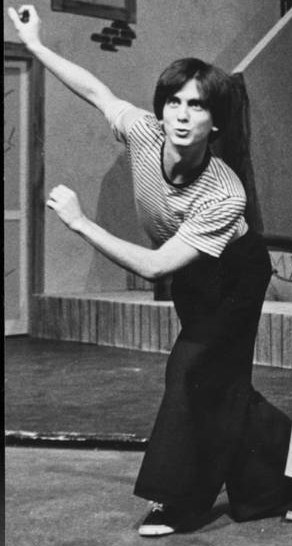
The actual physical move, by coincidence more than design, happened while I was out of the country. For about a year, my high school had planned a 3 week trip to Europe for their juniors and seniors, and about 30 students were going, including myself. (Though it's hard to tell, that's me on the steps of the Acropolis in Greece. Dig those groovy trousers!). So, I left my home in Atlanta with my friends in early June, and when I returned to the states, "home" had miraculously been moved into a new house in Los Angeles.


(The move, by the way, turned out to be all for the best for me, as I wrote a while back, but at the time, I was a misery.)


It was a deeply depressing moment at the New York airport, when I had to say good-bye to my life-long friends as they boarded their connecting flight back to Atlanta, and I, completely alone and in despair, boarded my plane to LA. My plane was overbooked, and I was bumped up to first class to make room. It was my first time flying first class, and I was too young to enjoy the free booze, so who cares? The plane was one of those early 747s, with the first class lounge, and spiral staircase, and the works.


George Carlin was in the seat next to me. I was not his biggest fan, but of course I knew who he was.


Being the starstruck teenager that I tried to avoid being, I worked up the courage to ask for his autograph. Politely, he said he did not sign autographs but, perhaps because he knew he would be sitting next to me for 5 hours, he drew a happy face on a cocktail napkin and gave it to me.


George Carlin drawing a happy face? I bet that napkin would be worth something now...
In memory of those Seven Dirty Words, and that flight across the country...


Update, 6/24/08: The Kennedy Center announced yesterday that Carlin will in fact receive the Mark Twain Award posthumously (posthumorously?)...

Sunday, June 22, 2008

"I come not to praise Caesar..."

...actually, I do.


I popped into Julius Caesar at the Shakespeare Theatre Company today, to see the first half of their current Roman Rep. (I saw Antony and Cleopatra on its opening night, about which I have already blogged.)


I am not at all surprised that my buddy Kurt Rhoads, who assumed the role of Marc Antony just last week, has slipped seamlessly into the part. (I don't know why, but my friends are always the best actors in their shows. It's a mystery...). Kurt had been greatly underused in his previous roles in the Rep, but he surely shines now, especially in the uber-famous funeral sequence, as Antony simultaneously eulogizes Caesar, and euthanizes the reputation of Brutus. This long speech must rank as the second most famous monologue in all of Shakespeare, right behind Hamlet's "To Be or Not To Be." NOBODY wants to be saddled with a speech so familiar that an audience can easily tune it out. But Kurt's performance was full of immediacy and realism, and we quickly forgot that we had heard the speech dozens of times before.


That's a fine actor.


Aubrey Deeker, whom I don't claim as a buddy but is an actor who always impresses me, is mostly unseen in this show, but his brief appearances as Octavius set up his much larger presence in Antony and Cleopatra.


Director David Muse has done his best to enlarge the influence of Caesar in the play, and Dan Kremer plays the title character with arrogance sufficient enough to turn his friends into his enemies. But structurally, Shakespeare never meant Julius Caesar to be about Julius Caesar, as he is dispatched in the middle of the play. The piece is meant to be dominated by Antony, Brutus, and Cassius, and this production fulfills that obligation.


Tom Hammond brought true heroism to the role of Brutus, and Scott Parkinson was a less sleazy Cassius than others I have seen. I enjoyed both their performances very much.


I can only find a few faults with this production. One is its length. Caesar can easily be abridged, but here, I found my mind wandering on occasion. The scenes with the conspirators seemed to brood an awful lot, rather than display the dynamic urgency with which they are usually played. I also had some trouble with the fight choreography, specifically the battle sequences in Act II. I have a personal dislike of stage fighting in slo-mo, and feel it really only works if the stage is full of actors participating. Here, a handful of soldiers crept on, in dim light, and displayed such stylized movements that I was completely removed from the reality of the moment.


I was quite taken with the final scene of Julius Caesar, which clearly set up the future importance of Antony and Octavius (who ultimately became the first Roman Emperor, Augustus) as the rulers they would become in the second part of the Roman Rep.


And of course, I'm thrilled that Kurt has this terrific opportunity to really show off his chops...