Saturday, March 15, 2008

Theatre Droppings: a smokin' "KISS," and a kiss for "SMOKE"

These pages have been dormant for a while, as my every waking moment has been concerned with my return to the Madness of Shear. The show is an exhausting one to perform, and even more exhausting to rehearse, so I've been essentially brain-dead while trying to get back up to speed. More on that anon.


This weekend was the first time off I've had in a fortnight, so I took the opportunity to check out some local Theatre Droppings, hoping the diversion would help clear my head.


Signature Theatre has kicked their Kander and Ebb Celebration into high gear with a hugely successful production of Kiss of the Spiderwoman. I imagine the original Broadway production was anchored by Chita Rivera in the title role, but here, the show is dominated by the spectacular performances of Hunter Foster and Will Chase, as the unlikely cell-mates Molina and Valentine.


The show is an intensely atmospheric piece, with the minimal plot taking a back seat to the scenic elements. The huge multi-leveled set houses the largely male ensemble like caged animals, with Steve Cupo's creepy warden observing from on high. Matt Rowe offers the clangiest sound design heard at Signature since Grand Hotel, but the effect is electric. And that dripping sound which often fills the quiet moments is a chilling reminder of the degrading conditions to which these prisoners are subjected. My only complaint concerns the matinee audience of oldsters who hacked and coughed their way through the show, reacting to the frequent use of smoke onstage.


This is the first production of Kiss of the Spiderwoman I have seen, and while its unrelenting, tragic darkness will never put it at the top of my list of Kander and Ebb favorites, Signature's offering is riveting from start to finish.


Yesterday, I schlepped out to Wayside Theatre's Front Royal space to catch their latest installment of the Smoke on the Mountain series. I have not seen any of these crowd-pleasers before (there are three of them), but I had a good idea what kind of musical I was attending. The trilogy about the Sanders Family of preachers and proselytizers has been a huge hit around the country for years, and Wayside's cast has played all three shows together. The result is a tightly-knit group who really delivers, both musically and dramatically. I have to admit that I went in expecting Bluegrass Nunsense but with Baptists, so I was quite surprised that I was sucked into this slender story of a family dealing with a loss and a return. The plot is paper-thin, but each member of the cast gets their chance in the solo spotlight. Each family member "testifies" in their own way, with a couple of monologues slanted toward comedy, including that of Liz Albert, with whom I worked years ago when she was a student at Shenandoah University. It was a treat to see the mature performer she has blossomed into. Most of the monologues tugged at the heartstrings, though I suppose there may be some who are uncomfortable with the overtly Christianic tone of the show. But that did not get in the way of my appreciation of the performance given by my buddy Larry Dalke, as the black-sheep uncle returning home. His world-weary speech comparing himself to the apostle Peter was a highlight of the production. And my friend Thomasin Savaiano, as the hugely pregnant, hugely tone-deaf elder daughter of the family, gave a performance rich in both physical comedy and emotional truth. (Selfishly, I love it when I can claim my friends are giving scene-stealing performances. I'm sure it makes me look good, though I'm not sure how...)


And I look forward to the fourth entry in the Smoke on the Mountain series: The Sanders Family Goes Hawaiian.

Tuesday, March 4, 2008

Theatre Droppings: New York, 1978

For some reason, the shows I saw in New York in '78, when I was barely out of diapers and just learning how to eat with a fork, are less vivid in my mind than those I saw in '75 and '77. I wish I had paid better attention, as this was to be my last trip to Broadway for 13 years.


Truth be told, I do have very vivid memories of two of the shows in this group, but as for the remaining six, I have only flashes of moments.


I remember being enchanted with the only straight play I saw that year, or rather, with the actor playing the title character. After a lifetime in the business, actor Bernard Hughes reached star status as "Da", the patriarch of an Irish family who returns from the dead to haunt his son (mostly humorously). I remember Hughes being a real delight, but I may be prejudiced in his favor, as he appeared in one of my favorite "unknown" films, Cold Turkey. I love it when an actor who has toiled in the business his whole life finally strikes it big; Hughes won every acting award that year, and deservedly so.


All the other shows I saw that year were musicals, though two or three of them were pretty unconventional. The biggest hit among these three was Dancin', a Bob Fosse extravaganza in which the chief star was, of course, the dancing. Fosse set his choreography to pre-existing songs in a sort of revue (it had a bit of singin' , too). I remember almost nothin' from this evenin' of dance, except feelin' that it went on too long. The music ranged from Neil Diamond, Cat Stevens, and Melissa Manchester, to a classical tune or two, and a long section devoted to "American" music, like George M. Cohan songs and the like. I have a distinct memory of seeing a young Ann Reinking in several leading spots, but my program says no, she was not in the performance I saw. So much for my memory. Examining the song listings, I got a giggle from one of the numbers in the "America" section, a song called "Pack up your Troubles in your Old Kit Bag and Smile, Smile, Smile." I giggled because this song is not American in origin, but was instead written by a Brit during World War One.


Another musical odd-duck I caught was an off-Broadway smash called I'm Getting my Act Together and Taking it on the Road. My recollection of this female-centric piece was that, as a male, I was not supposed to understand it. And I didn't. The thing was written by its star, Gretchen Cryer, and was all about women taking their place in the world. One of the songs, according to the program, tells you everything you need to know about this show: it's called simply "Strong Woman Number."


But the weirdest show I saw in '78 happened to be its final performance. After more than a year's run on Broadway, and earlier at Joe Papp's downtown Shakespeare Festival, Runaways was closing. This show was developed by Elizabeth Swados by casting kids who were living on the streets, except that by the time I saw the show, the original cast was making Broadway salaries and were no longer "runaways." In fact, my program reflects that I saw several "street urchins" who had previous professional stage credits, so I am a bit skeptical to the claim that these performers had all been living on the street before Swados plucked them from their poverty. I really could not relate to this show, which was written, composed, and directed by Swados, who had no interest in concocting anything pleasant for an audience. (I've previously trashed her later musical, Doonesbury, but she was no better here.) I am glad I saw Runaways, however, as it taught me to be very suspicious of any show which has only one creator who also acts as the director.


The three remaining musicals I saw were much more traditionally structured. After his extraordinary success as the Emcee in Cabaret, Joel Grey was elevated to star status, but he was, and has remained, better "in support." The Grand Tour followed George M! and Goodtime Charley, all attempts to turn Grey into a musical leading man. The Grand Tour was just, well, bad. Jerry Herman furnished another of his post-Mame flops, and Grey came off chilly. I am a great fan of Grey, having seen him in a summer stock production of 1776, but he's just not suited to headlining a musical. It took many decades for him to realize this, and he's had more recent success in the Chicago revival and in Wicked, playing supporting roles in both.


In one of the quirks of the business, both Joel Grey and Bernard Hughes ended up in the film version of The Fantasticks.


I loved On the Twentieth Century through and through. It was here I was first introduced to Judy Kaye, a performer who had been knocking around town for a while, usually understudying stars. In fact, she received her big break in this show due to the fact that she was understudying Madeliene Kahn, who deserted the show shortly after its big opening night. Kaye inherited the part, and played it so well that the producers decided to give the role to her, rather than searching for another star to replace Kahn. On the Twentieth Century also featured terrific performances by John Cullum and Imogene Coca. Yet with all this star power, this show was stolen by a relative unknown (he was certainly unknown to me), a young man with good looks, good pipes, and spectacularly comedic physicality. Any time Kevin Kline was onstage, you couldn't look away. He won the Tony and a big career boost for this role; shortly thereafter, he won his second Tony for Pirates of Penzance and filmed Sophie's Choice.


I've saved my favorite show of this bunch for last. Ballroom was a gorgeous failure, but not to me. To me, it was just phenomenal. A year after bowling me over as Miss Hannigan in Annie, I returned to New York to find Dorothy Loudon starring in the newest Michael Bennett musical, his follow-up to the monster smash, A Chorus Line. It was based on a TV movie which had starred Maureen Stapleton, and concerned a middle-aged woman dealing with the death of her husband, and her attempts to reenter the world. She does so by frequenting a ballroom dance hall. Bennett populated his ensemble with dozens of aging hoofers, most of whom had substantial Broadway credits but who hadn't been on the boards in years. These oldsters furnished an almost non-stop array of ballroom dances, and even stopped the show with their second act disco dance routine. I thought this show was movingly played and beautiful to watch, but there were substantial structural problems. The majority of the music was sung by two band singers in the background, with the only book songs handled by Loudon. She did a terrific job with these numbers, and furnished cabaret singers with a new standard by introducing "Fifty Percent." I loved this show so much, I returned later in the week to see it a second time, but I was clearly in the minority on this one, as the show closed shortly after opening, losing more money than any show up to that time. Though Loudon would continue to appear regularly on Broadway, in both straight plays (Noises Off, West Side Waltz) and musicals (she replaced Angela Lansbury in the original Sweeney Todd), Ballroom was to be her last chance to create a musical role for Broadway.

Monday, March 3, 2008

Split Focus

It was a weekend which included visits to Ireland, Italy, and Illyria. And Foggy Bottom, too.


It's a good thing when a lot of different things are going on in an actor's life. It beats the alternative: nothing going on in an actor's life. But it does lend itself to a bit of scattered thinking: where am I supposed to be, and when? And what should I have prepared?


The fun began Friday night, when I attended the first and only rehearsal for the Washington Stage Guild's reading of two short Irish one-act plays. The Stage Guild has been running a series of these readings in lieu of a full season of shows, as they await the completion of their swanky new digs. These readings are always fun, and there isn't much pressure, as the actor has the script in his hand during the performance. Still, one wants to give a good show, so, to prep for this event, I trotted out my old cassette recording of the original off-Broadway production of The Hostage, in order to brush up my Irish brogue.


Saturday, I visited Mickey the Hairdresser, in order to remove the gray from the topper. As I have already mentioned, I am rejoining the Madness of Shear this week, and I always take the initiative to remove those pesky reminders of age. The role I play in the show, Tony, just does not have gray hair. At least, not in my mind, so not on my watch. Later in the day on Saturday, I attended the "twilight matinee" of the show (6 PM curtain).


Sunday afternoon was our first performance of the Irish plays. There were lots of laughs (both playlets were comedies), and as always, it was great fun to work with the Guilders. I look forward to our second reading of these plays Tuesday night.


After the staged reading, I dashed home to change my clothes and head north to Baltimore, for my callback for Twelfth Night at the Baltimore Shakespeare Festival. I appeared in the show waaaaaay back in my undergrad days, and would love the chance to tackle the piece again.


I read for Malvolio, the puritan servant who secretly loves his mistress, and for Feste, the clown.


I returned home Sunday night in time to get about 5 hours sleep before returning to the Baltimore Shakespeare Festival Monday morning. This time, the callback was for Taming of the Shrew, and I spent a couple of hours reading various servants and lovers.


The fun won't be stopping yet. Tomorrow, Tuesday, will be my first Shear rehearsal, a full day's worth, after which I will pop over to perform the Irish plays once more for the Stage Guild. The remainder of the week will be spent at the Kennedy Center, getting up to speed before our first performance of Shear Madness Monday night.


It's great to be busy as an actor. There are many, many periods when that is not the case. I just wish I had been a little more disciplined before all this activity started.


Maybe I would have completed my taxes...

Tuesday, February 26, 2008

Theatre Droppings: New York, 1977

Fast Forward two years, to 1977, when I was just a toddler. The week between Christmas and New Year's, I was able to enjoy some Sondheim, some Strouse, some Shaw, some shivers, and a seductive Broadway debut.

I have confessed previously to have seen the musical revue Side by Side by Sondheim twice in a single week, due to the presence in the cast of Nancy Dussault and Hermione Gingold. Well, this is the week in which I did that unusual, slightly disturbing thing. In my own defense, the cast was top-notch, and Sondheim's music always benefits from repeated hearings.

I attended two other musicals that week in 1977, both of which held surprises for me.


I enjoyed the heck out of I Love My Wife for a few reasons. The comic lead was a gangly livewire named Lenny Baker, who had already won a Tony for this role. He dominated the show, but not to the exclusion of a sedate, subtle young woman making her Broadway debut. In a largely reactive role, Joanna Gleason made such an impression on me that I left the theatre wondering who the hell she was (according to the program, here is one of the things she was: Monty Hall's daughter, a fact which seems missing from her subsequent bios).

Nobody ever does I Love My Wife these days, despite its being a relatively small-cast show (only four principals, and an on-stage band; no orchestra needed) with a fun-filled score by Cy Coleman. It's very much a Period Piece, that period being the swinging 70s. I Love My Wife is about wife-swapping.


The other musical I saw that year was one of the biggest hits of the decade. I thoroughly enjoyed Annie, though for the first 20 minutes or so, I was confused. Not by the story, which was simplicity itself, but by the casting of a milque-toast young girl named Andrea McArdle in the title role. In those early scenes in the orphanage, she literally vanished among the group of livelier kids, who always took the focus from her. But about 20 minutes into the show, sitting on the floor of a blank stage, in a pinspot, with Sandy the dog curled up at her side, she revealed why she was in the show. As that anthem of optimism, Tomorrow, was belted by that naive little pre-teen, I swear the lighting fixtures in the theatre started to quiver. By the time she hit those final phrases, the walls were shaking, the seats were vibrating, and the audience's mouths were open.


Nobody could believe such a sound was coming out of such a young human.


McArdle was nominated for a Tony, but lost it, quite rightly, to her co-star, a woman who had been knocking around Broadway for years, appearing in flop after flop. With Annie, Dorothy Loudon became the success she had always deserved to be. Every comic moment landed perfectly in her performance, and her showstopping number, Easy Street, remains one of the most dynamic songs I have ever witnessed onstage.


I saw two straight plays during that trip, both of which were dominated by the star at their center. Frank Langella received raves for his reinterpretation of Count Dracula as a sexual being, and I have to admit his suave performance was a far cry from Bela Lugosi. Still, I don't remember much about this production, which was the basis for a movie version co-starring Laurence Olivier.

But this was one instance where I fulfilled that old adage, and left the theatre "humming the set." The design elements of Dracula, both sets and costumes, were handled by Edward Gorey, who was primarily known as the author of macabre short stories and cartoons. The Addams Family television series was in part based on his caricatures, and his drawings can still be seen in the opening credits of PBS's Mystery.

The last show I saw during this trip was my first George Bernard Shaw play, a production of Saint Joan, with Lynn Redgrave in the lead (and Robert LuPone, fresh from A Chorus Line, in support). I couldn't have known at the time that I would be meeting and, for one night, studying with Ms. Redgrave, almost 20 years later. While I was interning at The Shakespeare Theatre Company in DC, Redgrave came to town specifically to conduct a Master Class for the younger members of the company. But there was a twist: this "class" took place in front of 400 patrons who had paid dearly for the chance to watch Lynn Redgrave teach. There were only a handful of us actors involved, all of whom performed a Shakespearean monologue. Redgrave was a truly gracious coach, and the evening was a successful one, partially due to her ability to calm our nerves in the green room before the class began. She brought out a slim volume of Shakespeare which had belonged to her father, Sir Michael Redgrave, and explained that she never went onstage without spending a moment holding this worn, dog-eared, cloth-bound book. We all took our turn with this mysterious ritual; we were not about to decline this chance to participate in such a Redgravian tradition.


The theatrical voodoo worked, and that evening remains one of the most exciting and fulfilling I have ever spent on any stage, anywhere.

A few years later, Lynn premiered her one-woman show, Shakespeare for My Father, which dealt with her complicated relationship with her dad, and I'm sure she spent a moment backstage before every performance with that slender volume she inherited from him. I imagine she did the same back in 1977, right before that performance of Saint Joan which introduced me to Shaw, and to this extraordinary actress.

Monday, February 25, 2008

WAITING

I'm not much good at waiting, which is a shame, since I spend so much of my life doing it.


Tonight is a perfect example.


This afternoon, I attended an audition at the Baltimore Shakespeare Festival. I've auditioned there at least once a year for, I don't know, 6 years or so. I always get great response from the auditors before hearing nothing. Today's issues were Twelfth Night and Taming of the Shrew. I was particularly interested in the former, as it has several good roles for me, and is being directed by a lovely woman who has always been enthusiastic about my work. We had a long discussion about my participation in Shear Madness, which will overlap 12th Night rehearsals a bit.


That is, it MAY overlap. I heard today that the closing date of the spring company of Shear has not been finalized, so it's entirely possible that there will be no conflict. Or, it's possible that the Shear contract may extend, putting me out of the running for the Balto Shakes gig completely.


So, tonight, I wait for word on a callback while I wait for word on exactly how long my commitment to Shear Madness will be.


There's more waiting to be done, too. Tonight, at a gala cocktail party or something, the annual Helen Hayes Award Nominations are being announced. I really hope my director for Opus, Steve Carpenter, receives a nod, as he certainly deserves one. (The last time I worked with Steve, he got one, so maybe I'm his good luck charm?) I suppose there is also a slight possibility that the show itself could be nominated, either as Best Resident Production (that one is not very likely, as the smaller, low-budget shows are usually overlooked in this category), or in the new category of Best Ensemble.


It would be a nice boost for the Washington Stage Guild to get some publicity with a nomination, as the company is not producing any fully staged shows this season.


So, there's waiting to be done.


Waiting for a callback.

Waiting for a contract length.

Waiting for a kudo.


Not waiting for a cocktail, though. I'm no good at waiting.


That's why I drink.

Phone Rings, Door Chimes, In Comes "Company"

The new video of last season's Broadway revival of Company is a welcome addition to the Sondheim on Screen collection, about which I have already written.


Seeing it reminded me of the acclaimed Sondheim Festival which ran at the Kennedy Center back in 2002. KenCen produced six full-scale productions, and imported one from Japan (Pacific Overtures). I saw five of the six, but as finances are always a consideration in my life (Welcome To The Theatre), I skipped Passion, which I just can't bring myself to admire.


The five shows I did see were successful for me in varying degrees. I had the biggest problems with Sunday in the Park with George, which surprised me because the piece always moves me greatly. The concept at KenCen, however, placed the action in an art gallery, with the actors moving among paintings on easels, a distinct departure from the original concept. I never got used to it, and as such, came away disappointed in the production, and in its leading man, Raul Esparza.


But when I saw Merrily We Roll Along, I started to wonder if I had misjudged Mr. Esparza. Here he tore up the stage as Charley, and with the terrific Michael Hayden as Frank (the only production of Merrily I have run across in which Frank is sympathetic), they produced the single most memorable, most moving moment of the Festival. When, as college chums hanging out on the roof, waiting for Sputnik to appear in the sky, they sang hopefully of "Our Time," I embarrassed myself by breaking into tears.


I don't have strong memories of A Little Night Music, which surprises me, as it starred one of my favorite quirky actresses, Blair Brown. One of the Festival's few major casting missteps happened with this show, in the casting of Barbara Bryne as Madame Armfeldt. Ms. Bryne has a long history playing Sondheim mothers, having created both Jack's Mother in Into the Woods and George's Mother in Sunday in the Park. But as Desiree's mother in Night Music, she was pretty lackluster. I never for a moment believed this woman, in her prime, could have been granted a duchy for her sexual exploits with the King of the Belgians.


Surely the starriest of the Celebration was Sweeney Todd, with Brian Stokes Mitchell and Christine Baransky. They were both exceptional, and I fell in love with Baransky, who completely erased images of Angela Lansbury in the role. (I later enjoyed her in another Lansbury role, Mame, in a production which was rumored to be moving on to New York, but didn't.)


Which brings me back to where I started, Company. At the Kennedy Center, the main attraction was Lynn Redgrave as Joanne. I am a big fan of the younger Redgrave (I have a personal memory of her Master Class which I will save for another blog entry), but the night I saw the show, she was having vocal problems and came off a bit growly. But then, the creator of the role was Elaine Stritch, so nobody really cared. At the center of this Company, in fact billed above the title, was John Barrowman. A very pretty man, with a strong set of pipes, but he succumbed to what I think is a common problem with Company: everybody surrounding Bobby is more interesting, and he often fades into the background. It's hard to be dynamic when the role requires so much observing.


In this respect, then, the most recent Broadway Company's Bobby(Raul Esparza, by coincidence) had a distinct advantage. I cannot judge how he came off in the theatre, but with the benefit of screen close-ups of his reactions on the recently released video, he became the center of the piece. In fact, everyone involved with this Company came off very well, including the book writer, George Furth. In the past I have found some of the scenes unrealistic and a bit cunning, but in this production, the strength of the book writing came through. I confess that I was not wild about the concept of the cast playing their own music, which has become something of a trademark for director John Doyle. Perhaps it worked better in the theatre, but on screen, I just could not get used to seeing the actors hauling around their instruments while they were, you know, acting. Hard to infuse your character with emotional realism while nonchalantly holding a French Horn.


But I enjoyed the staging of this revival very much. There was no dancing at all; instead, the almost constant movement of the actors, including those on the periphery, reinforced the restlessness of this group of New Yorkers. I bet in the theatre it was real dynamite.

But please, get rid of those horns...

Sunday, February 24, 2008

Theatre Droppings: Catholic Tastes

I saw three local productions this week, all of which included a zealous Catholic influence.


I caught up with The Tricky Part at Signature Theatre on its last day. Martin Moran wrote and performed the one-man piece, and has been doing the show, off and on, for several years (in fact, the show was announced for last season at Signature, but Moran landed a gig in Broadway's Spamalot and postponed). I found this piece to be both touching and alarming. Moran is a quiet, ingratiating presence onstage, as he wanders out from the wings and begins chatting with the audience. Gradually, his story unfolds, and the picture of himself as a child, which sits on the table behind him, takes on added significance. The show is well-directed, and the climax of the piece, in which Moran reads from his journal, is set apart from the rest of the show, as it should be. It's a horrific story of child abuse, and a redemptive story of healing, all told in Moran's eloquently quiet, conversational style.


Olney Theatre Center, the scene of one of my recent crimes, is producing the John Patrick Shanley winner, Doubt. The buzz in the lobby beforehand was all about the touring production which had swung through DC a little while back, with Tony winner Cherry Jones in the central role of the Nun on a Mission. So, local actress Brigid Cleary had her work cut out for her, and in fact, I haven't read a single review of her work that did not mention Cherry Jones. So perhaps I had an advantage because I had never seen the play, and I could absorb Olney's production on its own merits. It's a terrific piece of writing, and is well-played by this cast. As with The Tricky Part, the abuse of an adolescent by a member of the clergy is at the center of the show, though here, we are never really sure if the abuse took place. Doubt will continue to generate debate through this production, and through the upcoming release of the film version, with Meryl Streep taking the role of the accusatory Sister Aloysius.


Keegan Theatre is remounting their 2003 production of Brendan Behan's The Hostage, a show which figures in my professional history. Back in LA, I appeared in a production directed by my late mentor and coach, Bobbi Holtzman, so of course, I'm sure her direction is superior to any others I may encounter. But I can say without hesitation that Keegan's Dave Jourdan, playing the central role of "Pat," is far superior to the sour, embittered actor with whom I worked. (In one of her few missteps, Bobbi hired a broken down old drunk to play a broken down old drunk. Big mistake.) But back to Keegan's production. It's a large and unwieldy script, full of musical diversions and audience interactions, but I think Keegan did a creditable job. I'm afraid some of the dialogue was lost to the audience, a result of poor projection of thick Irish brogues, and frequent clompings of actors' feet as they stomped up the stairs and onto the upper platform which framed the playing area.


The story concerns the Irish Republican Army's abduction of an English soldier to be held hostage, in retaliation for the Brits having condemned one of their own IRA boys to die. Joe Baker is goofily likable in the title role, and in fact, all of the major roles were very well played. As so often happens in a non-union production, the actors surrounding the leads were occasionally a bit wobbly, but I came away with a renewed affection for this unusual play, as well as lots of memories of my production so many years ago.


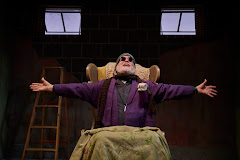
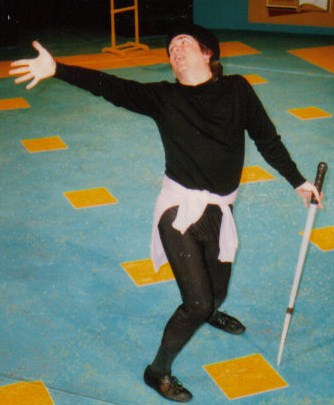
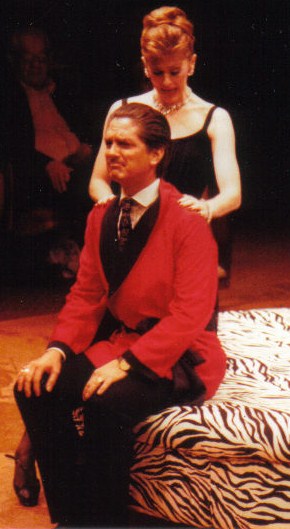
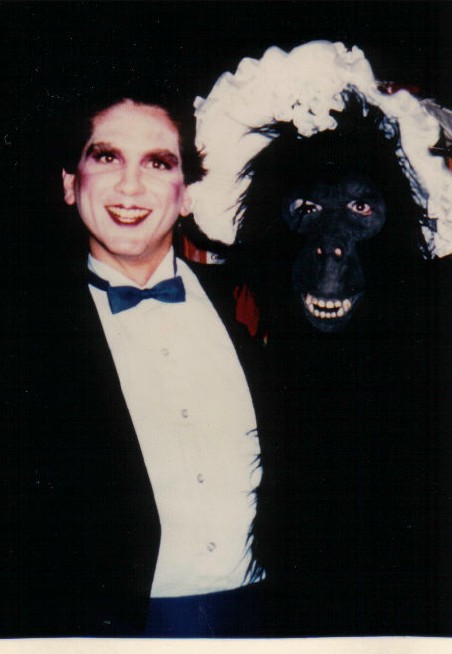
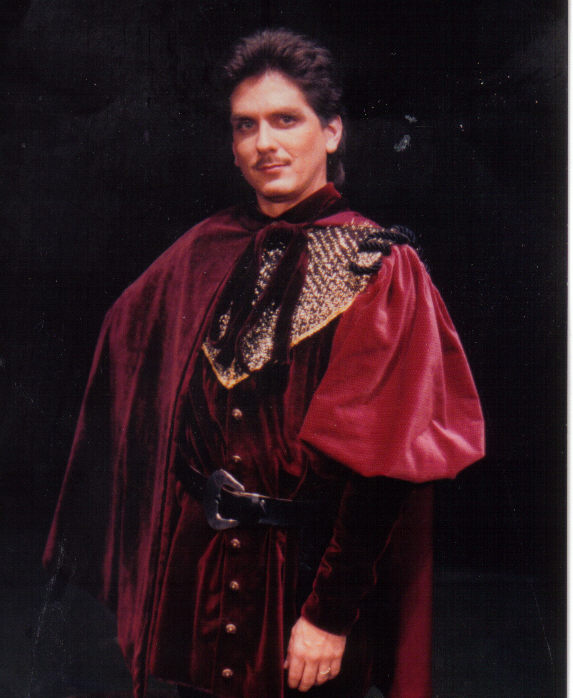
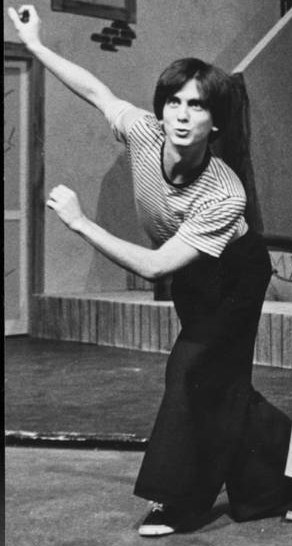
(that's me, standing in the "O", as hustler/crossdresser Rio Rita)