Friday, April 5, 2013

Friday Dance Party: Here's To The Lady Who Lunched

This news may not have made the national headlines, or even the entertainment section.  But here at the NY Branch, this is big news.  All the local papers have mentioned it, and the Grey Lady Herself, the Times, was present Tuesday and filed a report.  
 

There are only five performances, though the Times suggests they are not really performances;  perhaps they should be called "evenings."  But on Opening Night, Liza was there with Tony Bennett.  So was Bernadette Peters and her Into The Woods creator James Lapine.  Even Tom Hanks spent his only night off from his own show to schlep up to the Upper East Side to pay tribute.  Here in New York, attention is definitely being paid:  Elaine Stritch is saying goodbye.
Though she claims she'll be back, it seems unlikely.  Stritch's cabaret career at the Cafe Carlyle is legendary.  She has lived upstairs from the club for over a decade, but has decided to move back to her hometown in suburban Detroit, to be near the family she left 70 years ago.
Aging's a bitch, no matter who you are, but when you are a stage performer, it's particularly grueling.  It's why Peter O'Toole retired not long ago (I wrote about that here), and why Dame Maggie Smith has lamented that, because of advancing age, she will never return to the stage.  At 88, Elaine Stritch is calling it quits. 
Stritch can get laughs anywhere, including in a trashcan.
Beckett's Endgame was never so funny.

Decades of diabetes and alcohol abuse have taken their toll, as well as the natural effects of growing old.  She's had several minor strokes and several physical falls, one of which broke her hip, requiring her to use a cane.  Her memory is so faulty, according to the Times critic, that her farewell cabaret is sadly uncomfortable.  She also admits to being back on the sauce, allowing herself one drink per day. At age 88 and in poor health, is anybody going to tell her no?
Elaine's final Broadway appearance was in 2010, replacing Angela Lansbury in the revival of A Little Night Music.  She freely admitted she was wrong for the part of the courtly courtesan, Madame Armfeldt.  Bernadette Peters, playing her daughter, was wrong too, but as both women are considered premiere interpreters of the work of Stephen Sondheim, the public responded, and the revival's life was extended.
Despite a career which is stunning in its longevity (she made her Broadway debut in the 40s), she is hardly a household name, and I doubt middle America could pick her out of a line-up. 
When Company took her to London, she met her
husband, and stayed. She did Neil Simon (The
Gingerbread Lady) and Tennessee Williams
(Small Craft Warnings), and spent four seasons
headlining the above Britcom, Two's Company.

But she's truly a theatrical icon.  It's hard to explain her appeal;  she may not be one of those "love her or hate her" types, but there are still lots of people who do not understand why she is so revered.  She took over for Uta Hagen in the original Who's Afraid of Virginia Woolf?, and Woody Allen has made good use of her in several films.  Even David Letterman has used her, in a running gag about a horny housewife.  She will be remembered, most especially, for her musical performances, but even in her prime, her voice was more a bray than a belt.  And in recent years, her musical ear has become downright lousy.  Still, she's sometimes called "Broadway's last First Lady," mostly due to her musical resume. 
Stritch and Bea Arthur appeared together in an early TV program, but a bit of a rivalry sprang up decades later.  Elaine tells the story of losing the role of Dorothy on The Golden Girls due to an unfortunate ad-lib.  Arthur, whose one-woman show landed on Broadway simultaneously with Stritch's, assured her audience she would NOT be singing "I'm Still Here," a direct dig at Elaine, who was up the street bringing down the house with the number. Bea's show was nominated for the Tony, but she lost it to Elaine's.
She understudied Ethel Merman in Call Me Madam, and headlined the national tour. She has also toured in Mame and The King and I
As Joanne in Company.

Noel Coward placed her in a supporting role in Sail Away, then elevated her to the lead out of town.  Her performance in Company is considered one of the great performances in the history of the musical theatre.

Through most of her critically acclaimed Broadway career, the Tony Award remained elusive. 


Why do the wrong people travel?, Stritch wondered in Sail Away.
She was nominated twice for her musical work: she lost her award in Sail Away to both Anna Maria Alberghetti (Carnival) and Diahann Carroll (No Strings), as there was a tie that year, and she lost her award in Company to a tap-dancing Helen Gallagher (No, No, Nanette). 

 
The only time I saw Stritch live onstage was in A
Delicate Balance. She was spectacular.
She is also a strong dramatic actress, evidenced by her two Tony nods for straight plays:  she lost her award in Bus Stop to Una Merkel, whoever the hell that is, and her award for A Delicate Balance went to Zoe Caldwell's Maria Callas (Master Class).  She finally won the award for her autobiographical one-woman show At Liberty.
Elaine Stritch: At Liberty is available on DVD and is worth seeing.  She relates her journey as an artist and as a woman with surprising self-deprecation and candor. Her stories about Brando and Garland and Merman and others are riveting.
She did better with her television work, which has yielded seven Emmy nominations over the years, and three wins. 
Playing Alec Baldwin's mother
has earned her multiple Emmy nods, and one
win so far. Look for a final nomination for her
this year as well, for an episode in which she
comes out as a lesbian.

Her guest turn as a lawyer on Law and Order in 1993 earned her a trophy (she beat out, among others, another Broadway oldster, Gwen Verdon, who was nominated for an episode of Homicide), and she was repeatedly nominated for her recurring role as Alec Baldwin's mother in 30 Rock (she won in 2007).  Her third and most meaningful Emmy win was for the HBO presentation of the show for which she won her lone Tony, Elaine Stritch At Liberty.  It is fitting, then, as we say goodbye to a true theatrical treasure, that this week's Dance Party comes from that acclaimed one-woman show.
All of New York is hurrying to the Carlyle this week, for Elaine's swan song.
Stritch has probably three signature songs from various times in her musical theatre career.  The 11:00 number in Coward's Sail Away, "Why Do The Wrong People Travel?" is surely one.  The second is most definitely the song for which Elaine will be most remembered, Company's "The Ladies Who Lunch." 
As the acerbic, chain smoking, martini swilling Joanne, Stritch cemented her reputation as a performer who takes no prisoners.  In Company, after a failed attempt to seduce leading man Dean Jones, she raised her glass to toast the Ladies Who Lunch, introducing one of the masterpieces of musical theatre. 
But there is a third song which became closely associated with Stritch in her later career.  In 1985, our gal participated in an all-star concert staging of Follies, and stopped the show with her rendition of this number.  There is a clip of that performance out there, but I prefer the one below. 
The man's shirt over black tights was a
signature look for Stritch through the years.

This week's Dance Party is from At Liberty, and features our Elaine at her best: honest, rueful, and endearing.  Yes, Elaine Stritch can be endearing.  I imagine this week's farewell "evenings" at the Carlyle are pretty endearing, too;  how could they not be?  A great theatrical performer is bringing her career to an end. But like everything else she's done in her life, she's doing it on her terms.  Everybody rise.

Monday, April 1, 2013

Friday Dance Party: The National Smashtime

It's a double header this week, for reasons which will soon become clear.  Both clips come from that stylish disappointment, Smash
This week's Dance Party features big numbers from both these gals, as they vie to land the role of a lifetime.  Both these ladies have strong pipes, which Marilyn Monroe surely did not (in her few musical appearances, she was likely to slide off key at any time).  But such verisimilitude would have been unworkable in a series concerning a Broadway musical, so we pretend that Monroe could sing.
The trailer for the series, which made the rounds a year and a half ago, was dynamic and exciting.  The show looked to be, in a nutshell, Glee for Grownups.  Perhaps I should not have connected it with that other musical series, as, like Glee, Smash has not lived up to anybody's expectations.  I continued to follow the show throughout its first season, watching it dismantle itself.
There was constant trauma behind the camera.  Creator Theresa Rebeck, left, refused any attempts to help her run the show, though her second-in-command, David Marshall Grant, was an experienced hand at it. She insisted the private life of Debra Messing's character, based on her own life, remain central.  It did not gel with the rest of the story.  Meanwhile, Spielberg chose two minor characters as his favorites, pumping up their importance in an already bloated storyline.  The show collapsed under its own schizophrenia.
This second season, I've been taping the episodes, but have not watched one yet. 
Debra Messing is the biggest TV name
attached to Smash. Rebeck saw herself in the
character, and wrote much household drama for
her which added nothing. Messing's frumpy
wardrobe drew derision from critics, who
grew tired of her layered look. You never saw
Messing without a scarf roped around her neck.
It is no coincidence that Rebeck herself is never
seen without such a scarf.

I'm sure I will, especially considering this second season appears to be the show's last.  The ratings have been worse than disappointing, and the network recently announced the show is moving to TV's Graveyard, Saturday night, for the remainder of its season.  This is the kiss of death to almost any series.
Messing and Christian Borle play the musical's writers.  He wipes the screen with her.
I have felt about Smash the same way I felt about Glee when it was new.  I watched the thing out of a feeling of obligation, because the show was so unusual for weekly television, and it had, at least on the surface, resonance with my own life. 

Oscar winner Angelica Huston is giving an
oddly compelling performance as the producer.
One Facebook wag wonders when she began
looking like the Joker. But I applaud her
willingness to embrace her maturity.

Smash, like Glee before it, quickly degenerated from a strong opening to episodes which were downright cringe-worthy.  Every once in a while, a moment would pop up which was excellent, full of life or wit or panache, but so many more were dreary and uncomfortable.  These two shows are among the most inconsistent TV programs I have ever watched.
I find the musical numbers in Smash to be the highlights, as opposed to the numbers in Glee, which are the lowlights.
Back to Smash, from which this week's Dance Parties are plucked.  The show was created by Teresa Rebeck, who had some experience with TV writing but is primarily known as a playwright. 

A running gag has producer Eileen tossing her cocktail into her ex-husband's face. That face belongs to actor and Pulitzer prize winning playwright Michael Cristofer (The Shadow Box).  Season one provided great fun for theatre fans, who could pick out stage vets in every episode.  The show is shot in New York and makes fine use of the local theatrical talent.
Rebeck had complete control of Smash's first season, and the show floundered under her leadership. 
Shortly after premiering on Smash, Christian
Borle won the Tony for Peter and the Starcatcher.
He remains a bright spot on the show's canvas.
He gets his own Dance Party here.

I was not aware, at the time, of all the trauma happening behind the cameras, but the chaos created by Rebeck has been well documented.  She left the show after the first season was concluded, but apparently her replacement has been unable to repair the damage Rebeck's iron fist had inflicted.  As I mentioned, I have yet to watch a single episode this year (but I know I will, as I feel obligated to support a show which, at least ostensibly, purports to illuminate the world in which I live).
Megan Hilty shines in all her numbers.

Smash concerns the creation of a new musical for Broadway.  Our two ingenues spent most of the first season battling for the leading role in said musical, about Marilyn Monroe.  One of our gals, Megan Hilty, has become a particular favorite of mine on the show, but apparently, not of her boss. 
Jaime Cepero as Ellis, the duplicitous personal
assistant, was the most hated character on Smash.
But Spielberg loved him, so his role was enhanced.
I understand the role does not appear in season 2.

One of Smash's executive producers (and the one upon whose name the show was picked up) is Steven Spielberg, and he was displeased with Hilty from the first day.  All this was reported in the papers, so poor Megan had to go to work every day knowing that one of the most powerful and respected talents in show business wanted her fired from her job.
Smash is populated with actors with serious Broadway cred.  Megan Hilty, left, created the role in the stage musical 9-5 which Dolly Parton played in the film.  She spent time in Wicked as well.
The second of our stars this week is a gal named Katherine McPhee.  I had no idea who this person was, though she receives billing over Hilty, who has numerous Broadway, TV, and film credits to her name.  Turns out she was a contestant on American Idol, so no wonder I had never heard of her.  I find her dull as friggin' toast.
I was excited to see one of my favorites, Jack Davenport, in the Smash cast.  I have to admit, I much prefer him in the above film, as the sweetly clueless lover of The Talented Mr. Ripley.
Let's get to this week's Dance Parties.  Smash's musical numbers are far superior to those on Glee, but perhaps I'm biased as they tend to have a more theatrical flair. 
Jack Davenport's over-the-top performance
as the maniacal director is disconcerting. A
new musical requires a real conciliator at its
helm; Derek Wills is anything but. I have to
remind myself Smash is not a documentary.

Plus many of the Smashy songs are originals, written by Broadway talents.  Both these clips display one of the strengths of Smash:  the show intercuts rehearsals of various numbers from the Marilyn Musical with glimpses of what the finished product might look like.  I find this very, very fun.  The choreography for Smash's first season won the Emmy.
These are some of the casualties of season one. Guest stars Jennifer Hudson and Sean Hayes, among others, have populated season 2, so these guys had to go. I was particularly sorry to see Will Chase (lower left) get the axe, as I have been his fan since seeing him in Kiss of the Spider Woman.
Our first number features my personal favorite, Megan Hilty (who had a birthday last week, consider this her card). 
I caught Hilty in concert at the Kennedy
Center last year. She was dynamite.

In the context of the show, the number is being performed as sort of an audition by the director/choreographer, in order to see if there is any interest in moving forward with a workshop of this new musical.  Play ball!

This next clip features Hilty's rival for the role of Marilyn, the aforementioned McPhee. 
Katherine McPhee.  Who the hell is she, and
why is she starring in this series?

If memory serves, this number was used as her character's final callback for the role of Marilyn.  I find her only adequate, but I actually like the material here very much.  It's a catchy tune.  Once Smash ends its run, I expect we will continue to hear good things from Megan Hilty, while I expect Katherine McPhee will sink into relative obscurity.

Thursday, March 28, 2013

The Pearl Anniversary

In the first weeks of this blog, I wrote a letter to my mother
 
In the intervening six years of my blithering on and on in these pages, I have occasionally written more about her.  But she deserves another entry today.  My memory is a bit spotty about my mother's 10 year battle with the breast cancer which ultimately took her life, but I have strong memories of March 28, 1983, 30 years ago today, the day she died.
Earliest known shot of my mother and me.
We brought my mother home from her final visit to the hospital several months earlier.  We were told her battle was coming to an end;  she was indeed terminal.  The doctors, in their wisdom, predicted she might last another month to 6 weeks.  She lived longer than that.  She was on oxygen, and a large tank, resembling an oil drum, was set up next to the king sized bed in the master bedroom.  She had a portable tank, too, which she occasionally used when she left the bedroom, but that became infrequent after a while.  She was just too weak to walk. 

My mother's 4th child was this dog:
Ashley Wilkes Williams. He was manic
about playing ball, and was not allowed
beyond the kitchen. But if he detected
Mom was in distress, he broke the rules
 and charged up the stairs.


We did not hire home care, which would have been the last thing my mother wanted: to have a stranger bustling around her at this intimately private moment.  We set about doing Home Care on our own.  My older sister Laura, who lived in Atlanta, flew out to Los Angeles.  She was a homemaker, in an age when that species was pretty much extinct, so she was the one usually making the meals and running that aspect of the house.  My younger sister Joan, who was studying at UCLA at the time, and living on campus, stopped going to class and moved home.  She slept on the floor next to my mother's bed, and spent a lot of time in the room with her. 
My sisters shared the workload of caring for my mother in her last weeks.  Here, they shared a pizza.
My father still had to go to work during this period;  he slept in the guest room so as not to disturb my mother. 
The oxygen tank which sat next to Mom's
bed looked a lot like this, but with valves and
gauges. It was impossible to pretend all was
well with this thing whirring away.

I didn't do much during this period, other than keep tabs on the oxygen levels, and arrange for the tanks to be exchanged when needed.  My sisters handled most of the daily tasks associated with caring for my mother.   I took my turn, you see, the previous ten years.

1974, my senior year of high school, coincided with the first year of my mother's cancer diagnosis.
My mother was diagnosed with breast cancer soon after we moved to L.A. in 1973.  I lost track of the various surgeries, chemotherapies and radiation treatments she endured for the following decade.  Some years were better than others, as she seemed to be in remission, and life went on as normally as possible.  But those periodic visits to the oncologist, to "check the numbers" or to scan for disease activity, were fraught with anxiety, though my mother rarely showed it. 

I can't imagine how my father coped.
During Mom's final weeks, he was forced into making
"final arrangements": funeral, cremation, interment,
all while watching his life partner
drift away.

I lived at home all through that decade, while little sis Joan eventually moved on campus and big sis Laura maintained her own family across the country.  Most of those years, our family lived a relatively normal, uneventful life.  After college (during which, as I said, I lived at home), I was working two part-time jobs, as a waiter and as a customer service clerk at Sears, while doing shows at night.  So I can't claim to have spent a huge amount of time with my mother during those years, except that I slept there.  And ate there.  And sat many times with her, casually chatting away, not realizing how those moments would become special to me in memory.

We did have a routine for a while.  I would come home from whichever job I had attended, often around 5 or 6.  My father was a workaholic at Lockheed and was never expected home until much later in the evening.  I would dash upstairs to check the messages on my phone machine (remember those?) and to change out of whichever uniform I had worn to whichever job that day:  tie and slacks for Sears, dreary brown vest and sensible shoes for the restaurant. 
Halloween with "my Sears Ladies," as I called the middle-aged women with whom I worked in the Sears Complaint Dept.  At my mother's insistence, we kept her disease private, so these ladies did not know how much they helped me during the long fight. These women tended to treat me as a surrogate son, and I allowed them to mother me.
After leaving me alone a little while, my mom, puttering around in the kitchen, would holler up the stairs to me, "Want a cocktail?"  This was a running joke with us;  our "cocktail hour" consisted of sharing a can of light beer while we chatted about our day (it was my mother, incidentally, who clued me in to the fact that you could get more head on your beer if you salted it.  It's a trick I still use).  

This must have been during my teen years.  I don't see any beer.

Those early evening chats were always about normal, mundane things;  we rarely if ever spoke about her cancer.  She was determined that her individual fight would not interfere with our family life, as long as she could help it.  So, when she was undergoing chemo, she always took her treatments on Monday, so that the accompanying nausea would happen mid-week, and she would feel relatively fine by Friday.  The weekends, then, felt normal to her and to us.
My mother is known as "Jo" to her grandkids.

In another entry one day, I'll probably relate the story of the day my mother's cancer returned for the final time, about a year before she died, but I'll wait on that one.  I have so many memories flying around my head this time of year.  My mother was taken, as I mentioned, on March 28, which, in 1983, landed on the Monday between Palm Sunday and Easter; Christians call this Holy Week.  This is a fairly unusual occurrence, as Easter is usually later in April.  This year, 30 years later, March 28 once again falls during Holy Week.  I'm not particularly religious, but I like to think that coincidence has some sort of cosmic significance.
Jo was a hometown beauty,  the first
Apple Blossom Queen of Hendersonville, NC.
She resembled Rita Hayward during this time;
I wrote about that here.

The atmosphere around the house was not as grim as you might imagine, during those final weeks 30 years ago.  Joan did a great job of keeping my mother's spirits up as she became more and more bedridden.  I remember one afternoon bounding up the stairs after my day shift at Sears, to the tune of dance music pounding from the master suite. 


As a married woman, Jo was often
told she resembled Juliet Prowse;
I wrote about that here.

Michael Jackson's Thriller was the album of the day, and one of its many hits was playing on the radio.  Mom was sitting up in bed, contentedly knitting or reading or something.  Her feet under the covers were bopping around to the beat.
Even bedridden, you had to dance to this album.
I'm not sure when exactly my mother realized that she was terminal.  At least in those days, such patients were not informed of the bad news unless they specifically demanded the truth. 
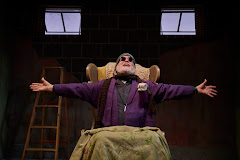
I was in rehearsal as Dr. Einstein in Arsenic and Old Lace
during my mother's last weeks
(I wrote about that experience here).
If I hadn't had this goofy show
to return to after her death, I wouldn't have made it.

The oncologist in charge, one Dr. Chernoff by name, was an expert, I suppose, in losing patients, and his advice was to allow my mother to come to the realization on her own.  So when we brought her home from the hospital in January of '83, she was under the impression that more treatment would be proscribed.  Chernoff, to his credit (and believe me, I don't give him much) liked my mother enough to actually perform house calls, unheard of in modern times.  During one such visit, I overheard Mom ask what the next step for her would be.  He replied simply that she would be given some steroids to strengthen her and to make her more comfortable.  A silence lingered after his answer, and I have a hunch it was at that moment that my mother began to realize she was not going to recover.

At one point, she surprised us by asking to see a minister.  My parents were members of a local Presbyterian church, but did not by any means attend regularly.  The minister there was happy to come out to see my mom.  I brought him up to her room, and as I closed the door to give them privacy, I heard her demand, "So, do you really believe there is a heaven?"

Clearly, in a very private way, my mother was struggling with her truth.  As I mentioned, she lived longer than the doctors predicted.  As the days lengthened into weeks, Laura had to return home to tend to her own family.  A few days more went by, and my mother stopped speaking much, and stopped eating at all. 
I used this cheap ice crusher many times daily to
refill Mom's bedside glass. She sucked on crushed ice
to ease the painful sores which developed in her mouth.
The sound of this machine is unmistakable. After her
death, I threw it out. 30 years later, I still can't stand
the sound of ice crushing in a machine; I have to
leave the room.

I'm told this is quite common for terminal patients when they realize they are not going to survive.  After several days went by, during which she refused all food, Laura returned to L.A., and we resumed The Wait.  Ultimately, Mom began eating again; she must have come to some kind of peace in her own mind.  I was sitting with her one afternoon, giving my sisters a break.  She slept a lot during those last days, and the bed was so huge (and she was at that point very, very small) that I was lying on top of the covers on my father's side of the bed, reading.  She turned over, from one side to the other, and murmured to no one in particular, "I'm so tired of this."

The evening of the 28th, she began to have substantial trouble breathing.  She didn't seem to be getting enough oxygen, and I called our technician, asking for a better mask for her;  she had been using one of those which put tubes up the nostrils.  He hurried over with one of those over the mouth-and-nose things, but he arrived too late.  I don't think it would have done much good.  It was time.

But we were all there;  my memory is crystal clear on the scene.  My father was kneeling at the side of the bed, holding my mother's hand. Her eyes were transfixed on his.  My sisters were sitting motionless, waiting for the inevitable.  And me, I was standing up, but very still.  I have to admit that we were not a particularly close family, the kids were raised to go our individual ways, but during this terrible period, we banded together.  And at that moment, 30 years ago today, I'm sure we helped her.  At the moment she died, we were all there.  In a way, we were my mother's angels.  And that gives me comfort.
Joan "Jo" Williams
10/18/28 - 3/28/83

Friday, March 22, 2013

Friday Dance Party: The Culture Of Rape

I wish I had a clip of the production of Man of La Mancha in which I appeared.  Nancy O'Bryan as Aldonza broke your heart.
Not a very nice phrase, is it, "the culture of rape"?  The term has been tossed around a lot recently, most notably this week, as the notorious Steubenville case concluded.  Those animals were lucky to be tried in juvenile court, and deserve to be labeled sex offenders for the rest of their lives, because that is what they are.
The little hamlet where these punks perpetrated their crimes has been called a real Football Town, where the high school players are treated as kings and they are protected from the consequences of their actions.  When the verdict was announced this week, one of them broke down into tears and moaned to his lawyer, "now no one will want me."  Was he worried that no woman would ever wish to spend her life with a sex offender?  No, he was worried that no FOOTBALL TEAM would want him.
Not a very pleasant subject for the Dance Party, is it?  I've been wondering this week how often violence against women has been featured as entertainment, and how rarely there are meaningful consequences for the perpetrators. 
The Rodgers and Hammerstein chestnut Carousel has an abusive relationship at its center.  Billy Bigelow had a nasty habit of slapping around his gal, and even physically threatened his own daughter from the afterlife.
I seem to remember the film The Color Purple had a very violent streak, so I assume the musical version does, too.  Violence against women has always been dramatically titillating, I suppose, and the culture in which it seems acceptable has been around for a long, long, time.
Even if you've never watched a daytime soap in your life, you've heard of Luke and Laura.  This romantic duo from General Hospital are still on the show's canvas more than 30 years later.  Their wedding remains the highest rated episode in the history of daytime drama.  They landed on the covers of People and Newsweek and inspired the term "supercouple."  Know how their romance began?  He dragged her onto the floor of a disco and raped her.  But the chemistry between the actors was so strong, Luke was transformed into an offbeat hero.  Unbelievably, this is not the only instance in soap history when a rapist became so popular that he was reinvented as a leading man. General Hospital has TWO such anti-heroes.
That most famous of chamber musicals, The Fantasticks, features a "Rape Ballet," a comic sequence in which a kidnapping of the ingenue is staged.  Preceding that insensitively named segment, the score features a song which, for decades, was commonly called "the Rape Song." 

As Mortimer in The Fantasticks, I participated in the comically rendered "Rape Ballet." Even as a teenager in the 70s, I was uneasy with the way the writers bandied around that word. Didn't "rape" always mean sexual violence? Apparently the writers did not think so.
The lyrics repeated "rape" over and over, comedically, as a conman convinces the ingenue's father that the "rape" (his word) of his daughter will be a good thing.  "Rape is the proper term," El Gallo assured the dad.  "It's short and businesslike."

Or at least it was.  The creators of The Fantasticks, many many years too late, were convinced to change their offensive language;  all mention of rape has now been removed from the classic show.
In The Fantasticks, Schmidt and Jones did not intend a sexual meaning when they composed their Rape Ballet.  The fact that the sequence remained in the show, under that name, for decades, speaks volumes. (I wrote about The Fantasticks a while back and mentioned this issue.)
This week's Dance Party features a searing number from an old warhorse, Man of La Mancha.  This musical from the mid-60s did not shy away from violence;  this song is sung by the leading lady, a prostitute, immediately after she has been gang raped (mercifully, offstage). 
The classic Forsyte Saga had the unhappy marriage of Soames and Irene at its center. In an early catalytic episode
of the 1967  miniseries, Soames "asserted his marital rights," and raped his wife. By the end of the 26 hour series,
he had been transformed into a charming curmudgeon.
 
The Scarlett/Rhett relationship in Gone With the Wind is
more than tempestuous: it's violent. Here Rhett subdues his
wife and carries her upstairs against her will. But the next
scene alleviates the viewers' fears: Scarlett is humming in bed
while she enjoys the sunshine and breakfast on a tray. What
was the message being sent to women here? And to MEN?

There are many renditions of Aldonza available in video clips, it appears to be very attractive to female singers who really want to show some grit.  This clip comes from the disappointing film version of the show (when Peter O'Toole retired last year, another clip from the movie received the Dance Party treatment). 
I appeared in Man of La Mancha at Wayside Theatre several years ago.  Our Aldonza delivered an earthy performance; I wrote about it here. Her rendition of Aldonza was far superior to Sophia Loren's overplayed version below.
As far as I can tell, Sophia Loren was singing for herself (O'Toole was dubbed in his big numbers), as she fumbles several of the notes of this song.  I've got some problems with her overall performance anyway, but for this week, when violence against women is in the national consciousness, Aldonza is an appropriately timely clip.