Friday, May 11, 2012

Friday Dance Party: Killing Me Softly With This Song

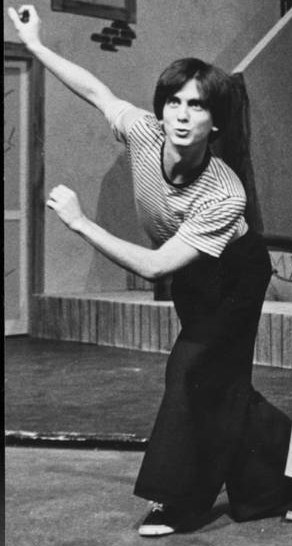
Ontkean went on to Twin Peaks, Hamlin to L.A. Law. Jackson, late of Charlie's Angels, went on to Scarecrow and Mrs. King.

A birthday and an award ceremony intersected, in my own peculiar mind, with the biggest news of the week, and the result is this week's Dance Party.  Be forewarned:  not only doesn't it dance, it barely moves.  But the number has some importance in my life, and it helped gay cinema a bit too.
With gay couplings in the news, thanks to the president's endorsement, I've been thinking of one of the first films I encountered which included such relationships. 

I had no idea who Harry Hamlin was when I first saw him in Making Love. Fourteen years later, I worked with him onstage at The Shakespeare Theatre Company.  I never told him the importance his film had in my life.
The theme song from Making Love was co-written by Burt Bacharach, who, along with his former partner Hal David, won this year's Gershwin Award, given by the Library of Congress.  Everybody knows the music of Bacharach & David, even if they don't know they do, as their tunes dominated the pop charts during most of the 1960s and 70s. 
Bacharach & David provided the soundtrack for a generation.
This week's Dance Party, though, was written in the early 80s, when the team had parted ways. 
Burt Bacharach and Carol Bayer Sager won the
Oscar and Grammy for "Arthur's Theme."
"Making Love" was nominated for a Golden
Globe, but lost to "Up Where We Belong," from
An Officer And A Gentleman.

Here, Burt provided lyrics (he was usually a composer) in partnership with his squeeze at the time, Carol Bayer Sager.  The song was a fairly big hit for Roberta Flack (in fact, it marked her last appearance in the Top 20 as a single), but has not retained the staying power of her other, bigger hits.
Roberta Flack had bigger hits, but
none affected me as much.

The song is the theme song from Making Love, which was released in 1982 and which some consider to be a landmark film.  I can't quite agree with that, but I will admit that it was a significant step in the evolution of the gay cinema. And it was certainly a landmark for me
The poster looks like Ingmar Bergman.
The actual film was more
Movie-Of-The-Week.

I remember seeing the film in the theatre, with my friend Scott, and we were both greatly affected by seeing gay men on screen who were neither flamboyant nor freakish.  But the film is so friggin' earnest that it's a bit colorless.  This was one of the first attempts by a major studio to put gay subject matter in the neighborhood cineplex, and 20th Century Fox's timidity was showing. 
The screen lovers.


By today's standards, the film is completely inoffensive, but in 1982, Hollywood was scared.  The atrocious reaction which Al Pacino's film Cruising had aroused two years earlier made all the majors skittish about gay content, so Making Love is as inoffensive as possible.  A couple of scenes, for example, took place in gay bars, and I wondered at the time, where were the Bette Davis Drag Queens? 
1980's Cruising was a crushing indictment of the gay leather scene and garnered massive protests in the gay community.
Director Arthur Hiller did a bang-up job making the gay subculture in Making Love seem normal and non-threatening, and palatable for the public at large.  His film includes a comforting grandmotherly figure, over-played by Wendy Hiller, and the gay boys indulge in sports and BBQs, with nary a Broadway showtune in sight.
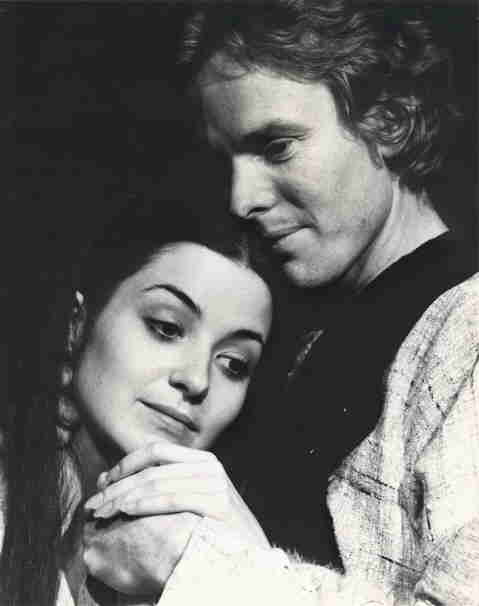
Kate Jackson and Michael Ontkean
previously played spouses in TV's
The Rookies.

Making Love was not a box office success, and its place in gay cinematic history is overshadowed by the next big Hollywood film to place homosexuality center stage, Longtime Companion.  
This early AIDS
film garnered Oscar love.  In
comparison, Making Love seems
like an episode of thirtysomething.

But when I see the film now, it still catches me in the throat.  The theme song is pretty languid and definitively soppy, but it reminds me of a pretty significant part of my youth.  I recognize the tortured leading character, played by Michael Ontkean, as well as the hedonist played by Harry Hamlin.  I was both of them.
Harry Hamlin was warned not to play gay, that it would halt his career before it really started. Four years later, he was the star of the hottest series on TV, and the most desired man in America.
I even recognize those streets in West Hollywood where some of the film takes place.  Mostly, though, I recognize the confusion of feelings, and the ashamed secrecy in which I lived much of my life during that period. 

President Obama's recognition of gay relationships, plus Burt Bacharach's Gershwin award (and the coincidence that Burt turns 84 Saturday), gives me the opportunity to share a song, and a film, which made an impact on my life.  It's a bit grainy, just like my memory:

Friday, May 4, 2012

Friday Dance Party: Kick Her Right In The Coriolanus.

Taming of the Shrew, American Conservatory Theatre.
Tonight I'll be starting rehearsal for my next endeavor, I'm sure I'll be writing all about it in subsequent pages.  In honor of the gig, this week's Dance Party features a number from the film version of the stage play which was inspired by my new project.  Clear as mud?
Taming of the Shrew does not, as far as I know, have a musical version, though civilians sometimes think Kiss Me, Kate is one. 
The original Broadway production won the first Tony
Award for Best Musical, in 1949.

The Cole Porter classic is an original piece which contains a few snippets of Shakespeare's text.  It is the story of an acting troop putting on a musical version of Taming of the Shrew, conveniently called Kiss Me, Kate.  So, there are backstage shenanigans as well as onstage numbers which comprise the entirely fictional musical in question.  Still not clear?  Who cares?
Ann Miller's rendition of "Too Darn Hot" was one of the few major revisions made from stage to screen.  On stage, it's sung by chorus members. On film, Miller's Lois Lane tap dances on the furniture during a cocktail party.
Kiss Me, Kate is considered one of the classic chestnuts of the Golden Age of the American Musical, and is still revived with regularity today. 
This London revival was filmed
live for PBS.
The film version is a pretty faithful adaptation of the Broadway show, though the clip below is one instance where an adjustment was made.  In the stage show, the song is sung
by a couple of gangsters who find themselves unexpectedly onstage.  Here, the same two gangsters try to cheer up the leading man after he's been dumped. Wherever it's placed, the number is still one of the memorable tunes from the score. 
Teen Idol Rex Smith toured in a
revival in the  90s.  He did not look
like this at the time.

Our stars here are Keenan Wynn, who knew his way around a musical, and James Whitmore, who did not.  But they make a bit of fun of Whitmore's lack of coordination in the dance,  so all's well that ends well (sorry).
That's Bob Fosse, with Carol Haney, during a specialty pas de deux constructed for the film version.
I'll be brushing up my iambic pentameter in the coming weeks, playing Gremio in Taming of the Shrew.  I have a pretty fair amount of experience with the Bard, having appeared in about a third of his plays (so far), but it's been a decade or so since my last Shakespearean show.  This summer, I'll be doing two, so it's time to heed these guys' advice. 

Tuesday, May 1, 2012

Waiver Games, Part IV: There's No Place On Earth Like The World

That odd lyric ("there's no place on earth like the world") was included in one of the songs which were peppered throughout Brendan Behan's sprawling vaudevillian treatment of the Irish/English conflict, The Hostage.  The show was to be my fourth foray into the world of waiver theatre in L.A.  I did not go willingly into that good night's entertainment;  I had to be convinced and cajoled into participating in the piece, and became a member of the cast solely due to the entreaties of the director, Bobbi Holtzman.
I spent a dozen years, off and on, studying with Bobbi. She was a great influence on my life.
I wrote a bit about my long relationship with Bobbi here, soon after she died about four years ago.  I cannot overstate the influence Bobbi had on my life, both artistic and personal, and I find myself thinking of her often.  I first met Bobbi when she taught my Acting Three class at Cal State Northridge, and we formed an immediate bond. 
Bobbi.

After the semester ended, I joined her adult acting workshop, which met twice a week for intense scene study.  It was during these sessions that I believe I became an actor, and the tools which she gave to me are still being used today.
At CSUN, Bobbi directed a stunning production of the Lorca classic, The House of Bernarda Alba. It was seductive and suffocating at the same time. My oldest friend Claudia had a major success, as did Diane Rostant, who would go on to star in The Hostage.
It must have been around 1980 when Bobbi was invited to direct a full-length play under the auspices of her own non-profit theatre company, NTG. 
That's Bobbi's husband Alan
in the background, where he usually stayed.

She directed only once every 3-4 years back then, as her technique required buttloads of rehearsal time, and was exhausting for everyone concerned, including her ultra-supportive husband, Alan.  Bobbi's choice of The Hostage was both understandable and dangerous.  It is an unwieldy piece, taking place in a Dublin whorehouse, in the late 1950s.  Author Brendan Behan had used the piece as a forum to ridicule both sides of the Irish/British conflict, and the show was an unlikely mix of comedy, heavy drama, audience interaction, and Music Hall. 
An unusual four-disc album was released, of the full original Off-Broadway production of The Hostage. Julie Harris had some success as the ingenue, Teresa.
On first look, this was not at all Bobbi's cup of tea, as she was attracted to down-to-earth dramas with realistic characters.  The Hostage was peopled with flamboyant characters who often stopped the action on stage in order to sing a song or tell a joke to the audience. 
This was not our production, but it could have been: an eclectic group of misfits living together in a boarding house / brothel during the Irish Troubles.
Bobbi's directorial style was fluid and without sharp edges.  She would never have any success directing a farce, with the specific timing required for such things. 
Bobbi's workshops were serious and satisfying.
Her students were intensely devoted to the work and to her.
Then someone would have a party.

Her forte was the personal interaction among actors, and her shows usually looked very spontaneous and even improvised.  The Hostage, on the surface, looked like such a play, but in reality, it was to require a strong sense of timing and reliable specificity.  A particular type of actor would be necessary to pull off this show, and Bobbi was only partially successful in finding such actors.

But, back to me.  Once Bobbi decided to direct The Hostage, she asked me to play the featured role of Rio Rita, a transvestite prostitute who was one of the many oddballs who lived in the boarding house where the action took place.  At the time, I was struggling a lot with facing my sexuality, and I was deeply concerned about playing such a role which might embarrass my parents.  Though Bobbi did some strong convincing, I declined the offer to play the part.  Bobbi cast the role with my good friend Cris, another of her longtime students and friends, and began a rehearsal process which would last many months.
Cris was also part of Bobbi's gang, as well as being a good
friend of mine. He has continued in the business, and is now
an Emmy-winning TV personality and producer.

Meanwhile, I performed in one of my favorite shows, A Funny Thing Happened on the Way to the Forum, produced at a local women's club/dinner theatre. (You can read my thoughts on that production here.) 
After Bobbi caught this performance in
Forum, she renewed her efforts to get me
into The Hostage.

My best buddy Judy directed that piece, and as we were both close to Bobbi, she was invited to attend.  Bobbi loved the production, and in particular, my performance, and she once again began pushing for me to join her cast.  Our buddy Cris had at that point discovered that he would prefer to help Bobbi produce the show, rather than appear in it, so she was once again looking for someone to play Rio Rita. I finally relented (Bobbi was a force of nature which could not be denied for long).  The part was certainly a flamboyant one, but to call him a drag queen would be a misnomer.  I never appeared in what we would now call drag;  instead, I wore a provocatively placed scarf or a silk robe, over everyday, male attire.
Again, not our production, but this is a fair indication of Rio Rita's looks (he's the white guy with his hand to his chest): not at all a modern drag queen, he was ready to drop his flamboyance and blend into the real world of the 1950s.
We had two runs of The Hostage, the first in Encino, CA, and the second at the Pilot Theatre, which was one of a number of Waiver houses in Hollywood.  Our cast included several of Bobbi's workshop participants, though she did some casting At Large as well.  This being a waiver show, no one was paid, and Bobbi had the luxury of using a large cast.  Our ensemble of whores and drifters was particularly dynamic, and included an actor from Czechoslovakia, who spoke stilted English and played a Russian sailor.
Not our production, but the guy in the striped shirt is the Russian Sailor looking for love. In our production, he was a Czech sailor looking for his props.
In his particular sequence, this character wanders into the house, and the hookers begin to fight over him. Meanwhile, he reaches into his sock and pulls out a wad of cash. One night, this poor actor forgot his prop money, and spent several tense moments searching his pockets, his shirt, his socks, even his hat, looking for his cash. The entire action of the stage stopped, waiting for him to produce the money. Bless him, he remained in character, and babbled in Czech, which sounded like Russian to our ears, while frantically searching his pockets.  At just the moment when the audience began to feel some alarm that something was actually going wrong onstage, I pointed at the front door of the set and shouted (in my Irish brogue), "Throw him out!"  The stage exploded with exclamations, and the audience erupted with relieved applause. 
Heston was not packing heat when he
came backstage to meet the cast.

(This actor's day job was as valet to Charlton Heston, I kid you not. Heston came to see The Hostage during its initial run, and was very gracious backstage to everyone.  He was much less public about his politics back then, and I was pretty pleased to shake his hand, not realizing that I would later be invited to take his gun out of those hands when they were cold and dead).
Joe Colligan has gone on to
a substantial on-camera and
voice-over career.

Bobbi's greatest achievement in casting The Hostage was with the two actors playing the romantic leads.  Joe Colligan had played the title role during his undergraduate career, and he was ripe to attack the role again.  I thought he was outstanding as the British soldier captured by the IRA and stashed in the whorehouse until he could be executed.  I loved watching Joe's work, as he had a charisma which was undeniable. Plus he introduced me to Fosters Beer. 
Diane Rostant was one of the strongest
actresses to come out of CSUN. Here she's
causing trouble in The Crucible.

Playing opposite Joe, as his love interest, was one of my CSUN cohorts, and one of Bobbi's favorite actresses, Diane Rostant.  Diane's work was always seamless and grounded and utterly, utterly real;  she may have been the best dramatic actress to come out of my generation of CSUN students.

In the role of Meg, the landlady and ersatz madam of the house, Bobbi cast an off-beat character actress  who was also her friend, Bunny Burnhart. 
Bunny Burnhart (seated) played Meg with
vivacious humanity. Bobbi directed her
many times; this is Hot L Baltimore.

Bunny was one of the most memorable people I have ever interacted with, and she gave an outstanding performance.  Unfortunately, the majority of Bunny's stage time was shared with the man who ultimately sank our production.  Barry Cahill was an older gent who had been knocking around Hollywood for decades, playing one-scene roles in television and film, and becoming more and more bitter about his lack of fame. 
Barry Cahill died this year, at the age of 90, never
coming close to the success of his wife. He was
a misery to work with.

His bitterness was compounded by the fact that his wife was substantially more successful than himself.  She was an original player on General Hospital, and worked steadily on the soap for over 40 years. I knew exactly who Rachel Ames was, and had a lot of respect for her talent, as did everybody else. 
I was thrilled when Rachel Ames
dropped by rehearsals, after a
full day of taping
 General Hospital. She had class
and charisma, sorely lacking in
her husband.

But she was clearly the breadwinner in her marriage, and her husband was not the kind of man who could easily accept that fact. By the time Barry was cast in the central role of Pat in The Hostage, he had become an embittered and obnoxious drunk. 

I had a success in The Hostage (the gay press gave me raves, duh), and my father and sister attended the show.  My mother declined to see the production.  I was upfront with her about the flamboyant, somewhat queenie characterization I was giving, and she asked to be excused from watching.  I had no problem giving her a pass;  she was never comfortable with my feminine tendencies, and as Rio Rita, director Bobbi was encouraging them. 
Our flyer gives the impression my role was bigger than it was (I'm standing in the "O"). Though draped in scarf and silk robe, I had street clothes of the period underneath.  Rio Rita was always ready to "pop down to the docks to see if I can pick us up a sailor."
The Hostage taught me a lot about how to conduct myself in a professional setting (it gave me a pretty good Irish accent, too).  I saw the animosity which Barry Cahill created toward himself with his obnoxious behavior, and I also saw the respect which our younger leads Joe Colligan and Diane Rostant engendered.  Though I had been studying with Bobbi in her private workshop for years, I was glad that I took the plunge and finally worked with her as a director. 
Bobbi's workshop presented me with
a cake on the occasion of my last class,
as I headed off the grad school in 1993.

Bobbi was well-respected on the Waiver circuit as a director and as an actress, and when she died in 2008, after a long decline, there was quite an outpouring of admiration for her.

It would be 3 or 4 years after The Hostage before I worked again under the Waiver Code.  That next venture would be the first American production of a text which was over 400 years old, and had shady Shakespearean ties.  To get the scoop on that chestnut, come back for Part V of My Waiver Games. Meanwhile, you can read the full series, so far, here.


Sunday, April 29, 2012

Waiver Games, Part V: Shakespeare-Adjacent

...the fifth installment in a series of blogs recounting my experiences working in various Waiver theatres in Los Angeles.  Go here to read earlier entries...
My  penultimate appearance in a Waiver Theatre production signalled a move away from the comfort zone of working with friends, which was probably a good thing. 
Other than my first foray into Waiver theatre, at least a decade earlier, this was the first time I landed a Waiver gig on the strength of an audition.  And it may have been my most prestigious appearance during my Waiver career.  The show was the American premiere of a 400-year old chestnut with questionable pedigree.  But lots of moxie.


The household help of The Puritan Widow. I'm on the left.
Annie Potts appeared at the Globe,
years before becoming a
Designing Woman.
The Globe Playhouse in West Hollywood, CA, (not to be confused with the Old Globe Theatre in San Diego, CA) was a scaled-down replica of Shakespeare's own Globe Theatre.  A gent named R. Thad Taylor built the place, and spent several decades producing every single play by the Bard, in order.  His was the first professional theatre company to do so. 
Waiver Impresario R. Thad Taylor, with the mock-up of his Globe Playhouse, which produced important classical works during Waiver's heyday.
Shakespeare's contemporaries like Jonson and Marlowe were also produced at The Globe, as well as all the plays in the Shakespearean Apocrypha. 
John Ritter stretched his classical muscles
at The Globe
before joining the land of sitcom.

These are plays which are UNcertainly connected to Shakespeare, that is, texts in which the Bard may have had a hand, but did not create entirely on his own.  Pericles and Two Noble Kinsmen are the best known of these apocryphal plays (and are now routinely included in Shakespeare's Complete Works), but there are many more plays in which Shakespeare's involvement is still being debated.

This title page caused the play
to be associated with Shakespeare.
The jury has come in, fairly conclusively, on The Puritan (sometimes called The Puritan Widowe), and scholars are now pretty certain that the play was written by Thomas Middleton.  The title page of the first printed script cites "W.S" as the playwright, which is why The Puritan shows up in the Shakespearean Apocrypha in the first place.  Middleton is now believed to have aided our Will on the script for All's Well That Ends Well, so perhaps the Bard returned the favor.  Regardless of who wrote it, The Puritan's first professional production on this side of the Atlantic happened at the Globe Playhouse in West Hollywood, CA, over 400 years after its first performance in London, and I was in it.
The actors' view of the audience at the Globe Playhouse.
I was personally pleased that I had won a role with a cold audition. Most of my other Waiver appearances were the result of my having been recommended, so no audition was required.
One of several comedic fights in
The Puritan.

My audition skills, then and now, are pretty damn poor, and I auditioned for dozens of Waiver shows without getting so much as a callback. So snagging a role at The Globe was a proud moment in my young career. The role was a small one, but it had a bit of importance in the theme of the piece, which illustrated the hypocrisy of the puritan movement during the Jacobean period. My role, provocatively named Simon St. Mary Ovaries, was a servant to the title character, and I showed up occasionally to spout puritan nonsense while everyone else did the opposite.
I don't remember why I disapproved of the marriage of The Puritan's daughter. I never went anywhere without my prayer book.
The show sounds pretty dry, but the director did a great job jazzing things up, and his casting of the play couldn't be beat.  As with most other Waiver shows, our cast was full of actors looking for that big break on screen, but luckily, they had substantial stage chops as well. 
This cast partied well. I enjoyed their company,
but can't remember a single name.

I was pleased to make the acquaintance of these folks, who really knew how to party, and it was an unusual change for me to be performing with a group of strangers.  I knew only one other actor going into the production, the lovely and talented Kurt Hansen;  Kurt and I were both alumni of Cal State University, Northridge, though we had attended the school several years apart. 
Kurt Hansen was the only actor I knew before beginning the project. He played a suitor to one of The Puritan's daughters (I think). I was later to play Prince John opposite Kurt's Robin Hood in dinner theatre.  He was a talented actor and singer, and looked great in tights.
I was to get to know Kurt much better in a few years, when we appeared together in an original musical at the Granada Theatre, but that was not a Waiver production, so that story is not part of this series. 

The lobby of the Globe Playhouse
As for The Puritan, well, it was by far the smallest role I had in any Waiver production, but the fact that it was an American premiere of a text which was so old, and which had ties to Shakespeare, means it remains on my classical resume.  I don't regret doing the show for a minute.
The Globe Playhouse has changed names several times since its success as a classical house.  Currently, it's home to a lesbian theatre group and film festival.
During the run of The Puritan, a casting call went out for the show which would turn out to be my final appearance under the Waiver code, and my most disastrous. 
Our program claimed the production
was a World Premiere. It wasn't,
but it was surely the American one.

Several of my castmates from The Puritan attended that audition, we all felt very confident that the producers would be thrilled to cast us all, since we were all working at such a prestigious theatre as The Globe Playhouse. 
The Globe's The Tempest.

But as it turned out, I was the only one of us to snag a role;  my Puritan cohorts dodged a bullet when they were not cast in Mandragola, while that bullet hit me squarely between the eyes.  Stay tuned for the sixth and final entry of My Waiver Games.


Friday, April 27, 2012

Friday Dance Party: Her Name Is Barbra

In the early 1960s, my parents took their first trip to New York City.  My father was working his way up the corporate ladder at Lockheed, and he was beginning to travel for his job.  This was a rare occasion where he was invited to bring his wife along.  My folks were put up in a swanky hotel, and decided they must see a Broadway show.  This is not because my parents were great theatre buffs;  neither of them attended plays regularly, until I dragged them into the theatrical landscape years later.  But back then, if you were a tourist in New York, you went to see a Broadway show.  They had no clue which show to see, so they asked the doorman.

"You'll never get into Dolly," the concierge said, "but go down the street and see if you can get into that one."  My folks did as they were told, and walked down the street to the Winter Garden Theatre to see a play they had never heard of, about a performer they couldn't remember, starring a woman whose name they could not pronounce.
"Hello, Gorgeous"
It was 6 or 7 years later that my father first told me this story, of the night my parents lucked into seeing Barbra Streisand, on stage, playing Fanny Brice in the original Broadway production of Funny Girl. (I wrote of this story and others several years ago, when Streisand first graced the Dance Party.) 
In rehearsal for Broadway's
Funny Girl.

The show brought the star national attention, but even back then, her face and voice were not recognizable to the majority of the country.  She lost both her Tony bids, to Phyllis Newman and Carol Channing, and her national exposure was limited to occasional appearances on talk shows.

Based on her star turn in Funny Girl, CBS approached the young Streisand to star in her own TV special.  My Name Is Barbra was broadcast on April 28, 1965, and was such a success that the network signed her up for 4 more specials.
Barbra's TV specials were Emmy bait.

Streisand produced one special a year for the next three years, programs which were critical and popular smashes.  She won Emmy awards, and produced Grammy-award winning albums based on those specials.
A Happening In Central Park,
her first concert special, showcased a legend in the making.
Despite the stage fright which kept her off the concert stage for many years, Streisand is always at her best in front of an audience.
In 1968, Funny Girl the film turned Barbra into a superstar, and she lost interest in television. 
Produced solely to fulfill her CBS contract, her
1973 special was her least satisfying.

It was to be 6 years before she reluctantly produced the final TV special required by her CBS contract.  Her subsequent specials have tended to be "Making Of..." documentaries, or later, filmed versions of her concerts.  She will be remembered primarily for her film work, and for her phenomenal success in the recording studio, but it should be recognized that her first widespread, national fame was a result of these television specials.

This week's Dance Party comes from My Name Is Barbra, which introduced her to the country.  She is young and green, but her performance is focused, and she is showcased beautifully.  I am not a slavish devotee of Streisand, but I will submit that her voice, in its prime (such as in the clip below), is one of the preeminent musical instruments of the 20th century.
Hilarious moments, full-throated production
numbers, and a healthy mix of melodrama:
Funny Girl was the perfect vehicle to launch
a superstar.

The clip below contains a medley of several songs from the stage version of Funny Girl, as well as an early rendition of Fanny Brice's "My Man," which is not included in the stage show but became a highlight of the film.  As she has aged, Barbra's voice has deepened, and she no longer has the range she once had, but no one can fault her for that.  Streisand turned 70 years old this week, and in her honor, enjoy this clip from her glory days: