1927-2011
Jarrott spent the 50s and most of the 60s in his native Britain,  creating an extensive resume of well-respected television programs. His output included TV adaptations of plays by Pinter, Fugard, and Hugh Leonard. He placed Jeremy Brett in The Picture of Dorian Gray and Jack Palance in Jekyll and Hyde. After these successes, he moved to Hollywood to make some money. His most
  prestigious films were back-to-back historical epics Anne of the Thousand Days and Mary, Queen of Scots, which garnered a total of 16 Oscar nominations between them, including acting nods for Richard Burton, Genevieve Bujold, Anthony Quale, and Vanessa Redgrave. Jarrott won the Golden Globe for
  directing Anne..., but received no other accolades for his work. In fact, critic Pauline Kael wrote that he was not a director, but just a "traffic manager." (When composer John Barry died recently, I wrote a bit about my attraction to the real Mary, Queen of Scots.) Jarrott's next film was the notorious flop musical Lost Horizon, which sank producer Ross Hunter's career and initiated the breakup of the songwriting team of Burt Bacharach and Hal David.

It had an all-star cast. Olivia Hussey, John Gielgud, Peter Finch, Michael York, Sally Kellerman, and Charles Boyer were all trapped in this endless, 150-minute trip to Shangri-La. It was this disastrous film which inspired Bette Midler's oft-quoted quip, "I never miss a Liv Ullman musical." Charles's remaining feature films include The Dove (Timothy Bottoms sailing around
 the world solo) and The Other Side of Midnight (3-hour melodrama based on a Sidney Sheldon potboiler), plus two films for Disney, The Last Flight of Noah's Ark and Condorman. Jarrott worked extensively in American television, delivering biopics about Eisenhower, heiress Barbara Hutton, Edward VIII and Wallis Simpson, and Pope John XXIII. He died last month at the age of 83.
It's odd to say that Hollywood lost one of its great directors, since Lumet never  directed a film there. He always shot on location, and, over a career which spanned 50 years and over 50 features, New York was more often than not that location. Though born in Philly, he spent his formative years in New York, as the son of actors in the Yiddish theatre. He himself spent some time on the stage, making his Broadway debut at the age of 11. His stage acting career included Kurt
  Weill, and playing Jesus, twice. WWII interrupted his career, and when he returned to New York, he found himself at CBS, where he learned the craft of film directing by guiding the You Are There series, starring Walter Cronkite, and by helming over 200 live programs during TV's Golden Age. One of the success stories of that period of live programs, 12 Angry Men, provided Sidney with the opportunity to direct his first feature film.

 under budget and on time ( he moved so quickly that Paul Newman quipped he was the only man who would double park in front of a whorehouse). He also had the ability to inspire actors to deliver dynamic performances. He was, in fact, known as an actor's director, and 19 of the performances he directed on film earned Oscar nominations. He had a healthy respect for the stage, though his own live theatrical output was minimal. He directed Shaw and Camus, but had a huge flop with his first
  foray into musical theatre, 1962's Nowhere To Go But Up. Anybody who places Martin Balsam in a leading role in a musical needs to stick to the silver screen. The show lasted only 9 performances, and is remembered only as Dorothy Loudon's Broadway debut. Lumet's only other musical project was the disastrous film adaptation of The Wiz in 1978, in which the role of Dorothy was ludicrously aged to accommodate Diana Ross. The flick was a critical and financial bomb, but boasted some pretty creative uses of Sidney's favorite star, the City of New York.
  At least half of Lumet's movies were theatrical adaptations. He placed Jason Robards
  in O'Neill's The Iceman Cometh on live television, and later, directed O'Neill's masterpiece Long Day's Journey Into Night for the big screen (star Katherine Hepburn gave a pretty harrowing performance). He filmed Arthur Miller's View From the Bridge with Maureen Stapleton and Carol Lawrence, and Chekhov's The Seagull with James Mason and Vanessa Redgrave. He placed Marlon Brando and Anna Magnani in The Fugitive Kind, an adaptation of Tennessee Williams's Orpheus Descending. Later, he filmed the longest-running comic
  thriller in Broadway history, Deathtrap, with Michael Caine, Christopher Reeve, and Dyan Cannon, and when he was tagged to direct the film version of Equus, he agreed that star Richard Burton should return to the stage and play the leading role for several months to prepare for the film.
  That attention to the actor's craft made Lumet very popular among film stars. He usually spent two or more weeks in rehearsal with his cast before he ever shot a frame of film, practically unheard of in Hollywood.
But his respect for the actor, and his ability to bring out truthful performances, meant that the biggest stars were eager to work with him. Henry Fonda, Lauren Becall, William Holden, Rod Steiger, Phillip Seymour Hoffman, Walter Matthau, Nick Nolte, Sean Connery, George C. Scott, Timothy Hutton,  Glenn Close, Dustin Hoffman, and many other heavyweights peppered his casts. Al Pacino played two of the greatest roles of his career in Lumet films (Serpico and Dog Day Afternoon), and many believe Paul Newman's finest performance was given in Sidney's The Verdict. Ingrid Bergman received a career-topping third Oscar in 1975 under his direction (Murder on the Orient Express), and Anne Bancroft gave one of her best performances in the barely-remembered comic gem (and one of my favorite divertissements) Garbo Talks.
 Lumet's interest in stories of moral complexity did not inhibit his attraction to dark comedy; Just Tell Me What You Want in 1980 was not a critical success, but is highlighted by an intense fight and chase sequence between stars Ali McGraw and Alan King, during which an entire New York department store is demolished. On the inside.
 Lumet's masterpiece is generally considered to be Network, his dark satire
 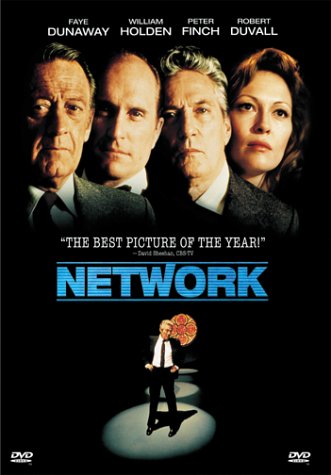 of the television news business. The film was nominated for 10 Oscars, winning four (three of them for actors Peter Finch, awarded posthumously, Faye Dunaway, and Beatrice Straight). Not only did the film create a national catchphrase ("I'm mad as hell, and I'm not going to take it anymore"), it provided what turned out to be a prescient view of television's future. Take a look at the movie today, and the rants of Howard Beale, and the turning of a news program into a vehicle ripe with personal commentary, so closely resemble the shows found on Fox News, that it's pretty eerie.
  (Really, is that Peter Finch in the above pic, or Glen Beck?) It's said that Sidney Lumet is the finest director never to win an
  Oscar, and though he was awarded an honorary trophy in 2005, he remained disturbed that he had never won in competition. He was nominated four times, for 12 Angry Men, Dog Day Afternoon, Network, and The Verdict. Lumet delivered his final film, Before the Devil Knows You're Dead, in 2007. He died last week at the age of 86.


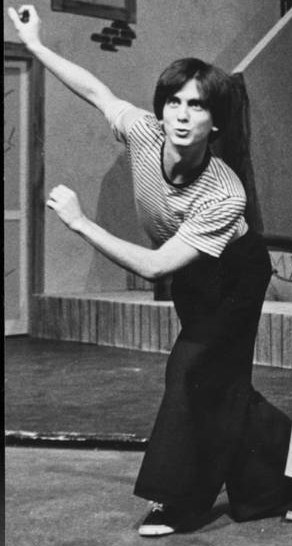
 But back in 1980, McCrane looked like this:
  I wrote
 The show was one of the biggest flops of the decade, and TV Guide includes it as one of the top ten worst television programs in the history of TV. See what happens when you force dramatic actors to sing and dance?


 Everybody remembers the year 330, right? AD, of course. The Emperor Constantine, the first


 Many theatres try to minimize the effect of missing actors by employing swings. These are



,+Olney+Theatre+Center,+2004.jpg)


,+Shakespeare+Theatre+Company,.jpg)

,+Warehouse+Theatre,+1999.jpg)
,+Are.jpg)
,+Everyman+Theatre,2002.jpg)
,+First+Nationa.jpg)
,+Shakespeare+Theatre+Company,.jpg)


,+Granada+Th.jpg)
,+Globe+Playhouse,.jpg)
,+Valley+College,+1975.BMP)
,+CSUN,+1976.jpg)