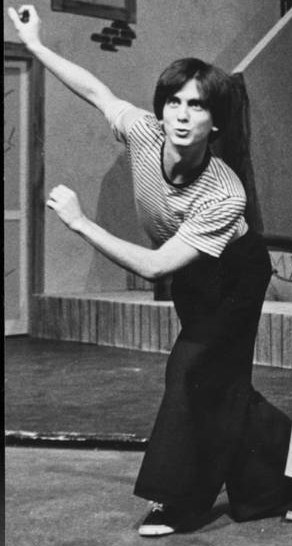
April 2, 1956 - September 17, 2010
The elder statesman of the daytime soaps will have its plug pulled tomorrow, after a 54 year run. It became the longest running fictional program on television after its sister soap, Guiding  Light, left the air last year (I wrote about that demise here). It is the last survivor of the Proctor and Gamble Company, which was once the premier provider of daytime drama, having given the genre its name and having
  produced more than 20 series, but which has systematically divested itself of its productions over the past decade and more. Well, who could blame them? It costs about 50 million dollars a year to produce a one-hour daytime soap, with no rerun or DVD sales potential to offset costs; a game show or talk show is budgeted at half that amount. The soaps have seen a steady decline of their audiences for decades, beginning with the movement of housewives out of the home and
  into the workforce. It's also thought that the audience erosion was hastened by, believe it or not, the O.J. Simpson trial in the early 90s. The
 trial was carried live by all the broadcast networks and preempted daytime programming for weeks on end. Once the trial was over, the viewers never returned to their old viewing habits.
 But back to As The World Turns, or ATWT, as we soap scum call it. The series was widely considered the most old-fashioned of the current soaps, and with some reason. It made its reputation during the period when all the daytime dramas were filled with endless talk and very
 little action, with melodrama-soaked organ music, and actors who were far from starry. But ATWT deserves some respect, and it's going to get some in these pages.


The show can claim a number of important firsts, beginning with its debut on April 2, 1956. It  was the first soap opera to run a full 30 minutes, beating another P&G production, The Edge of Night, to the punch; the latter show also ran 30 minutes, but premiered 3 hours later, the same afternoon. Why is any of this important? Well, at the time, the daytime dramas were all
  patterned after the radio soaps, and ran only 15 minutes. The doubling of airtime meant that the stories told on these programs could involve a greater number of characters, rather than the single, usually heroic character around which the earlier, 15 minute shows revolved.
ATWT was a ratings grabber, and within 2 years, had risen to the top of a very crowded field. It remained the #1 soap opera for a whopping 20 years, a record which has since been broken by The Young and the Restless. But considering the sheer numbers of viewers who were watching
  soap operas during the 60s and 70s, as opposed to the smaller numbers during the 80s and 90s, ATWT must be considered the most watched soap of all time. The show was so successful that, in 1965, it created a prime-time spinoff series, Our Private World, the only daytime soap in history to do so.

At the center of that short-lived evening soap was Eileen Fulton's performance as Lisa Miller Hughes, a character which was also a trend-setter. (She is on the right in the above picture; the
 woman on the left is Geraldine Fitzgerald). Eileen's role was the first "supervixen," a man-hungry homewrecker who would stop at nothing to achieve her goals. That archetype created by ATWT is the antecedent to Dynasty's Alexis Carrington and All My Children's Erica Kane, and a host of other rich bitches. Fulton has played the iconic role for 50 years.
In 1988, ATWT defied its conservative reputation by presenting the first gay male character in daytime.

The writers were pretty brave to introduce Hank Elliot as a fashion designer whose off-screen lover was dying of AIDS. Other soaps were addressing the AIDS crisis by giving the
 disease to a heterosexual (usually a woman), so ATWT should be commended for their attempts to depict the disease in more realistic terms (at least as they were observed in the 1980s). The show also tackled the issues of rape and Alzheimer's in a pretty brutal fashion. ATWT can be credited with the first gay male kiss, the result of allowing one of their legacy characters to be revealed as gay (a legacy character is one which has
  substantial history on the show's canvas; in this case, the gay teen in question was a character who had grown up on the series, and was part of one of the show's core families).
 As most soaps can boast, ATWT provided a training ground and a launching pad for a host of well-known stars. Meg Ryan spent three years on the show in the early 80s, an experience she has expunged from her resume. But Julianne Moore, who spent the late 80s playing twins on the show (and winning an Emmy for her efforts), is so proud of her association with ATWT that she
  made a one-day return to the show this spring. Martin Sheen spent five years with the soap in
  the late 60s, and Richard Thomas, Parker Posey, James Earl Jones, Marisa Tomei, Ming-Na, Lea Solanga, Mary McDonnell, Thomas Gibson, Dana Delaney, Jason Biggs, Tamara Tunie, Steven Webber, James Van Der Beek, and Courtney Cox all spent time in ATWT's Oakdale.

Perhaps a more impressive item, though, is the woman who remained with the show throughout its 54 year run. I wrote about actress Helen Wagner when she died a few months ago; she achieved a spot in the Guinness Book of World Records as having played the same role longer than any other performer in television history. She uttered the first words spoken on ATWT ("good morning, dear"), and she was performing live on the show when Walter Cronkite cut into the program to announce the assassination of JFK.


It was a tragedy that her death came so close to the ending of ATWT, as the plan was to have her character, matriarch Nancy Hughes, utter the final words of the series.
As The World Turns is going out with a little bit of glory. Though its final episode will air tomorrow, production actually ceased months ago, on Wednesday, June 23rd. Four days after
 the final scenes were shot, and the sets were dismantled, and the show was officially history, the cast of ATWT swept the Daytime Emmys, winning HALF of the drama performance awards. Obviously, the show was not cancelled for artistic reasons. At the Emmys, there was a very brief salute to the show, but because production had ceased, Proctor & Gamble did not foot the bill to fly their full cast and crew to Vegas to attend the ceremony. As far as they were concerned, this 54-year chapter of their corporate life was over.
The final Emmy tally for As The World Turns can not yet be counted. The past several months of the show will be eligible for Emmy consideration at next year's awards, and it's entirely possible that, though the show will have been long gone, the dynamic writing, directing, and acting the company has delivered in its final months will be recognized with more awards. I would not be surprised if one of those nominations will be for Outstanding Achievement in Art Direction/Set Decoration/Scenic Design, as the production designer for the series (the guy
 responsible for the "look" of the show) is my college buddy Pat Howe. Pat joined ATWT in time to be nominated for the Emmy in 2000, and has been nominated every year but one ever since (hey Patrick, what did you do wrong in 2003?). He has won the Emmy six out of the past 10 years, a spectacular achievement which, I hope, leads him to bigger and better gigs.
If you've made it this far, you must be wondering what kind of lunatic goes on and on about a soap opera. Well, you're kind of right. But I have an emotional attachment to this particular show which can be traced back to my mother's womb.
My mother was a life-long soap-opera hater; though
 she spent most of her adult life as a housewife (oops, I mean "domestic engineer"), the last thing she would ever want to do was spend time during the day watching these silly programs. When I became aware of soap operas, in my teens, she would roll her eyes and wonder how an otherwise intelligent kid could be so interested in such claptrap.
But she confessed to me that, for three months, she was a regular viewer of As The World Turns. In April of 1956, she had a toddler at home and a baby on the way, and back
 then, pregnant ladies were not expected to do much. So, in the later months of her pregnancy, she turned on the TV out of boredom, and watched As The World Turns during its first months on the air. She may even have witnessed Helen Wagner's early morning greeting on the very first episode. In July, once I was born, she flicked off the TV and, figuratively speaking, never turned it on again. But maybe that introduction to soap operas in utero is one of the reasons I will be mourning the death of As The World Turns. Its final episode, #13,858, airs tomorrow.






 1914-2010




,+Olney+Theatre+Center,+2004.jpg)


,+Shakespeare+Theatre+Company,.jpg)

,+Warehouse+Theatre,+1999.jpg)
,+Are.jpg)
,+Everyman+Theatre,2002.jpg)
,+First+Nationa.jpg)
,+Shakespeare+Theatre+Company,.jpg)


,+Granada+Th.jpg)
,+Globe+Playhouse,.jpg)
,+Valley+College,+1975.BMP)
,+CSUN,+1976.jpg)