Friday, April 2, 2010

Friday Dance Party: 53 years and 10 Minutes Ago


There are probably a couple of reasons I have never appeared in a musical by Rodgers and Hammerstein. The legendary team wrote quite a few musicals, but very few roles for a character actor like me. I would probably not turn down a role in one of their chestnuts, but it's unlikely I would ever fall in love with one. They are just too sugary sweet for my tastes.

The show from which the clip below is lifted has been seen by more than any other R&H collaboration, for the simple reason that it was written for, and originally broadcast on, television. In TVs early decades, all the Broadway stage composers wrote for the medium. Cole Porter did it with Aladdin (in fact, it was his final work), and placed Sal Mineo in the lead (Sal, by the way, appeared in one of the creepiest Dance Parties I've offered, check it out). Bock & Harnick did it with Oscar Wilde's The Canterville Ghost, Comden & Green did it with I'm Getting Married, and Jule Styne and Sammy Cahn did it more than once. Bacharach & David wrote On The Flip Side for pop star Ricky Nelson, and Barry Manilow turned his story song Copacabana into a vehicle for himself. Even Sondheim got into the act, with Evening Primrose, starring that musical theatre legend Anthony Perkins.

You've probably never run across most of those, but the show provided by Rodgers and Hammerstein is fully remembered, Cinderella.


After its initial broadcast, the team adapted the piece for the stage, where it is a perennial among high schools and amateur groups. It is the most saccharine of all their shows, and I find it hard to get through, but the original production, written for Julie Andrews and broadcast in 1957, is available on DVD and deserves a look (Andrews is a return visitor to the Friday Dance Party: here she is with Gene Kelly, and here with Mary Tyler Moore). The clip below features Andrews, natch, and her co-star Jon Cypher, who would go on to have a career as a character actor. You'll also glimpse Broadway stars Kaye Ballard and Alice Ghostly as the step-sisters, and the husband-and-wife team of Dorothy Stickney and Howard Lindsay as the royals (Edie Adams is not seen here, but appeared as the fairy godmother). The show has been remade a couple of times for television, notably with Leslie Ann Warren and Celeste Holm in the mid-60s.

I find the following clip interesting as it illustrates a pretty smart solution to a huge logistical problem director Ralph Nelson had. He had to squeeze 56 performers, 33 musicians, 80 crew members, 100 costumes, and four huge color TV cameras into a studio measuring 4200 square feet. His solution was to build high. Watch this clip with an eye to the stairs, as Nelson had his actors entering and exiting vertically, rather than horizontally. It gives the illusion of much more space than the production actually had.


Cinderella was broadcast live 53 years ago this week, on March 31, 1957, and though it was in color, the only print which survives is this black and white kinescope. It was estimated that 117 million people watched the show, making it, up to that time, the largest audience for any event of any kind in the history of the planet. Rodgers himself put it into perspective when he deduced that, had the show been presented onstage in a Broadway theatre, and filled 8 shows a week, it would take 140 years to match the original telecast's audience.

Musicals written for television have had a hard time in recent decades, with the exception of the High School Musical franchise Disney has created. Those shows have been adapted and are playing on stages all over the place. But I have doubts that those pieces will still be produced 53 years from now; Cinderella probably will be.

Thursday, April 1, 2010

Theatre Droppings: From the Piazza to Skid Row


As usual, I am still reeling a bit from the closing of my recent show, but I bet I'll address that later. Here's one thing the demise of Lord Arthur Savile's Crime has done: though it's been months since I have had the time (or the inclination) to see what other theatres in town have been up to, I now have the time (and inclination) to do just that.

Arena Stage has been floating around town for the past several years while their home campus gets an Extreme Makeover. I caught their holiday offering of The Fantasticks at the Lincoln Theatre, and quite a while ago, I was mesmerized by Next to Normal, on its way to Broadway. That latter musical was staged in a converted movie house in Crystal City, which is where I saw Arena's current offering, The Light in the Piazza. This is surely a chamber musical staging (I have a feeling that the original production at Lincoln Center was bigger), and is compromised a bit by the flat, static set, consisting of a couple of archways, a stairway, some movable columns, and a Gothic set piece which is immovable and inhibiting. Thematically, the show depends on the dramatic beauty of Florence (and Rome, too), none of which we can visualize with the hulking backdrop Arena's designer has provided. The Crystal City space is not ideal for the show, but I think an open, airy stage and some visually interesting lighting effects would have been a better conduit for this very romantic story.

I was curious about The Light in the Piazza, as a New York friend saw the original production and proclaimed it "boring." Based on Arena's offering, I would disagree. The cast is very good, headed by a bunch of New York actors (no surprise there) who are all top-notch.

The local talent which comprised the ensemble was not used to their best ability, in my humble opinion, but of course, I am prejudiced toward local talent. In particular, Tom Simpson (with whom I worked in Man of La Mancha at Wayside last year) and Michael Sazonov (whom I admired greatly in One Flew Over the Cuckoo's Nest at Round House last season, and whose name, sadly, is misspelled in the cast list) were greatly underused.

And I freely admit to being an uneducated listener when it comes to music. The score by Adam Guettel, Richard Rodgers's grandson, has some pretty lush moments, and the small orchestra (perched atop the battlement walls, or so it seems), provides great accompaniment. I am not a fan of recitative, which occasionally rears its operatic head in the show, but the stand-alone ballads are gorgeous, delivered by great voices. The eleven o'clock number, "Love to Me," sung by Nicholas Rodriguez's young Italian, is a showstopper.


I also popped out to Ford's Theatre to see their current show, Little Shop of Horrors. I have a hunch this particular title was chosen more for its commercial value than for its position as an American classic. But the show is always fun, and this production showcases some terrific local talent, including my grad school buddy Elliot Dash. He voices the plant, Audrey Two, but in a very nice staging twist, he is placed above the stage, where he sits in a spooky green light. The show, in cast you forgot, concerns an invasion from outer space, so why not assume that the blood sucking plant at the center of the action is the leader of the aliens?

I saw a noon matinee of this show, which is a tricky time for singers who are required to belt scores such as that of Little Shop. The trio of ladies who provide backup and critique throughout the show are all rooftop raisers, I'm sure I've seen all three individually take the ceiling off various theatres.


The gal playing the leading role, Jenna Coker-Jones, is a dynamo. She is entrusted with the only two ballads in the piece, and she delivers them with such style that they are the musical highlights. (And the guy sitting in my chair, ie: me, NEVER thinks ballads are the highlights of musical productions.)


This is a swell production of Little Shop of Horrors; I hope it makes buttloads of money for Ford's.

Tuesday, March 30, 2010

"Smile, Baby"

She was on the vaudeville stage by the age of two, and appeared in several silent film shorts before she could talk; if she was required to cry on camera, it's reported that her mother told her the dog had died. Though she created a solid acting career on stage and film during her adult years, a fictionalized account of her childhood overshadowed her actual accomplishments.

June Havoc

1912 (or 1913)-2010

She never really knew how old she was, as her mother carried five different birth certificates with five different birth dates, in order to satisfy child labor laws. During her early life in vaudeville, she was bringing in a whopping $1500 a week, a fact overlooked in her sister's memoir which became the basis for the musical which is most closely linked to her public identity. If you are a musical theatre fan, these facts are starting to sound familiar. She first hit the stage as Baby June, graduated to Dainty June, then, at the age of 13 or so, abandoned her domineering mother and a sister she later called "beautiful and clever...and ruthless," eloping with chorus boy Bobby Reed.

This is the plot of the first act of Gypsy, and it haunted Havoc throughout her career. She remained bitter that the musical based on the memoir of her sister, burlesque star Gypsy Rose Lee, left the impression that sister June sank into obscurity after taking off with that dancing boy ("Tulsa" in the musical). In fact, though her teen years were spent in poverty (she and her young husband entered dance marathons in order to share in the free meals afforded the contestants), she eventually carved out a stage career which included the original production of Pal Joey, and a film career which included costarring with Gregory Peck in Gentlemen's Agreement. She was a playwright and director as well as an actress, winning a Tony nomination for directing Julie Harris in her own play Marathon '33, at a time (1963) when female stage directors were few and far between.

Major Broadway appearances included her portrayal of Miss Hannigan late in the run of the original Annie, and an acclaimed performance in the 1975 sex farce Habeas Corpus (I actually saw that production, and wrote about it here). She replaced Ethel Merman in the original production of Panama Hattie, and decades later, headlined the second national tour of Sweeney Todd.


Here's a quickie clip of Havoc's work on an original musical called Happy Birthday Aunt Sarah, which ran on the Omnibus series during the early days of television. I remember seeing her sister Gypsy Rose Lee (at right) on various talk and game shows during my childhood; there is an undeniable family resemblance. This clip confirms that Gypsy's Baby June grew into a performer of charm and comic talent:


In 2003, a small Off-Off-Broadway space was christened the June Havoc Theatre; her final performances were in 1990 on the daytime soap General Hospital. She died a few days ago, at the approximate age of 97.

Saturday, March 27, 2010

Bob & Fess & Mack the Knife


I'm sensing a Soviet plot. I hope those Men From U.N.C.L.E., Robert Vaughn and David McCallum, are keeping a lookout for dangerous situations, since our TV spies are dropping like flies. On the heels of the death of Peter Graves, whose best known role was in the espionage thriller Mission: Impossible, comes word of the death of another television spy:


Robert Culp

1930-2010


He had headlined an earlier TV series in the 50s called Trackdown, but his co-starring role in the mid-60s show I Spy made him a household name. The series was unusual for several reasons, as it mixed a sly wit with the action common in the espionage genre of the period. More importantly, the show introduced one of television's first dramatic lead characters of color, played by Bill Cosby. The chemistry between the two stars was palpable, and though it was Cosby who won Emmys every year of the series, the duo stood side-by-side in the Civil Rights movement of the period.

Culp also broke new ground in Paul Mazursky's first film, Bob & Ted & Carol & Alice, a spoof of the sexual revolution of the late 60s (it's about wife-swapping; that's Elliot Gould, Natalie Wood, and Dyan Cannon sharing the bedtime).


Culp returned to his "spy" roots in the 80s, when he costarred as an FBI agent in the light-hearted fantasy series The Greatest American Hero.

He was apparently a recurring regular on Everybody Loves Raymond, but as I didn't (love Raymond), I never saw his sitcom work. He died the other day as a result of a fall at the age of 79.


Another television star of the mid-60s recently died:

Fess Parker


1924-2010


Parker's appearance as two iconic American heroes overshadowed anything else he attempted in his acting career. In the mid-50s, Fess was a contract player for Warner Brothers, and appeared in a single scene of the horror flick Them!. Walt Disney viewed the film with an eye to cast star James Arness in the role of Davy Crockett for a three-episode television event. Instead, he chose the little-known Parker to play the frontiersman, congressman, and Alamo martyr. No one knew it at the time, but with Davy Crockett, Disney had invented the mini-series; he was more excited about the explosive interest in coonskin caps, lunchpails, and moccasins which the show ignited. (It's said the price of raccoon fur shot up from 25 cents a pound to over 8 dollars thanks to the Davy Crockett Craze.)


Uncle Walt placed Fess under contract, and gave him one of his most memorable film roles in Old Yeller, among other features. In the mid-60s, Disney created a television series around the legends of Daniel Boone, with Parker in the title role. The show lasted six years; Parker later retired from acting (after turning down the role of McCloud). He spent his subsequent years running a wine resort.

Here's a guy I never heard of until his death, but his contribution to the theatre should not be overlooked.

Carmen Capalbo


1925-2010


In 1952, he was a brash young man in his 20s when he attended a concert presentation, directed by Leonard Bernstein, of the Kurt Weill classic The Threepenny Opera. The show had already had an English language production in the early 30s, but with a new adaptation by Marc Blitzstein, Capalbo was determined to reintroduce it to New York. He persuaded Kurt Weill's widow, Lotte Lenya, to reprise the role of Jenny, which she originated in the 1928 Berlin premiere, and opened a new production at the Theatre de Lys (now the Lucille Lortell) in Greenwich Village in 1954. The show was a smash, but was forced to close to make room for an incoming production.


A campaign to reopen the show resulted in Threepenny Opera returning to Off-Broadway in September, 1956, where it set the record as the longest running musical in New York (it kept that record until The Fantasticks surpassed it in 1966). The Tony Award committee broke with its own rules when, in 1956, it awarded the Tony for best supporting actress in a musical to Lenya's Off-Broadway performance; a special Tony went to the production itself.

This Off-Broadway revival remains the pivotal English language production of the show, and included in its opening night cast Bea Arthur (barely recognizable at right), John Astin, and Charlotte Rae, as well as the legendary Lenya. Capalbo directed several pieces uptown on Broadway, including the original production of Moon for the Misbegotten, but he will best be remembered as the man who put Off-Broadway on the map, while bringing a musical theatre classic to the attention of the western world.

Friday, March 26, 2010

Friday Dance Party: Still In Business


I am not alone in thinking Stephen Sondheim is the greatest American composer/lyricist ever to work in musical theatre. Just check out the folks at Roundabout Theatre Company, who just renamed one of their Broadway spaces The Stephen Sondheim Theatre. Sorry Henry Miller fans, the theatre which used to carry his name now belongs to the Tony- and Oscar-winning Steve.
Sondheim is, these days, late in his career, but his work is still being showcased all over the place. On Broadway, for example, as I write this, the acclaimed revival of West Side Story, for which he contributed lyrics way back in the 50s, is still going strong after a year or more. The first revival of A Little Night Music is poised to swipe some Tony awards, with the star power of Catherine Zeta-Jones and Angela Lansbury keeping the houses full (this revival is the fulfillment of a wish I made a while ago). And as if that were not enough, the newest revue of Steve's work, Sondheim on Sondheim is currently in previews, with a starry cast including Barbara Cook and Vanessa Williams (I wrote about seeing the first Broadway revue of Sondheim's work, Side By Side By Sondheim, here), and a second revue called Putting it Together remained on the Great White Way as long as its star, Carol Burnett.

I was first introduced to the work of this genius in my college days, by one of the biggest Sondheimophiliacs ever, my friend Valerie. Val is a few years older than I, and headed a clique which centered around musical theatre, so I was always flattered to be included in her gatherings. At one such evening, she pulled out the cast album of the original A Little Night Music, and I was entranced. Frankly, I was so blown away that I sat in a corner the rest of the night, reading along with the lyric sheet as the album played.

I was hooked. I was soon studying the lyric sheets and cast albums of Follies and Company, and since then, am sure I have spent countless hours reveling in the Sondheim canon as it developed. I suppose I would have eventually found Sondheim on my own, but Valerie's enthusiasm for his genius was infectious. She has become one of Steve's acquaintances over the years, and with his approval, has just created a new revue of his work appropriate for teen performers, entitled Our Time. A few years ago, Val flew out to DC, and we enjoyed an out-of-town tryout of Sondheim's most recent show, Bounce. Well, at the time it was called Bounce; by the time it finally reached New York, it was called Road Show. (If you are interested, I revealed in previous pages my feelings about how Steve's work has been translated to film, and my reactions to the Company revival of several years ago.)

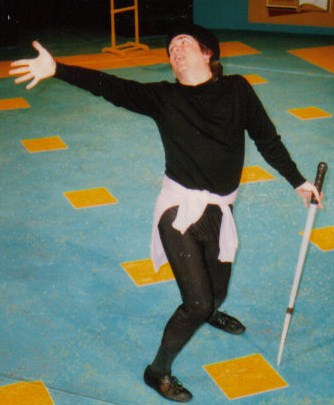
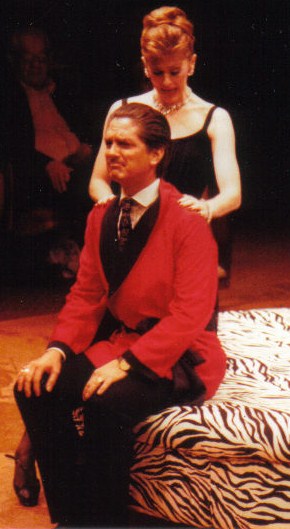
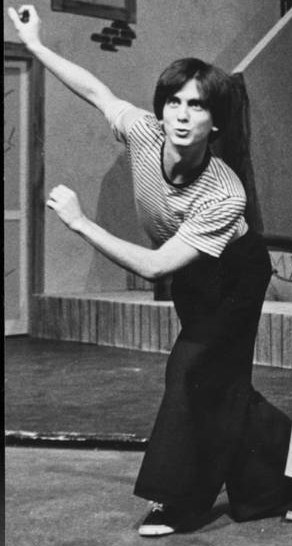
I have a full list of roles in Sondheim musicals I would like to play, but most will remain out of my vocal range. I've had a ball in the two roles I have played, in Sondheim's first Broadway appearance as both composer and lyricist, A Funny Thing Happened on the Way to the Forum. Back in the very early 80s, I played conniving slave Pseudolus in a dinner theatre venture:

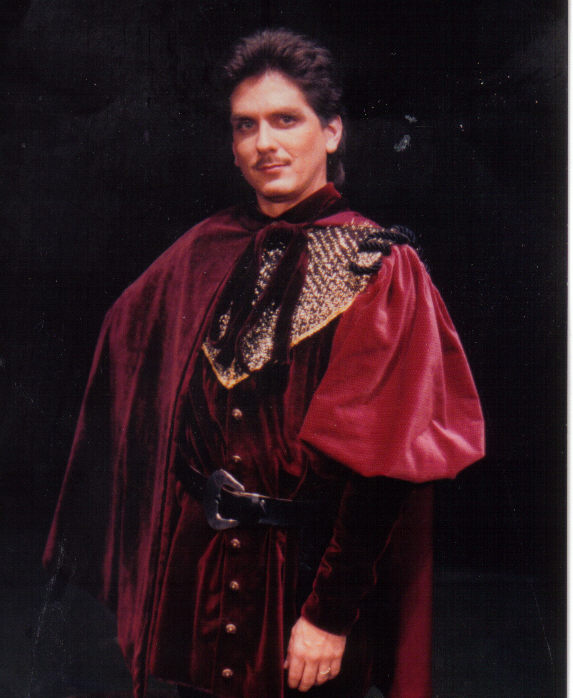
Over a decade later, I played the comic lech Senex in another production (both of which were directed by my best buddy Judy):


Have I wandered down memory lane long enough? Stephen Sondheim turned 80 years old last Monday, and a star-studded celebration was held in New York; the concert will be telecast on PBS later this spring. For this week's Dance Party, here is a clip from Steve's 75th Birthday Celebration, held in San Francisco. The song is from one of Sondheim's film scores, Dick Tracy, and was introduced to the world by Madonna, of all people (another Sondheim song from that film, Sooner or Later, won the Oscar.) Here, the song is performed by an adolescent belter named Hannah Rose Cornfeld:


Happy Birthday, Steve, and give us many more years of your genius.

Tuesday, March 23, 2010

Sunshine vs. Clouds


The week just past has been a prime example of the schizophrenic nature of the actor's life. Or at least, of THIS actor's life.

Our production of Lord Arthur Savile's Crime has continued apace, with audiences both large and small. The crowds are very much enjoying this slight, off-kilter Oscar Wilde tale of wit and murder. This week, we welcomed a new cast member, the lovely and talented Sunshine Capelletti, whose parents must surely have been hippies. I worked with Sunshine many times in the past several years, in staged readings, where we almost always played husband and wife, or brother and sister. She is a terrifically talented young woman, and she is the perfect choice to replace our original ingenue, Tricia McCauley, who had to leave the show due to a prior engagement.

After a gracious little amount of actual rehearsal, Sunshine stepped into the breach (and the breeches, as one of her roles is a man), and our shows have continued to gain a following. I have found a real affection for the two roles I play in the show, and an even greater affection for the folks with whom I am sharing the stage. I will be very sad when the show comes to its conclusion next week.


But for now, our shows have been greeted with enthusiasm and laughter from our audiences. It's been quite a good week, Stage Guild-wise.


But, as almost always happens in my professional life, where there is success, there is also failure. And I had my share of that this week as well. I was up for two shows this week, losing one because of stale fish, and the other because I have a penis.

Fords Theatre ("But otherwise, Mrs. Lincoln, how did you enjoy the play?" Yes, that Fords Theatre) had called me in twice for a new musical they are producing next year. I was frankly surprised to get the second callback, as the auditors did not express much enthusiasm during my first. But that just proves that one never knows, do one? I was very pleased to get the second callback, and worked quite a while on the four scenes and three songs they sent me to prepare. On the day of my callback, illness struck, and I just could not get out of bed any longer than to send an email apologizing for my missing the audition. That email was not picked up before my appointment time, so I received a series of messages and emails from the casting intern and the musical accompanist, wondering where the hell I was. Well, I was flat on my back in bed, trying not to expel any more noxious bodily fluids.

Once my situation was known to them, the folks at Fords were very sympathetic, but they had a show to cast, dammit, and apparently that show had to be cast that very day (opening night for this show is March 30, 2011. That's not a misprint; they were desperate to cast this show which will open to the public more than a year from now).

Well, what can you do? Point out to them that, with rehearsals starting 11 months in the future, perhaps their sense of urgency was premature? I had much higher hopes for a summer stock gig which turned from a good possibility to a sure bet to a complete gender reversal, in the course of about a week. I was invited to attend a private callback for this one (no one else was there, just yours truly), and spent half an hour having a ball with the director, my buddy Ray. I sang, read a speech or two, and talked about the logistics of putting this oddball little musical satire onstage. When I left, I felt I had delivered my best audition in a number of years.

I was pretty crestfallen, then, when the call came six days later, telling me I was not, in fact, going to be playing this aggressive theatrical agent in Ruthless, the Musical. They were going a different way, a euphemism often used to dismiss an actor. But Totem Pole Playhouse wasn't kidding; they really WERE going in a different direction: they were hiring a woman.


I suppose the role is sometimes played by an actress, since the character is in fact a female. It was originally written for, and played by, a man. What's more fun than a man in a dress?


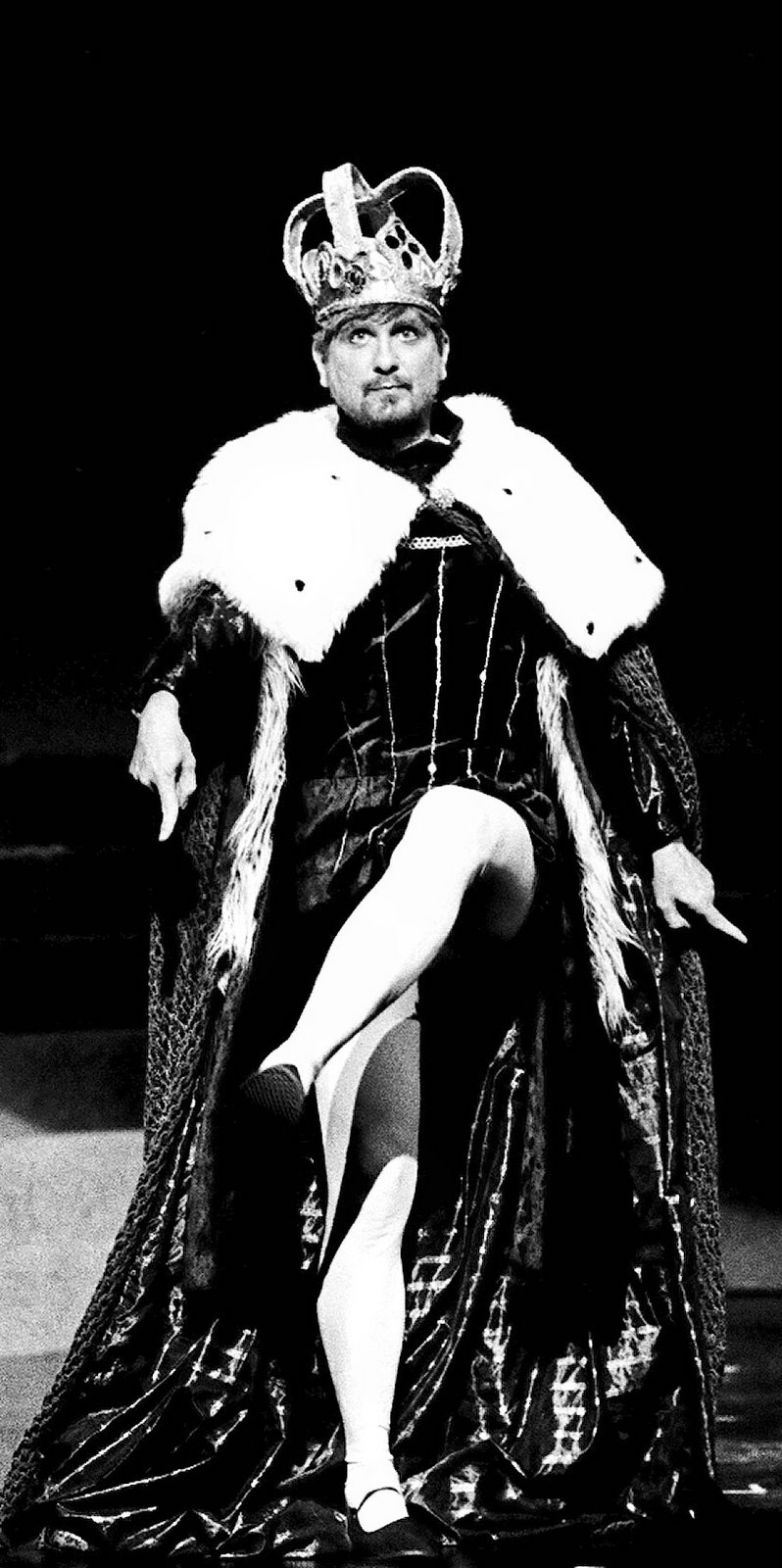
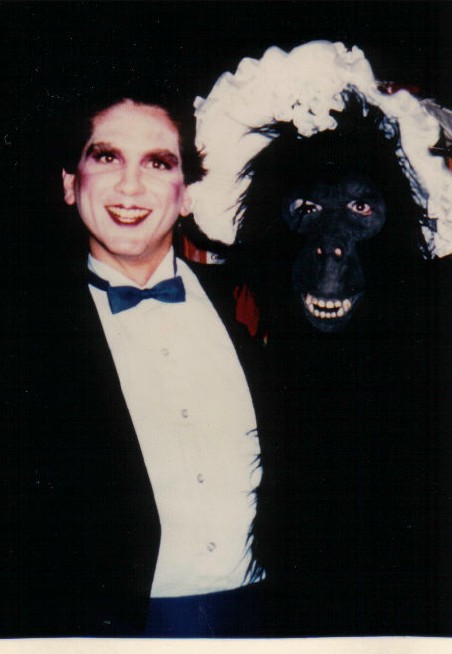
I have only played a few drag roles in my career, and I looked pretty gruesome in all of them. Perhaps a picture such as this one surfaced, and Totem Pole thought such a vision would frighten their audiences. Who knows?

So, after Sunday's matinee of Lord Arthur Savile's Crime, I return to the place where we performers spend so much of our time: on the dole.