Tuesday, June 9, 2009

The Kookie, Quirky Carradines

David Carradine:
1936-2009

By now, everybody in the world is buzzing over the provocative death of David Carradine. I don't begin to understand such things, being the naive innocent that I am. I do wonder why Carradine, if he indeed was...um...pleasuring himself with asphyxiation, was found in the closet. Is that part of the fantasy? Well, we may never know, though the Carradine family has apparently requested FBI intervention to sort out the mess in Bangkok.


I confess that I was not a big fan of David's, I suppose because I had no interest in his role in Kung Fu, which made him into a martial arts icon. His earlier breakout performance was in Bound for Glory, a bio-pic about folk singer Arlo Guthrie, which I also have not seen. But I have no doubt he was a fine actor, if for no other reason that it was in his genes.


The Carradine clan must be Hollywood's largest acting dynasty, beating the Baldwins, the Bridges, the Arquettes, and the Fondas. Patriarch John Carradine was surely the most prolific of the family, appearing in hundreds of films and television shows during his long career.


If he is remembered at all these days, it is as a regular player in lower budgeted films of the western and horror genre. His gaunt face and deep basso voice kept him employed for 60 years or more. John Ford used him frequently, and he created the role of the disillusioned preacher in the classic Grapes of Wrath:

John was an experienced stage actor, and led his own Shakespearean troop for many years. He has a fond place in my heart for his stint in the original production of one of my favorite musicals, A Funny Thing Happened on the Way to the Forum, in which he created the role of the procurer Marcus Lycus (he's on the far left).

John married multiple times, and sired four sons, three of whom (David, Keith, and Robert) became actors (he adopted a fifth son, Bruce, who is also a performer).


Middle son Keith Carradine is well-known for his appearances in several Robert Altman films, including Nashville, in which he sang his own composition, "I'm Easy." He won the songwriting Oscar for the tune. (Keith will be starring in this week's Friday Dance Party in these pages...aren't you trembling in anticipation?)


Robert Carradine is fairly well-known these days for having played Hillary Duff's father on the Disney series Lizzie McGuire. In his earlier career, he was a regular in the Revenge of the Nerds film series, and appeared with his siblings David and Keith as the Younger Brothers in The Long Riders.


The third generation of Carradines is headed by Keith's daughter Martha Plimpton, who was conceived while her parents appeared together in the original Broadway production of Hair. Ah, free love! Plimpton has had a long career in film and onstage, including a starring role in a John Waters movie which is near and dear to my heart, Pecker. (I'm in it, but did not work with Martha.) She is known to a whole generation of movie-goers as Stef Steinbrenner in the smash Goonies; she was often cast as the tomboyish, troubled teenager in such films as Steve Martin's Parenthood and Running on Empty, in which she appeared with her boyfriend River Phoenix. (She dumped him over his repeated drug abuse; he later died from an overdose.) Plimpton appears regularly onstage, and recently won three back-to-back Tony nominations for her work in Coast of Utopia, Top Girls, and Pal Joey.


Other members of the third generation of acting Carradines include Robert's daughter Ever, and David's daughters Calista and Kansas. Yes, these people actually named their children "Ever" and "Kansas." David even named his son, by actress Barbara Hershey, "Free." (That travesty has since been rectified: Free Carradine changed his name to "Tom").
There are other Carradines floating about, including Christopher, one of the original half-brothers, who became an architect and worked with Disney Imagineering, and Michael Bowen, another half-brother who has a recurring role on Lost. But my favorite member of the family remains Keith, probably because I caught one of his stage performances years ago. You wouldn't think anyone could be such a smooth dancer sitting down, but Keith accomplished the feat. Check back on Friday for the Dance Party, and you'll see why I think of him as the least odd of the oddball Carradines...

Kenny Rankin

1940-2009


In a career spanning four decades, Rankin was a well-regarded singer and songwriter. Though he had already released several singles, he was first noticed as a lead guitarist on Bob Dylan's landmark album "Bringin' It All Back Home" in the 60s. Appearances on The Tonight Show boosted his profile, and he became one of Johnny Carson's favorite musical guests (Carson contributed liner notes to Rankin's "Mind Dusters" album).


His hits included "Spanish Harlem," "Round Midnight" and "Peaceful." His smooth guitar skills were so evident on his cover of The Beatles' hit "Blackbird" that Paul McCartney requested he play the tune when he and John Lennon were inducted into the Songwriters Hall of Fame. His own compositions were recorded by Peggy Lee, Carmen McRea and Mel Torme, among others. Rankin was a long-time supporter of WeSpark, an organization created by my late friend Wendy Jo Sperber as a support center for cancer patients.
Here is a typically smooth performance of a soul-comforting tune:
Kenny Rankin died Sunday from lung cancer. He was 69.

Monday, June 8, 2009

Shape Shifting

I'm not a sci-fi geek, but I have long heard of "shape-shifters," who are supernatural beings able to morph from one form to another at will. I wonder, though, if there is a term for a person who causes shape-shifting to occur? If so, the names "Warner Crocker" and "Steve Przybylski" would be mentioned in the Wikipedia entry describing the term.


Last week, we began our third and final week of rehearsal for Man of La Mancha. We were a mess. Well, that's probably putting it too dramatically; we weren't a MESS, exactly, but we were clearly under-rehearsed and headed toward opening a merely serviceable production of this classic show. We were running out of time. Outside variables (such as sharing Warner and Steve for two weeks, a subject about which I refuse to shut up) added to the intrinsic difficulty of putting such a huge show onto the compact stage at Wayside. Progress at the beginning of the week was hampered by a number of things, including the necessity of re-staging much of the combat and dance movement which had been choreographed the previous week. Those earlier rehearsals were unfortunately conducted without the benefit of music, either live or on tape, so the synchronization of the music to the movement stalled the progress Warner had hoped we would be making. (He writes about the panic in the eyes of the actors here.)


Wayside has always had a limited rehearsal period, and who hasn't? I'm reminded of a tale I heard in grad school, of a production of Hamlet being directed by Stanislavsky at the Moscow Art Theatre. He rehearsed the damn thing for a solid year. On opening night, someone asked his opinion of the show. He replied, "If we only had two more weeks..."


So, the early part of the week had its share of stress. The lovely and talented Vaughn Irving was feeling a lot of it, as he choreographed all the fight and dance movement in the show, despite declaring over and over, "I'm not a choreographer." Sorry, Vaughn, yes you are. Get used to it.


Vaughn is one of the many success stories to come out of the Wayside Theatre intern program. He was an intern the year I first appeared at Wayside in Black Coffee, and since then has returned many times to its stage. He is a fine young actor (with a booming voice perfect for his role as The Captain, where he summons Cervantes to be questioned by the Spanish Inquisition), and is also a skilled and versatile musician (he spends most of our show in Pitland, playing a variety of percussive instruments). Vaughn's choreography for the show is both hilarious and harrowing, and includes a comic combat sequence, a gypsy dance, a stylized number with mirrored shields, and a frightening rape ballet.


Oh, and horses who hoof. The first big number of La Mancha comes after a lengthy dramatic scene which opens the play, and in a startling bit of stagecraft, Vaughn, Warner, and Steve (our musical muse) created a moment which brought spontaneous applause from the full theatre on opening night. Yes, after a rocky start early in the week, Warner and Steve, our "shape-shifters," did not surrender; with a positive and optimistic outlook, they pressed onward, and the week ended with two solid preview performances on Saturday (I'll relate the story of my huge gaffe during the first preview in a future entry...believe me, it's worth waiting for...).


The final proof that our show had shape-shifted from a tame production of a creaky chestnut into a dynamic illustration of the power of Live Theatre came on Sunday's opening night. As Cervantes and his manservant mounted those prancing actors wearing horse heads, and became Don Quixote and Sancho Panza, Defenders of the Right, our opening night audience exploded.


It's one of the most memorable moments I have ever experienced onstage.

David Marks


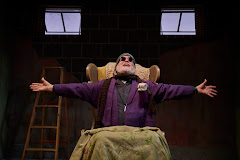
The DC theatrical community lost one of its leading comic players last week, with the fatal heart attack of David Marks on June 3. David was a 1987 graduate of NYU's prestigious acting program, and was a company member at Arena Stage for 11 years. He earned five Helen Hayes nominations and won the award in 1990 for Briar Patch at Arena. He was a regular player all over town, and excelled at boisterous, over-the-top characters such as in Olney's The Rivals (at top) and the Folger's Midsummer Night's Dream (above right). I did not know David personally, but enjoyed his performances whenever I encountered them. I particularly enjoyed his appearance as Pompey in Measure for Measure at the Folger a while back, where he held his own opposite the puppet playing Mistress Overdone (left).


David leaves behind his wife, producer/dramaturg Garland Scott, and son Harris.

Friday, June 5, 2009

Friday Dance Party: The (Asian-) American Dream

The star of this week's Dance Party was at the center of a major casting controversy in 1990.


Broadway of the 1980s was dominated by British imports, all of which were produced by Cameron Mackintosh. He provided the original productions of Cats, Phantom of the Opera, and Les Miserables, among others. When his West End production of Miss Saigon was ready to leap the pond, he ran into some trouble.


The male lead in Miss Saigon is a pimp called "The Engineer," who acts as a narrator, commentator, and occasional participant, to the story. (If Kander and Ebb had written the show, Joel Grey would have played the role.) In the West End, Jonathan Pryce played the part, and Mackintosh had every intention of importing the actor to recreate the role for Broadway. "The Engineer" is described as a Eurasian, a man of both French and Vietnamese heritage, and American Equity, under pressure from the Asian-American acting community, refused permission for the Caucasian Pryce to appear. With some justification, they felt the role should go to an Asian actor.


Mackintosh was the Darth Vader of Broadway at the time, and though Miss Saigon had the biggest advance box office sale in history, he threatened to pull the plug on the production (thus sacrificing hundreds of jobs and thousands of union work weeks). Equity relented, and Pryce opened the show in April of 1991, winning the Tony as Best Actor in a Musical. The show ran over 4,000 performances, and Pryce was succeeded by a long string of Asian-American actors.


Here is the performance of Miss Saigon at the Tony Awards, in which Jonathan Pryce gyrates, salivates, and practically masturbates. The number was apparently one of the showstoppers (I've never seen the show, as I'm afraid of helicopters), and it helped Pryce to his second Tony (he previously won for Comedians in 1977).

This year's Tony Awards are happening on Sunday, and in light of this week's bail-out of General Motors, I doubt anyone will be humping a Cadillac like Pryce did in 1991:


Jonathan Pryce turned 62 this week.

Tuesday, June 2, 2009

Missing Mrs. Muir

I woke up this morning with much on my plate. Four more rehearsals until the crowds show up in La Mancha, and though all the words, all the lyrics, and all the notes are in my brain, they are having a hell of a time getting out. In the correct order. And on time. And I have yet to seriously address my technical issues, which will consist of passing out swords, gloves, armor, hats, helmets, staffs, pots, pans, scarves, as well as moving stools, tables, buckets, and horse heads. In the correct order. And on time. While wearing a bugle.


Want to make an actor complain? Give him a job.


With rehearsal this evening, I have a full day to address some of these issues on my own. Instead, I awoke thinking about The Ghost and Mrs. Muir. Remember that show? It only lasted two seasons, back in the late 60s when primetime was peppered with a witch, a genie, and a car that was really your mother. Based on a film of the same name, it concerned a widow who moves into a haunted house. Hijinks ensued.


Except they really didn't, at least not much. Instead, the show turned into a rather tender love story between a ghost and a lady. With only a two season run, the show can't be counted a big success, but it contained a luminous performance by film star Hope Lange as Mrs. Muir. She brought a calm dignity to a show which was meant to be full of hilarious hocus-pocus; she snagged Emmy awards for both seasons.


Oh, and here's a story I love, which I'm not sure is true, but I hope it is. I've heard that Charles Nelson Reilly, who played the ghost's slimy nephew, was hired only for the pilot episode, in which he swindles the widow into renting the haunted house, site unseen. While shooting the pilot, Hope Lange alerted the writers and producers that Reilly's performance as the character was much too good to be dropped, and must make return appearances during the series. And that's what happened.


Here's the first scene of the pilot, which Reilly carries on his own. It proves Lange was right:


Two years ago last week, I wrote about Charles Nelson Reilly's death.

Monday, June 1, 2009

The Buddy Hackett Tenor


We all remember Buddy Hackett, right? The roly-poly comic was a fixture on sitcoms and late-night talk shows during the 60s, and headlined in Vegas for many years. He also appeared in a few musicals, including the film version of The Music Man (he sang a song called "Shipoopi," whatever the hell that means...) His comic trademarks were rubbery facial expressions and a spittle-spewing speech impediment, and live performances which were quite raunchy. He was never a favorite of mine, but his name has popped up regarding my gig at Wayside. When I was chatting about playing Sancho with our musical director, Steve called the role a “Buddy Hackett tenor,” and though I had never heard that term, I knew exactly what he meant.


Sancho Panza is written as a tenor, but does not, thankfully, require the pure sound of, say, Phantom of the Opera’s Raoul. Instead, it’s a character voice. The role, as written, is too high for my voice, which is much more comfy on lower baritone notes, a fact which did not seem to dissuade the Powers at Wayside from casting me. I’m glad they are taking a chance.


Our first week’s rehearsal was spent on music, and Steve proved himself to be one of those musical directors who cares more about the overall sound of the piece, and the comfort of the actors, than strictest adherence to the score. He has, quite magically, turned a huge musical into a chamber piece, with lots of guitar, bass, and exotic percussion, and the occasional clarinet and trumpet. He transformed the existing orchestrations, written for who knows how many pieces, into ones being played by only four people, and sometimes less. You would think the sound would be disappointing, but you would be wrong. The rustic, environmental sound which we are hearing from “Pitland” (which is onstage with us, as the music is being performed by the actors), suits our show far more than the larger, more Broadway-type sound normally accompanying the piece. It’s extremely exciting.


As for yours truly, I’m plugging along. In the choral numbers, Steve has wisely moved me to lower notes, and my solos are coming along, too (Sancho sings three numbers alone, and contributes to four or five more). But time is of the essence. We have been sharing director Warner and music director Steve with Totem Pole Playhouse, where they are remounting Cotton Patch Gospel ( I wrote about seeing the show last month here at Wayside). Two weeks of simultaneous rehearsals have not made it easy on anyone, and with apologies to Ray and Larry, my buddies in Gospel, I couldn’t care less how prepared their Totem Pole show is.


I want more Me of La Mancha Time.


This second week, we have been staging the musical numbers (there are more of them than you remember), and we’ll soon be heading into our final week, where, miraculously, this huge monster will come together (and during which I will be turning from sidekick into onstage prop master...tech rehearsals, for me, will be presenting another adventure in itself).


Onward.