This is the view out the picture window at the elevators
on the 29th floor of ManPlaza.
I am often to be found walking the 6 or so blocks from my digs to the Equity building, to sign up for or to attend one of the big cattle calls which the union requires of many theaters.
The other day, I was hiking up the street at about 8 AM, and passed the Broadway theatre which is presenting Newsies. There was a long line of teenagers camped out along the street outside the box office lobby. The show, I suppose, offers a certain number of student rush tickets for each performance, and the show is the Big Hit among the teen set (they must think it's brand new, as these kids in line could not have been very old when the film version was released).
I didn't take much notice of these youngsters, as I was used to the sight of a lengthy queue of teens early in the morning: when Glee's Darren Criss was in How to Succeed...(for about three weeks), the line wrapped around the corner and down another block. So, I took no notice. About half an hour later, having secured an audition slot for later in the day, I was walking back home, and took a slightly different route. I passed another Broadway theatre, where there was one lonely girl sitting outside the box office lobby. Heavyset, with glasses, reading a book, she was the first and only person waiting in line to snag a student rush ticket.
And the show the theater was hosting? The revival of The Best Man. The girl looked a little forlorn, sitting alone on the ground, with her book and her wool hat. She probably lives a lonely life in high school, in a world where everyone wants to see Newsies, and she prefers a Gore Vidal drama. I know which line I would have been in, had I been a current high school teen.
I've discovered during my time here that the belief that New Yorkers are rude is an absolute fallacy. Yes, New Yorkers are usually in a hurry, so they look pretty unapproachable on the street. But in my few months in the City, I have stopped numerous locals to ask directions. (I am notoriously ignorant regarding any kind of directions...my buddy Greg had to inform me that my apt was facing a different direction than I thought, months after I took possession).
The cruise ships which dock in Manhattan
do so a few blocks from ManPlaza.
I get completely turned around on the subway, so when I emerge from a stop, I am inevitably confused about which way is Uptown or Down. I flag down a hurrying stranger to ask, and I have always been helped with enthusiasm and kindness. In elevators, people are friendly and personable, particularly in my own building.
Each holiday brings a new lobby display at Manhattan Plaza. They are always kid-friendly and non-denominational, so the Easter display offered bunnies rather than crucifixions.
Everyone seems so happy (and lucky) to be living at Manhattan Plaza, they're all in a good mood. And you know that tradition where neighbors bring a gift of food or something to welcome you to the building/neighborhood? In my life as an adult, that has never happened, not in Granada Hills, not in Woodland Hills, not in Silverlake, not in Salt Lake City, not in Atlanta, not in South Carolina, not on Capitol Hill. I've moved a good bit in my life, and have never had a neighbor show up with a welcome gift. Until last week in New York, when a neighbor brought me homemade cookies.
Oh, and speaking of the elevator:
My building has 45 floors, and is serviced by a bank of 6 elevators. Since so few elevators service 800 apartments, you are rarely alone in one. When I hop onboard in the lobby, with several of my building mates, I can't help myself; I always check to see if anyone in the car is living on a higher floor than mine. I'm on the 29th floor, so there are only 16 floors above mine. If I am on the highest floor of anyone in the car on that ride, I win. (I don't know what I win, but I win.)
It's an involuntary, juvenile little game I play with myself whenever I am riding up the elevator. I'm sure there is something psychologically telling about the fact that I like winning that little contest, but I won't be examining that too closely. Perhaps it's a metaphor for opening this New York Branch of my life: it seems to be a winning decision most of the time, but sometimes does not.
The star of this week's Dance Party made a clean break with show business in the mid-70s, and in subsequent decades, has done a terrific job of living outside the limelight. Her reclusiveness has been so thorough, in fact, that her lengthy career in film, television, and on recordings is easily overlooked. But Doris Day was a major star of the 1950s, 60s, and 70s. She was the number one box office draw four years, and was in the top ten for ten years. Somebody crunched the numbers and, on the strength of those hits, has named her the number one female box office star of all time. I won't quibble with that math. Doris was not one of my favorites, I must admit, as I found her image a little clean-cut for my taste (a comic once quipped, "I knew Doris Day before she was a virgin"), and her style of wholesomeness went out of style in the late 60s. She famously turned down the role of Mrs. Robinson in The Graduate, for "moral reasons;" the film would have undoubtedly reignited her career.
Instead, she turned to television to pay off debts left by her husband/manager, who died without telling her he had committed her to a sitcom for CBS. The Doris Day Show ran a respectable five years, holding the timeslot preceding The Carol Burnett Show on Monday nights; the show is remembered as being a lightweight comedy in the vein of My Three Sons and Family Affair.
The program underwent some of the most dramatic changes in cast and premise of any sitcom in history, with Doris beginning the series as a widow with two sons, living on a farm. In subsequent seasons, our heroine moved to the city, worked as a secretary, then as a magazine writer, and in the final year, her kids disappeared without explanation.
Rose Marie played second banana to Doris
for two seasons.
The cast rotated wildly, with McLean Stevenson, Rose Marie, Peter Lawford, Bernie Kopell, Kaye Ballard, Denver Pyle, Jackie Joseph, and Billy DeWolfe all cycling through the series as regulars, at one time or another.
Day is a staunch animal rights advocate.
She wouldn't be caught dead in a mink
these days.
After the show folded, Day more or less retired from show business, though she resurfaced with a little show devoted to animals on the Christian Broadcast Network. In recent decades, she has become a bit of a recluse. She declined as many awards as she won, turning down both the American Film Institute Lifetime Achievement Award, and the Kennedy Center Honor. She accepted the Presidential Medal of Freedom in absentia, and was awarded the Grammy Lifetime Achievement, among other awards. These days, she lives under her birth name in a seaside California town, and occasionally surfaces for a radio interview (she steadfastly refuses to allow current pictures of herself to be circulated).
Doris Day's Best Friends marked the final public
appearance of Rock Hudson, whose gaunt visage
confirmed rumors of AIDS.
Her thorough absence has done a good job of removing her from the public consciousness, so it's been easily forgotten what a big star she once was.
Day's performance as Calamity Jane is
iconic in lesbian circles,
and her hit "Secret Love" has subtextual
meaning. Rumors of her
bisexuality pop up periodically.
Her singing guided two songs to Oscars ("Secret Love," from Calamity Jane, and "Que Sera Sera," which became her signature song), and she was at home in musicals, heavy dramas, and light romantic comedies.
Pillow Talk yielded Doris's only Oscar nod.
The field included Liz Taylor and both Hepburns.
They all lost to Simone Signoret.
This week's Dance Party features one of her rare dance numbers. Doris hoped to have a career as a dancer, but a car accident in the late 30s damaged her legs; you would never know it from this sequence from Lullaby of Broadway. Doris Day turned 88 years old this week.
I became your admirer pretty late in your career, having somehow avoided seeing your big, breakout role in Singin' in the Rain. I couldn't get into your Tammy phase, and had little respect for the title song from that series of films, which topped the charts for you in 1957.
I did enjoy your brassy performance in The Unsinkable Molly Brown, though I found (and still find) the movie to be a bit bloated.
A recurring performance as Grace's
mom earned an Emmy nod in 2000.
Your later appearances on television finally convinced me to reconsider my lukewarm feelings about your talent. Once you hit middle age, and started appearing as everybody's sassy mother, you had me. I went back and watched some of your very early musical stylings, including one of the goofiest novelty numbers ever, "Abba Dabba Honeymoon". I found that you had a bit of that sass even then.
America's Sweetheart had her husband stolen by a sultry siren.
And a brief reading of your personal history made you even more interesting to me. Three marriages, all of which ended in financial disaster for you, plus a daughter who put her contentious childhood on page and screen for all to see: you were an ingenue made of iron.
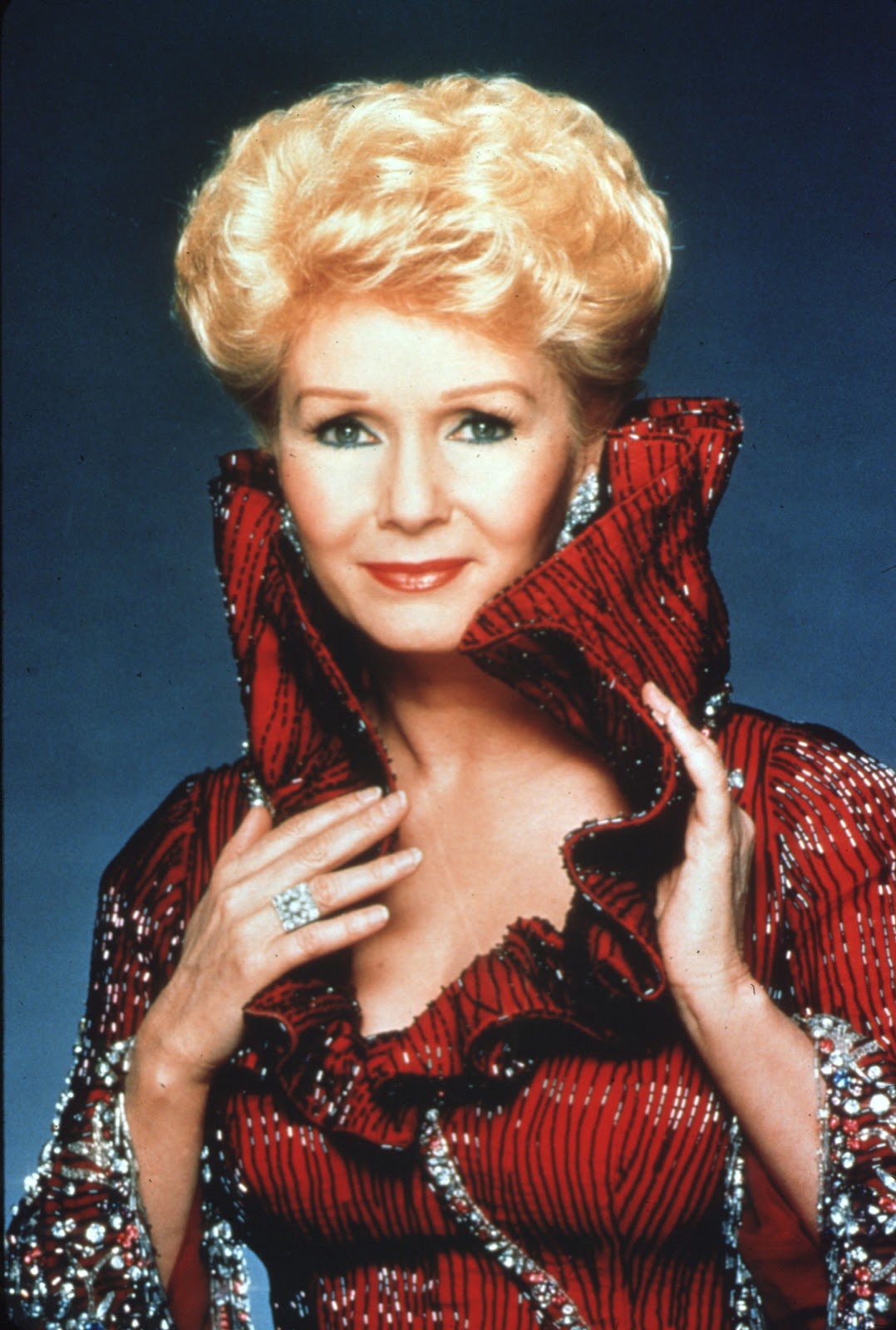
At the 1964 Oscars, Deb had no idea her tablemate Shirley MacLaine
would one day create a wickedly funny parody of her, in the film version
of Postcards From The Edge.
Daughter Carrie was in full Mommie Dearest mode when she penned
the autobiographical novel, Postcards From The Edge.
Then there was your shortlived TV show, which was cancelled when you made waves about accepting cigarette advertising. Your career tanked.
I've become an admirer, Debbie, evidenced by the fact that you appeared in the one and only Saturday Dance Party, last year when hurricane Irene was roaring up the eastern seaboard.
But Debbie, I'm just not sure you can be forgiven for this week's clip. Your rendition of this anthem to the counter-culture, while in a ball gown, with a chorus of dancers delivering hilariously incongruous choreography, well, it's almost too much. But I think you have a healthy sense of humor about such things, or you would still be smarting from the notorious "it twirled up!" sequence in your daughter's tell-all movie. So please allow us all to hoot and cringe through this week's Dance Party. And Happy Birthday on Sunday, when you turn a whopping 80 years old!
Stephen Sondheim turned 82 yesterday, so of course, he must be the source of this week's Dance Party. It's not like he hasn't been here before.
This sequence from West Side Story turned up quite a while ago, and when Karl Malden died, I took a look at the film version of Gypsy (though the video clip attached to my entry has since been removed, gotta love YouTube).
Turn off your cellphone when Lupone's around,
or expect consequences.
Into the Woods was on my mind a few years ago, during a trip to L.A., so we enjoyed several moments in the woods. When I caught the recent revival of Follies at the Kennedy Center, on its way, as it turned out, to Broadway and beyond,
This week's clip has a bit more significance for me, too. Not only is it one of Sondheim's most clever songs (and he is surely the cleverest lyricist ever), it comes from one of his New York musicals. Steve has no problem placing his shows anywhere they need to be placed, but he seems to have a special affinity for New York City.
Bernadette in Follies received
lukewarm reviews in DC. They
changed her dress in NY,
and she was a hit.
His very first full musical, Saturday Night, takes place there, as does West Side Story (of course), Follies, and large parts of Merrily We Roll Along. Most of the second act of Sunday in the Park With George also takes place in New York.
The original Company featured a multi-leveled, abstract set,
reflecting the alienation of New York living. I can relate.
The most Manhattanish of all his works, though, is surely Company. (I wrote a bit about the most recent Broadway revival of Company here; it's the one where everybody carried around a tuba or something equally awkward).
You could drive a person crazy with those horns.
Company is sometimes pointed to as a prime example of the concept musical, where the idea or theme of the piece takes precedence over a traditional plot.
Elaine Stritch took no prisoners in
the original Company.
It's certainly not a book musical, as it moves in a non-linear fashion, and it certainly is not a sung-through piece, as it contains lots of scripted scenes (by George Furth). In one, a prospective bride goes a little nuts, with all the anxiety surrounding her. I can sympathize. I am going a little nuts myself, with all the anxiety surrounding me this week, perhaps that's fodder for a future entry. For now, though, we can revel in the expert delivery of a very complicated song from Company, provided by one of the great comic losses of recent times, Madeline Kahn.
She was the 8th of 11 children, born into a poverty stricken family in the Dust Bowl of Oklahoma; she grew up during the Depression. She dropped out of school in the third grade, and was married as a young teen. She gave birth to a son, who died, and was divorced by her husband. Penniless and pretty desperate, she turned to prostitution. Well, wouldn't you?
The hookers from LaGrange, in the early part
of the 20th Century. Get a load of those ankles.
Now the story really gets good. In 1952, she landed in a brothel located outside the small town of LaGrange, Texas. As with restaurants, it was all about location, location, location, and as the whorehouse was only two blocks off the highway between Houston and Austin, it did banging business. Our Edna had a good head for the enterprise, and a good business sense too, so she bought the place when the previous madam died.
Miss Edna took over ownership in the early 60s.
Her rules for the brothel were strict and well-enforced. The gals did not fraternize with the townfolk (other than in a business sense), though they were encouraged to support local businesses; they visited the doctor weekly to circumvent any unpleasant social diseases. No alcohol was allowed on the premises, and no tattoos were allowed on the merchandise. A direct phone line was installed to the sheriff's office, in case there was any trouble with the clientele.
The gals did their duty for the troops, from
1894-1973. During the World Wars, they
sent cookies.
The brothel had been in existence since before WWI. When the depression hit, and cash was scarce, customers began paying for their fun with poultry, one chicken per sex act. The backyard exploded with chickens, and the whorehouse picked up additional income from the sale of eggs. The place became known as The Chicken Ranch, and received regular visits from politicians, soldiers, and freshmen from Texas A&M. Though prostitution was illegal in Texas, the Chicken Ranch and its proprietress Miss Edna were so popular, everybody looked the other way. On busy nights, a deputy sheriff was dispatched to the ranch to help park cars. Visiting the Chicken Ranch was considered a right of passage for college boys, and it was commonly quipped that more politicians had spent the night there than at the Driscoll Hotel and the Governor's Mansion combined.
Zindler sent his team inside, for hard confirmation
that there was, in fact, prostitution going on.
They said yes.
That is, until TV reporter Marvin Zindler from Houston got into the act. He spent weeks hiding in the bushes, snapping photos of the clientele, and he sent his associate and cameraman inside to do some investigating undercover. His reports forced the governor to order the place shut down, and in 1973, it was. The doors were bolted, and the prostitutes all left to survive a hard candy Christmas.
If you think this sounds like great source material for a musical, you're too late.
Carlyn Glenn won a Tony playing the madam
based on Edna Milton Chadwell.
The story became The Best Little Whorehouse in Texas, which opened on Broadway in 1978 and ran well over 1000 performances. The show won Tonys for stars Carlyn Glenn, in the role inspired by Edna Milton Chadwell, and Henderson Forsythe, as the sheriff.
Henderson Forsythe was in the midst of
a 32-year run on As The World Turns
when he unexpectedly won the Tony as
Sheriff Ed Earl Dodd.
More importantly, the show afforded Tommy Tune his first chance to direct and choreograph a musical (Tommy got his own Dance Party a few weeks ago, when he turned 73). Alexis Smith played Miss Mona (thank god they changed the name from Miss Edna) in the First National Tour (which spent 7 months in Los Angeles), and in 2001, a major revival starring Ann-Margaret, in her theatrical stage debut, took to the road (a cast album of that production is available. A-M sounds pretty good for her age, but I heard in the theatre, she was somnabulent).
Ann-Margaret's Miss Mona wore gowns by
Bob Mackie. The high-profile tour spawned a new cast album,
but failed to reach Broadway.
Parton made a splash in her film debut in 9-5,
she chose this film as her follow-up.
Dolly Parton bought the film rights as a vehicle for herself, and the resulting movie was quite different from the original. Parton was too young for the part as written; the original love story between the madam and the sheriff was in the past, looked back upon by the wistfully middle-aged couple.
For the film, the comedy was played up,
and the melancholy disappeared.
With Parton and Burt Reynolds in the roles, the love story moved to the present, at the expense of several interesting subplots. The movie version was despised by Miss Edna, who claimed there was nothing right about the film except that it happened in a whorehouse. What that unhappy hooker failed to accept was the fact that the ensemble musical which she had endorsed on Broadway had now become a star vehicle on film.
Dolly's happy. Her inclusion of "I Will Always
Love You" put the song back on the charts.
Parton herself wrote several new songs for the movie, including a regrettable duet with Reynolds, who should never have attempted a musical. And she took the opportunity to incorporate her old standby song, "I Will Always Love You," into the show, which brought further attention to that perennial. In addition to the soundtrack of the film, Dolly re-recorded one of the original songs from the show, "Hard Candy Christmas,'" removing the backup singers; she had another hit with the tune.
Theresa Merritt could have handled her character's big
number, but it was cut.
Sadly, the movie jettisoned several memorable songs from the original score, including a soul-tinged showstopper sung by the brothel's housekeeper (who was also based on a real person, the only black who ever crossed the threshold of the Chicken Ranch, on staff or as a customer).
WKRP alum Gary Sandy played
the Sheriff opposite Ann-Margaret;
his rendition of "Good Old Girl" is
excellent.
Another casualty is my favorite number from the show, a bittersweet ballad sung by the sheriff (but we'd be crazy to think the melancholy "Good Old Girl" would ever be accepted as a love song to the flamboyant, vivacious Dolly Parton). But my quibbling aside, I have to admit that The Best Little Whorehouse in Texas is a fun film to watch. The title caused some trouble in distribution, especially in the heartland where, hypocritically, the actual whorehouse had been allowed to operate for decades.
Like Bring Back Birdie
and Annie Warbucks,
this stage sequel flopped.
The movie was sometimes called "Best Little Cathouse..." or "Best Little Chicken House...". The Bible Belt needn't have worried; as Miss Mona proclaims in the film,"There's nothin' dirty goin' on." The critical reception to the piece was mixed, but when the box office receipts were tallied, the movie was the most successful movie musical of the 1980s.
As a casting stunt,
Miss Edna appeared on Broadway as her
predecessor Miss Jesse.
Edna Milton Chadwell, as I said, hated the film but had no misgivings about the stage play; she even spent some time in a non-speaking role in the Broadway production. Speaking of that original production, it was nominated for 7 Tony Awards, and a song was presented on the Tony broadcast that year. You can see the clip here, and be amused by the number of bleeps the censors added, in attempting to hide the subtext of the number.
That same number from the movie is this week's Dance Party.
Only one black guy on the football team? And in reality,
he would not have been allowed through the door of the Chicken Ranch,
even in 1973.
Melvin P. Thorpe and Marvin Zindler both proclaimed
"Texas has a whorehouse in it."
The film had an all-star cast: alongside Dolly, the movie is inhabited by Burt Reynolds, in an ill-advised musical role, Dom DeLuise, who is outrageously over-the-top as the TV reporter (Dom got his own Dance Party a long while ago, as well as an obit), Jim Nabors, who is unwatchable, and Charles Durning, who earned an Oscar nomination for his sly turn as the governor of Texas.
Despite his heft, Durning could have had a career in musicals.
I saw him in Ballroom, waltzing like a pro. His rendition of
"The Sidestep" was the highlight of Whorehouse.
None of those people appear in this week's Dance Party (though you may recognise character actor Robert Mandan as the Senator). Instead, enjoy the Texas A&M football team getting ready for their reward for winning the big game. If there is a more homoerotic number in a mainstream musical, I've never seen it.
Jeff Calhoun is now a respected
stage director/choreographer. We worked together
on a concert reading of Parade several years ago.
The redheaded kid who has several solo moments is a cutie named Tim Topper, and stay on the lookout for the quarterback of the team (he speaks to the Senator first, and tosses him the football). It's director/choreographer Jeff Calhoun, who is currently prepping Disney's Newsies for Broadway.
The woman who inspired the whole thing, Edna Milton Chadwell, died last week at the age of 84.
.JPG)


.JPG)

.JPG)







,+Olney+Theatre+Center,+2004.jpg)



,+Shakespeare+Theatre+Company,.jpg)

,+Warehouse+Theatre,+1999.jpg)
,+Are.jpg)
,+Everyman+Theatre,2002.jpg)
,+First+Nationa.jpg)
,+Shakespeare+Theatre+Company,.jpg)


,+Granada+Th.jpg)
,+Globe+Playhouse,.jpg)
,+Valley+College,+1975.BMP)
,+CSUN,+1976.jpg)