Thursday, August 20, 2009

Don Hewitt


1922-2009

The creators of ABC's Twenty-Twenty and NBC's Dateline must be awfully thankful that their competitor Don Hewitt had an idea for an unusual kind of news show back in the mid-60s. He pitched a prime time program consisting of celebrity profiles, investigative reporting, and feature stories to CBS, who flew in the face of reason and granted him an hour slot on Sunday night. Sixty Minutes was the first newsmagazine, and Hewitt can be credited with inventing the genre (in fact, he was the first to link the term "newsmagazine" to television. He wanted the show to reflect the mix of hard and light news which had been popularized by Life Magazine.)


Forty one years later, the show is currently the longest running prime-time program of any genre; it finished in the top 10 a whopping 23 years in a row, and has been the number one, top-rated program four times (so far). In its early decades, it was certainly appointment television in my family (and remains so for my father); that tick-tick-ticking of the stopwatch has become one of the truly iconic images in the history of television.


The correspondents in those early years were all newsmen of the highest caliber: Morley Safer and Harry Reasoner, along with curmudgeonly humorist Andy Rooney, became unlikely celebrities due to their involvement with the program. Dan Rather was the baby of the bunch; at his departure in 1981, Ed Bradley replaced him, raising the profile of African-American journalists across the country. But the breakout star of 60 Minutes was surely pitbull Mike Wallace, whose relentless questioning of his subjects became legend. The last thing any corporate or political swindler wanted to see out the window was Wallace, approaching his front door with a film crew.
Prior to the creation of 60 Minutes, Hewitt had a substantial career in television journalism. He was the first news producer to superimpose words onto the TV screen during a news story, and is said to have been the first to add cue cards to his broadcasts. In fact, he directed the very first news broadcast, in 1948, and in 1960, produced the first televised presidential debate. That debate probably remains the most influential of all subsequent debates, as historians claim it turned the election in John F. Kennedy's favor. As the story goes, Hewitt asked candidates JFK and Richard Nixon if they wanted make-up for the camera. Kennedy was confident in his tan and declined, so Nixon declined as well. Nixon's pasty complexion, glistening brow, and sweaty lip did not compare well with the healthy glow of the senator from Massachusetts, and Kennedy won the day. (Interestingly, polls which focused on voters who heard the debate on the radio reflected that people who listened to, but did not watch, the debate thought Nixon was the victor.)

But 60 Minutes remains the crowning achievement in Hewitt's career (in fact, it may be the crowning achievement in the entire history of CBS News). Under Hewitt's leadership, the show won 73 Emmy Awards and 9 Peabodys. The list of correspondents who have contributed to the program over the years is a Who's Who of broadcast journalism. Hewitt had final approval on every story which hit the air, many of which were highly controversial. He admits his decision to pull a story about a whistleblower of the tobacco industry was not his finest hour (the Russell Crowe / Al Pacino film The Insider covers that incident), and his decision to broadcast a tape of Dr. Jack Kevorkian ("Dr. Death") administering a lethal overdose to a terminal patient ignited a national debate about euthanasia. He was most proud of stories which exonerated the innocent, such as Morley Safer's investigation into the evidence which convicted a Texas man for robbery; the man was ultimately released.


Hewitt was at the helm of his creation for over 35 years, but was asked to step down at the end of the 2003-2004 season. Demographics were catching up with the old warhorse, and 60 Minutes had the oldest audience in television (and some of the oldest stars, too), so new blood was needed. Hewitt remained on the CBS payroll and continued to critique the work of his replacement. He was determined that the show maintain its core mission, which he summed up in four words:

"Tell me a story."


Don Hewitt died yesterday from pancreatic cancer, at the age of 86.

Wednesday, August 19, 2009

Robert Novak

1931-2009

In his youth, he was nicknamed "The Prince of Darkness" for his pessimistic view of life, a moniker he relished and used as the title of his memoir. A political columnist, commentator, and reporter for The Chicago Sun-Times, CNN, and Fox News, he felt no hesitation in revealing his own right-wing view of the world. I disliked Novak's style, and was one of those who applauded Jon Stewart when he labelled him "Douchebag of Liberty," for his hypocrisy regarding news sources (he had steadfastly refused to name his own sources regarding the Valerie Plame affair, but demanded CBS name their's during the Dan Rather debacle).

Novak became nationally infamous for publishing the name of CIA undercover operative Valerie Plame. Her husband, Ambassador Joseph Wilson, was openly challenging the George W. Bush administration's evidence for its invasion of Iraq, and Novak's outing of Plame was widely seen as an attempt to discredit opposition to the war by attacking the man's wife, an ethically questionable move at best. The revelation ignited a scandal from which he never really recovered; he complained it would "forever be a part of my public identity." He expressed no regret for the outing, an incident which lead to the Scooter Libby conviction. Novak claimed he "didn't hurt Plame a bit" by naming her in the press, but failed to acknowledge the danger into which he placed everyone who had ever worked with her during her undercover career.

There was some irony to this affair: Novak himself felt the war was unjustified. It was not the first time in his career that he broke ranks with the ultra-conservatives, which leads me to believe some of the kudos he has been receiving since his death. He was apparently a bulldog when he wore his reporter's hat, which is commendable, no matter how I feel about his politics. But he is one of the instigators of the now common practice of placing two loudmouths in a room together and letting them shout at each other. This kind of "commentary" does absolutely nothing to advance actual debate, and drives me right up the wall. When reporters allow their political biases to become their central calling card, which is routine these days, I don't know how they can still call themselves "reporters." I bet the late Walter Cronkite doesn't know, either.


Novak was one of the worst offenders of this practice, freely calling himself a "right-wing ideologue."


He landed on the front page again several years ago, when he ran down a homeless pedestrian in DC and left the scene. Apparently, he did not even know he had plowed into the poor schnook, and had to be flagged down by a guy on a bicycle before he would stop his car. This kind of thing is a symptom of the brain cancer with which he was diagnosed only a week later, and from which he died yesterday at the age of 78.


Sunday, August 16, 2009

Kathleen


We gathered last night for a big send-off. DC actress, masseuse, disease simulator, and party girl Kathleen Coons is heading west.


I saw Kathleen long before I ever met her. At least a decade ago, I attended my first Washington Stage Guild production, Major Barbara, which included in the cast my grad school buddy Steve Carpenter. Steve was doubling as upper-class snit Stephen Undershaft and, in Act Two, one of the bums in Barbara's Salvation Army shelter. He was a hoot as both.

Kathleen also doubled in the show, playing earnest worker Jenny in Act Two, who gets the crap beat out of her by one of the lowlifes. I have to confess I don't remember that role. But I surely DO remember her first appearance onstage, in Act One, in which she played Sarah Undershaft as a girl bored to the point of lethargy. It is not a huge part, as written, but Kathleen made the most of her moments, employing slow-motion movement which reflected the character's trance-like, uneventful life. She got funnier and funnier, crossing the stage in a smooth, serpentine walk that was an absolute scream.

This was not Kathleen's first appearance with WSG. That would be in a play called Ill Met By Moonlight. She tells a funny story of being cast through her friend Tricia, who was also in the cast, and meeting her director at the first read-through, still not knowing which role she was to play. Since then, she has been a regular player with the Stage Guild. Last night, she filled me in on a bit of her stage history here in town. Her first professional gig coincided with Steve's; they both appeared in the Source Theatre Festival, and actually met the night of the final honors. They became fast and good friends, and have worked together many times since. Kathleen has appeared on most of the stages around town: she played in a sandbox at Signature, restored some comedy at Olney, and mothered a girl in a goldfish bowl at Metrostage. She understands Sapphic souls well, having played for the all-girls' team at Source and Studio SecondStage.


It was backstage at Theatre Alliance that I finally met her. Steve was directing a well-received production of Thief River (for which he earned a Helen Hayes nomination), and Kathleen was often backstage during rehearsal and performances, helping out. She appeared on that stage several times over the years; I wish I had seen her there in Two Rooms, one of my favorite Lee Blessing plays. I recall her stunning work in Alice's Wedding in 2004 with particular awe. It's a two-hander, and she shared the stage with Aubrey Deeker; together, well, it was pretty magical. He was a soldier, and she was his bride; one of them was a ghost, or a memory, or both of them were, or something. My memory is pretty shoddy about those specifics, it was five years ago, give me a break, but I was blown away by two young actors at the top of their game:

Kathleen won a Helen Hayes nomination for her work.


I felt extremely lucky to finally share the stage with Kathleen a few years ago, in the Stage Guild's Opus. We were only onstage twice together, once in the big climactic group scene, and another earlier moment which became my favorite scene of the play. Kathleen is an actress who excels in the give-and-take we all hope for from an acting partner; it was a delicate little scene with many subtle nuances. Often, when two actors approach such a scene, there is a lot of discussion in rehearsal, breaking down the moments of the scene so they can be emotionally choreographed. Kathleen and I didn't do any of that. It may be that, subconsciously, we both felt too much discussion might break the fragility of the work going on. But I know I trusted Kathleen, and she trusted me, so we just stepped off the cliff, and played.


Our director (Steve Carpenter again) trusted the both of us, and we did not over-rehearse it. I had a pretty proud moment after our Designer Run, which was the first time the full play was seen by WSG's artistic director John MacDonald. He motioned me over to him after the rehearsal, and gave me a lovely compliment on that particular scene.


How did this get to be about me? Bad habit. Anyway, I loved working with Kathleen, and hoped to do so again. Other than a few staged readings, we haven't had the chance. I still have hopes, but it will be more difficult now that she's returning to Denver, to be closer to her family. The Mile-High theatre community is lucky to have her, but she'll be missed around here. She's a charming goof in civilian life, but when she comes to work, she Brings It.


Godspeed, Kathleen. Come back to us soon.

Friday, August 14, 2009

Friday Dance Party: Wild and Crazy Tapper


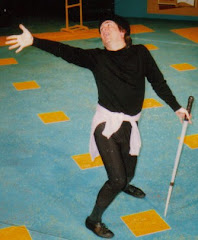
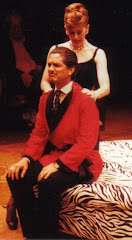
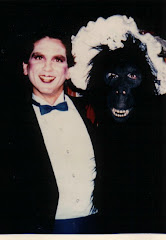
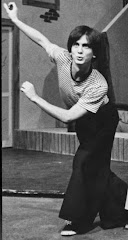
I'm a sucker for tap dancing. I delude myself into thinking I might have been a fair one, had I started early enough. I did a bit of it as the Emcee in Cabaret, but I failed to redeem myself for the terrible mess I made of George M several years earlier. I was horrendous in the role, though I didn't think my tapping was too bad, considering I had never had a lesson.


In honor of this week's Dance Party, I yield my tap shoes to Steve Martin, who is pretty impressive in this clip. Martin is one of the elder statesmen of comedy these days, as well as being a respected playwright (and a crackerjack juggler and Oscar host).


In the midst of his career, he was known for his absurdist stand-up routines, his hosting of Saturday Night Live, and even his recordings: he cracked Billboard's Top Twenty with his novelty song, "King Tut." But he was best known for his physical shtick; his film performances usually showcased his superb physical talents (take a look at All of Me). I maintain that the great physical comedians are also swell dancers; the two techniques are more related than you might think. And Martin capitalized on his natural physical grace in this clip (in it, he admits to having only started dancing about 8 months earlier).

This sequence takes a bit to get going, but around the 2 minute mark, watch out.


Steve Martin turns 64 years old today.

Wednesday, August 12, 2009

Reading, Stage Guild-style


Every theatre in town (and probably in the country) does staged readings these days, and I've done more than my share. Sometimes they are fairly extravagant; in particular, some of the musical Readings I have done were almost full productions (One Touch of Venus at American Century Theatre, 1776 at the Smithsonian, etc.). But usually, staged readings are exactly what they sound like: a bunch of actors sitting on a stage with the script in front of them, reading the play aloud to whomever shows up.
When Washington Stage Guild started doing this kind of thing, there was an attempt to physicalize the reading a bit; we made entrances and exits, and moved about the space with script in hand. Personally, I like that approach, as it adds a bit of visual interest to what is, let's face it, a pretty static endeavor. (I myself would fall asleep almost immediately if I were in an audience, just listening to people read aloud. It's the reason I don't listen to books on tape in the car.) But after a while, the Guilders found that their very specialized audience, one which is accustomed to listening to the elaborately phrased spoken word, didn't care much about such things, so all subsequent readings have been presented with the actors seated, reading from the script.

WSG has been presenting these public readings for a year and a half. I've just checked my programs (yes, I save programs. I'm that guy), and I have appeared in a whopping 16 of these readings for the Stage Guild. I confess that most of them run together in my mind, as we read them only once or twice, then moved on. But my programs remind me that I've done some Synge, some Priestley, and of course, some Shaw, the Guild's signature playwright. (I vote that his Captain Brassbound's Conversion receive a full production one of these days. Yes, its cast is too big, but if anybody can tackle it, it's WSG.) I did two readings of plays by J.M.Barrie, whose big hit was Peter Pan but who contributed these other juicy theatrical tidbits as well, and I was introduced to an early female Irish playwright, Lady Gregory.


We even did a few new plays (or rather, new adaptations), something for which there are other theatres in town better known. There was a science fiction story, translated from the Czech, called War With the Newts, in which I played a lizard with a speech impediment, and we presented a wonderful adaptation of an Oscar Wilde short story at the Kennedy Center's Page-to-Stage Festival last year (that adaptation, by WSG's Artistic Director Bill Largess, is a real keeper; it should definitely be produced).


Just last week, my buddy Steve Carpenter directed us in an hilarious, Soviet-era allegory called The Dragon, a play with such huge technical challenges that it is unlikely to be produced these days. And that's one of the reasons the Stage Guild has been reading these many, many plays; they are often pieces which could not be realized onstage, but deserve to be heard.

Well, there's another reason WSG has spent 18 months or more presenting these readings. Along with all other theatres, they have been hit hard by the recession; philanthropic donations have slowed to a trickle, and the economic collapse caught the Stage Guild at a particularly vulnerable moment. The founding artistic director, John MacDonald, about whom I wrote a bit, died very unexpectedly a year ago, amidst a Capital Funding Campaign that was already experiencing roadblocks. With fundraising difficult at best, WSG has been presenting these readings as a way to keep their unique brand of literate theatre in the public eye. Their brand is so well-known, in fact, that the International Shaw Society is holding a conference in DC in October, partly due to the Washington Stage Guild's presence here.


WSG will be producing an evening of Shaw one-acts on the Catholic University campus to coincide with the conference, and word is, a spring season of full productions is also being planned. I applaud WSG's decision to begin producing again; they fill an important niche in the DC theatre community, presenting Shaw and other language-heavy, literate plays which are often overlooked. I am proud to have appeared in their production of Opus two years ago, which remains their last fully produced show to date.


I am not on the inside, so I don't know what this spring season might entail, or where it will be presented, or anything. Perhaps the staged reading I did on Sunday for the Guild will be my last participation with the group for a while, though I hope not. Regardless, I find it commendable that the company is picking itself up and dusting itself off, and leaping again into the difficult waters of producing shows for the theatre.


Friday, August 7, 2009

Friday Dance Party: Viral Video


Well, the "JK Wedding Entrance" has gone viral, which I think means everybody in the world with Internet access has seen it. So, you won't be seeing it here. Those Youtube clips which suddenly catch the attention of the world are usually worth watching once, but I can't sit through them more than that. Even Susan Boyle's video grew tiring, didn't it? And that one actual DID become viral, as apparently it was the first step toward the poor lady having a nervous breakdown. And the Peanuts gang singing along with The Police, that one's pretty fun, too. But how often can you watch it, once the joke's been played?

As for Jill and Kevin's wedding video, which featured the wedding party dancing down the aisle to "Forever" by Chris Brown, that clip has made the happy couple famous. They even recreated the entire thing on the Today show, a poor choice to make, as a repeated viewing reflected the fact that most in the wedding party could not dance worth a nickle. There is a reason they didn't put white people on Soul Train. But whatever, they get to be famous for a while.

There has been a backlash to the popularity of that video, due to the couple's choice of entrance music. Chris Brown recently plead guilty to beating his girlfriend Rihanna (Full Disclosure: I had never heard of either one of them until he beat the crap out of her...that's how slow I am to pick up on current pop culture). Brown received a suspended sentence and community service (you have to REPEATEDLY break the law here in the US, before it's considered really a crime). But the popularity of the wedding video featuring Brown's song has increased the popularity of the song itself, boosting digital downloads of the tune from a mere 3,000 to an astounding 50,000 in a matter of days. That's an increase of 1,721% from the previous week. This, of course, puts lots and lots of royalties into the pocket of felony assaultist Brown. The wedding couple, of course, have created a website, because that's what newlyweds do as soon as they get married, and have requested that people donate some money to an organization dedicated to ending violence against women and children.


I guess they never considered actually removing their wedding video from YouTube.


As with all videos which "go viral," there have been some responses and some parodies. For this week's Dance Party, here's a fun one, reflecting Jill and Kevin after 6 months of wedded bliss:


Thursday, August 6, 2009

John Hughes

1950-2009

If you were a teen ager in the 80s, you are feeling the loss of Hughes, who chronicled post-adolescent angst in a string of successful films. I was (ahem) not a teen-ager in the 80s, so I saw only one or two of his hits. He was responsible for boosting the careers of several "Brat Packers" in films such as Sixteen Candles, The Breakfast Club, and Pretty in Pink.


John was originally a writer, and it was his work with the satirical magazine National Lampoon which lead to his film career. He provided the screenplays for several of the Lampoon films, including ...Vacation and ...Christmas Vacation, before stepping behind the camera with his teen comedies. Weird Science and Ferris Bueller's Day Off , in addition to his Molly Ringwald trilogy mentioned above, cemented his reputation as a writer who could recreate the rhythm and language of the Gen X teen-ager. Here's a fun clip which perhaps I should have saved for the Weekly Dance Party, but what the hell. I might consider this a John Hughes Signature Clip, as music and dance were always central elements of his teen flicks:


Hughes had some success writing for grown-ups too, providing Steve Martin and John Candy with Trains, Planes, and Automobiles, and working with Candy again in Uncle Buck.


Home Alone, which he wrote and produced, dwarfed his previous successes and is his biggest commercial hit. In his later career, he occasionally wrote under the pseudonym Edmond Dantes (a name he swiped from French literature: Dantes is the fictional hero known better as The Count of Monte Cristo); he provided the stories for Beethoven and Maid in Manhattan under that moniker. He wrote other familiar film scripts such as Mr. Mom, Dennis the Menace, and the remakes of 101 Dalmatians and Flubber.


Hughes has largely absented himself from the public eye since 1994. He died today from a heart attack at the age of 59.