Friday, September 12, 2008

Dinner and a Show

...it's a classic combo. Everyone loves gathering for a meal, either before or after a live performance. Beforehand, there's the anticipation of watching a performance which will be unique unto itself, or apres, the delight of gathering for late-night supper to dissect the show, and perhaps run into one of the performers (at the bar, of course).


But try putting Dinner and a Show together, in the same building or, god forbid, in the same room, and we run away in horror.


Dinner Theatre has a bad rap, only partially deserved. Who can forget that hilarious sequence in Soapdish, in which Kevin Kline is portraying Willy Loman in a dinner theatre production of Death of a Salesman?

It's true that in most situations, Dinner Theatre fails at both: the dinner is inedible and the theatre is mediocre.


Here in the DC area, I'm told that there were half a dozen or more Dinner Theatres years ago. These days, only two or three remain, the most prestigious of which is certainly Toby's. I have seen three shows there in the 12 years I've been a resident. My first trip there (I was accompanying a Helen Hayes judge, so I got in free), the show was Jekyll and Hyde, a piece which will never be a classic. Though I dislike that kind of Pop-Opera immensely, I will say that this production seemed quite good. (I was not the only one who thought so; the production received several Helen Hayes Nominations, and director Toby Orenstein won the award.)


I admit that I was taken aback when our waiter approached, and he was one of the actors in the show. This is not always the case in Dinner Theatre, but at Toby's, your waiter is also your entertainer. For this particular show, I knew only one fellow in the cast, and wouldn't you know it, he was my waiter.


This is a bit disconcerting for me, to be face to face with an actor in the show I am about to see. I am from the Old School, I suppose, in which the actors are forbidden to interact with, or even to be glimpsed by, the audience before the performance. Even more disconcerting, the actor returns to your table at intermission, to see how you are liking the show, and to collect his/her tip. All very, very unsettling to me.


But I guess civilians don't mind, and even like it, since Toby's has been doing this so long.


My second trip to Toby's did not involve a meal; it was to catch their kids' show, Suessical Jr., about which I have already written.


My third trip to Toby's was this week, to see The Producers. It was a Wednesday matinee, and I had called ahead to insure I could purchase a "show only" seat. These seats are half the price of the regular entrance fee; of course, you don't get to eat. No biggie for me, as I recalled from my first visit to Toby's that the food, while respectable, must charitably be called Generic Comfort Food. Meats, potato dishes, iceberg salads, and the like. Nothing wrong with any of it, and indeed, it seemed to suit the taste of the audience members, all of whom were senior citizens.


I wish the box office lady had told me to arrive a little later. When I called, she proclaimed I had to be at the theatre "absolutely No Later than 11:30!" I'm a dutiful boy, and arrived at 11:15, so I spent some time outside enjoying the day. Well, when I finally bought my ticket and sat down, the elders were still making their way to the long buffet set up in the middle of the room. Toby's, you see, is a theatre in the round, or a restaurant in the round, or perhaps more accurately, a cafeteria in the round. The audience is seated at tables surrounding the playing area, which is also the serving area.


I have a hunch that the theatre shoots for an "estimated" curtain time for the show, considering the variables of people returning to the buffet for second helpings. As such, I sat at my table and watched the seniors eat for almost an hour. I was greeted by a very personable young waitress, from whom I ordered a glass of their house white wine.


Don't ever do that at Toby's. You'll get the most sugary sweet Chablis imaginable. The price is only $3.50, but you get what you pay for...


Finally, the dining portion of the event was over. Kitchen staff appeared and unplugged various heating instruments, cleared the buffet, and dismantled it. As I said, the serving area is also the playing area, so after the sections of the buffet were removed, the stage was swept and mopped. The waiter/actor folks continued to attend to their tables, clearing plates, refilling coffee, and selling booze. They finally excused themselves to go backstage to get into costume and makeup.


The show at Toby's is really an all-day, or all evening, affair. The audiences spend several hours eating, and then several more hours watching the show, which is introduced by an MC who gives a lengthy (20 minutes at this performance) curtain speech. Add in the half-hour intermission, and you may get the feeling you are on an overnight camping trip.


Finally, over an hour after I sat down, the show began. This ensemble did a bang-up job executing some pretty intricate tap choreography. I've had a bit of experience with performing a musical in the round, as I played the Devil in Damn Yankees in an arena staging in Los Angeles. So I know the challenges of choreographing big numbers so everyone on all sides has something to look at. Toby's does it very well.

There was a bit of irony during Act One's biggest production number, in which the full ensemble is dressed, identically, as Little Old Ladies (think Andy Griffith's Aunt Bea). They performed a hilarious tap routine with walkers, in front of an audience which included several dozen people who had themselves arrived using walkers. The oldsters did not seem to take offense.


The leading performers were all creditable, and two were even more so. Jeffrey Shankle, playing Leo Bloom, the milque-toast accountant, and Adam Grabau as Franz Leibkind, the Nazi playwright, were especially impressive.


The gal playing the female lead, Elizabeth Rayca, turned out to be my waitress, and she had a belt which took the roof off the joint.


Toby's is completely non-union these days, though I've been told she occasionally hired an Equity actor or two in the past. Many of the leading actors in the DC area began their careers at Toby's or other local dinner theatres, before moving on to the bigger Equity houses. Seeing The Producers reminded me of my own experiences in dinner theatre in LA, about which I will go on and on in the next blog. You can hardly wait, can you?


As for this experience, I enjoyed Toby's production of The Producers immensely, though I wish it had not taken four hours to do so.

Wednesday, September 10, 2008

Sarah Palin

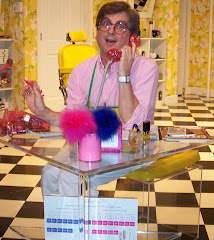
It's hard not to get swept up in the vitriol currently swirling around the presidential campaign, but my buddy Marni Penning is treating it with a light touch. She happens to bear a striking resemblance to the nation's most famous Best Kept Secret. Marni's a fabulous actress and fine mimic, as you can see, and I hope she gets some work out of this situation.

I can see no other upside to the current, inexplicable swell of positive reaction to Gov. Palin, the country's most famous Moose-Hater since Boris and Natasha. NPR's Diane Rehm led a lively discussion this morning regarding the GOP's masterful (some may say diabolical) manipulation of the media's access to Palin. Go here to listen: http://wamu.org/programs/dr/. One of her guests, "Heather," who is from something called the Independent Women’s Forum, clearly applauded the fact that Palin has been kept from the media, and thus the American public, for weeks

I don't care about Gov. Palin's amniotic fluid, or her unwed pregnant daughter, or her delight in slaughtering caribou. But I do wonder when she will be required to justify her certainty that she is ready to take over as President of the United States at a moment's notice. Apparently she's been using the last weeks to bone up on the issues, clearly signifying that she was not qualified to be a candidate when McCain chose her. Sadly, she will not be given extra study periods to learn her lessons when she is suddenly face to face with Putin or Ahmadinejad or Kim Jon-il or any number of hostile foreign leaders, none of whom will care that she has under-age children at home and thus should be treated with delicacy.

On Rehm’s program today, Ted Kopple lent a voice of reason to which I have to agree. There are less than 60 days until the public must make this vital choice. It is past time for Palin to step forward and answer questions regarding her positions, both domestic (Abstinence Only Education in schools? Any proof that’s working in Alaska?), and foreign (so far, her sound bytes reflect an inclination toward Standing Tough in the World, very similar to the bullying stance of the current administration. Any proof that’s working in the world?).

I never thought I’d hear myself say this, to anyone, but I can’t help it.

Stop hiding, Sarah. It’s time to Man Up.

Saturday, September 6, 2008

Bill Melendez

1916-2008


Thanks for giving us Peanuts.


In a career which stretched over half a century, he had a hand in animating all the early Disney and Warner Bros. characters, as well as later efforts Garfield and Cathy. But his greatest legacy remains his work with Charles Schulz, who reportedly trusted no one else to animate his work. He voiced Snoopy in all his incarnations, and gave the world a singular classic:


Tuesday, September 2, 2008

Summer, Unattended

It's now after Labor Day, so summer, at least unofficially, is over. Personally, I can't detect any difference between yesterday and today; the weather is exactly the same, and I don't see anybody yanking out their autumn sweaters due to the chill in the air. I have never lived in a place where the Autumn Chill happened much before mid-October.


But I digress. I attended a Labor Day BBQ out in the hinterlands of Maryland, to celebrate the ending of the season, so in that spirit, even though I am still sweating when I spend time outside, I will consider the Summer of 2008 over.


I think I missed it.


Many, many things happened this summer. I watched most of them from afar.


Of course, the Olympics dominated the season. I resisted watching the games on TV, though I did succumb to curiosity enough to catch an event or two online, after the fact. I watched Michael Phelps, the world's most unlikely sex symbol, win his record breaking medal, and I also watched that event he won by a .01 margin. But I only tuned in after I had heard all about it. I watched it in retrospect.


I did not watch the Opening Ceremonies, but enjoyed the later revelations that the Chinese had jazzed up the proceedings electronically for the TV audience. I felt bad for the little Chinese girl who was deemed too homely to present to the world, and was replaced by a more photogenic model. When that story hit, you'd have thought there was proof that the moon landing was faked. I had to chuckle. Americans would NEVER have done such a thing as replace an ugly girl with a cuter one, would they? No, Americans would have chosen a cute kid in the first place, and worried about the way she sounded later...


...remember they hired Audrey Hepburn, Natalie Wood, and Deborah Kerr before hiring Marni Nixon...


But I watched these and other Olympic moments from afar, usually by reading about them in the newspaper. As I said, I did not watch a single event live on television. What's up with that?


Missed the conventions, too. We're currently in the midst of the GOP wankfest, all of which I decline to view. I doubt I'll watch any presidential debate, either. I have a hunch, however, that I may enjoy the VICE-presidential debate...hehehe...


Yes, I know I was supposed to watch the Democratic convention, which was reportedly inspiring and uplifting and healing and all that. I'm really not sure why I didn't. It was an historic moment, after all. What the hell was wrong with me this season?


The summer of '08 began for me in the middle of June, the day after I finished my Spring Fling with Shear Madness. I had no future productions lined up, which is not that unusual in my life, and I was not overly concerned. I had a day's work on a film, which I did the week following my departure from The Madness. And I continued to be involved with the ongoing series of staged readings sponsored by the Washington Stage Guild.


Those readings took on added significance with the unexpected death of WSG's founding artistic director, John MacDonald. I cannot claim to have been one of John's intimates, but he welcomed me into the Stage Guild's fold over a year ago when I appeared in Opus. John, together with his wife Ann, had the ability to make you immediately feel like a member of the family. His loss cast a long shadow over the summer for me. It continues to do so.


For me, part of the usual fun of summer is Summer Stock. I was not invited to participate in any Summer Stock this year, but I did have a bit of fun seeing two shows at Totem Pole Playhouse, cheering on several friends, including Ray Ficca, who will be taking over the place in September. But somehow (through my own fault, I know), I missed both shows at Wayside Theatre this summer. I had two grand friends, Thomasin Savaiano and Larry Dahlke, in Always Patsy Cline, the show which reopened Wayside's theatre, and I had a strong curiosity about Moonlight and Magnolias, which Wayside produced at Shenandoah University. I am disturbed with myself that I let both these shows slip away without my seeing them, as I always have a ball seeing Wayside productions, wherever they are.


I also missed the entire four show season at Shenandoah Summer Music Theatre, a stock company to which I have grown attached over the years. I worked with both Robin Higginbotham and Carl Danielson last season in Bye Bye Birdie; this year they appeared together in the SSMT season opener, Singing in the Rain:


I heard that the lovely and talented Rick Wesley, with whom I have not worked but would give my left gonad to do so, was superb in the SSMT closer, The Producers:


I had planned to see both those shows. I saw neither.


It's all part of this feeling I have, that I was not really present this summer.


I did take a bit of action toward, you know, life, when I enjoyed a visit to my father in North Carolina. While there, I attended an audition at the up-and-coming North Carolina Stage Company. As I plan to spend much more time with Dear Ol' Dad in the near future, I have hopes that some work may pop up with NCSC. They are a theatre to watch.


My best friends Scott and Drew celebrated their 25th year together by getting legally married in Los Angeles this summer. I've been honored to be a part of their lives together from the beginning, when we shared a shoddy apartment in Panorama City in the early 80s, and I could not have been happier that they became legal this summer.


But again, I watched from afar.


So, regarding the Summer of 2008, I did much more observing than participating. Can't really explain it, but I know it's not a good thing. Perhaps I'll feel more motivated once the temperatures drop. I usually feel much more energized with a nip in the air.


I wonder where I can buy some firewood...


Sunday, August 31, 2008

Theatre Droppings: Visions of Hell edition

I visited two of the hottest shows in town at the moment, two extremely different pieces in very different styles, but with one element in common. Both plays reflect their own particular version of Hell.


2007's Pulitzer Prize winner for drama, Rabbit Hole, is finally making its regional debut, in a dynamite production at Olney Theatre Center. Along with Doubt, Pillowman, and others, it is responsible for a recent resurgence of interest in the contemporary dramatic play. David Lindsay-Abaire departs a bit from his usual fantastical concept (he wrote Kimberly Akimbo and Fuddy Meers, among other off-beat items), and has written an intimate portrait of a family attempting to emerge from the paralyzing grief caused by the death of a child. This seems to be a piece which, in the wrong hands, could come off over-wrought, and ripe for a Lifetime Movie (Citypaper's rave review mentioned the same thing, including the horrifying thought that the leading role would in that case be played by Meredeth Baxter). Olney's production avoids all the sentimental traps, and is a riveting success from start to finish.


The cast is led by Paul Morella and Deborah Hazlett as the parents of the lost child. Theirs seems a very realistic portrait of a marriage splintering into pieces; I never for a moment doubted they had been together for years (in the interest of full disclosure, Deborah is a close friend, and is yet another illustration of that phenomenon I've mentioned before: my friends always seem to be the highlights of their shows! Inexplicably, I take full credit). Megan Anderson and Kate Kiley play other members of the family, and both are very effective. Megan is saddled with a lengthy, "story" monologue at the very top of the play, during which the audience is trying to get used to the odd acoustics of the theatre. We can hear and understand everything, but it takes several minutes to adjust to the sound (the actors are wearing body mics). I have experience performing in this space (without mics), and can verify that the acoustics at Olney's New Theatre are not what they should be. Even with Rabbit Hole's box set shoved all the way downstage, it was deemed necessary to amplify the voices of this cast of very experienced stage actors. Why does it seem like so many brand new theatres have such lousy acoustics?
But I digress.


Kate Kiley, playing a role somewhat too old for her, nevertheless brings a welcome blast of humor to the role of the grandmother. Kate is an acquaintance of mine from the Shear Madness fold, and I was very impressed with her ability to deliver laugh after laugh while remaining absolutely connected to the truth of the moment.


The fifth character in the show, the teenager who is responsible for the death of the child, is played by Aaron Bliden, a student actor who hits all the right notes. His uncomfortable scene with the grieving mother is a terrific example of understated acting. Watch his finger tapping the plate.


Rabbit Hole is certainly one of the best things I've seen onstage in a long while, so I'm glad that the Washington Post (the "money review") sent Nelson Pressley to review it. He gave it a well-deserved rave, as has everybody else, but had the Post's Peter Marks been in attendance, there may have been a different outcome. Marks has lately revealed an impatience with plays about dysfunctional families; his review of Woolly Mammoth's Maria/Stuart pretty much flattened the piece, primarily because of his personal boredom with the premise of the "whacked-out family". The group currently living at Olney is surely dysfunctional, so Marks may have made mincemeat of this delicate, understated depiction of what can surely be described as a living Hell.


Studio Theatre has another regional premiere, containing a very different view of Hell. Jerry Springer, the Opera is exactly that. It is a huge production of operatic proportions, both in cast size and in size of cast. What is it about opera singers? Why are so many of them, shall we say, large of girth? Does all that extra body mass help hit those high notes? Whatever. I very much enjoyed this production, even as I had the same problem I have had with every single opera I have ever attended:


What are the words?


It must take a better trained ear than mine to determine what the singers are actually singing; such attention is paid to the length and purity of the note being sung, that the meaning of the actual word is often lost to me. And that's a shame in this piece, which is a wicked spoof of American popular culture. Studio has assembled a huge cast, numbering in the dozens, of singers and dancers, playing the low-life participants of a typical Jerry Springer episode, and the low-life audience members egging them on. This cast is so large, I couldn't possibly single them out, but I can report that the show is anchored by the only two Equity actors in the cast, Bobby Smith and Dan Via.


Smith has been on my radar since I first saw him at Studio in the leading role in A Class Act. He gave a wonderfully understated performance in Caroline, or Change several years ago, so I was doubly impressed with his flamboyant turn in Jerry Springer. He's a hoot as both the warm-up man for the Springer show, and as the Devil himself. Yep, in this show, the inevitable happens, and Jerry Springer goes to Hell. And why wouldn't he? I'm sure the couple sitting next to me would have applauded that fact, if they had stayed beyond the intermission. I think they may have been initially offended by the language of the piece; the F word was used so often it became meaningless (probably the authors' intention), and the C word was bandied about as well. Perhaps the pre-op transsexual was a turn-off, or the fat guy in the diaper, or any number of other deviants populating this world. I imagine, though, it was the line of tap-dancing Ku Klux Klansmen which finally drove this African-American couple out of the theatre, never to return.


Though I enjoyed the show, I found it to be overlong and a bit redundant. Yeah, we get it: Americans are fascinated with sleazeballs. But I suppose that is keeping with the usual structure of an opera: we are told the same thing four or five times in a row before moving on.

I have to commend Dan Via, who is currently playing the title role. I arrived at the theatre expecting to see Larry Redmond as Jerry, but apparently he could not continue with the show through its extension, and Via replaced him. Dan looks a bit young for the role, and is sporting the skankiest wig currently seen on any DC stage, but he is actually quite a gem. Act One is dominated by Jerry's freaky guests, but Via never fails to land his dry punchline. Act Two takes us to Hell, where Jerry finally takes center stage, and he is forced to host the most sacrilegious program imaginable. I give kudos to Via, who, throughout this sequence, managed to maintain a likable quality which I have never found in the actual Jerry Springer, who remains repugnant.
I came away from Jerry Springer: the Opera impressed with the magnitude of the piece, but curious: it seems inconceivable that the Studio Theatre Money Folks would allow 20 primo seats in the house to be occupied by members of the cast, thus robbing the theatre of thousands of dollars of income over the course of the run. It's a wonderful example of artistic need taking precedence over financial considerations. That is not the reputation the Zinoplex has around town. I wonder what those dozens of non-union actors, who are dancing their hearts out, singing their guts out, and stripping down to their underwear for every show, are getting for their efforts.
For me, THAT is a version of hell...

Monday, August 25, 2008

The Wind that Swept Through Georgia

FRED CRANE

1918-2008


It's been a tough summer for the few surviving cast members of the monster hit Gone With the Wind. Crane, pictured above on the right, passed away this weekend at the age of 90. He played one of the Tarleton Twins in the opening sequences of the classic film, and can claim to have uttered the very first lines of dialogue in the four-hour epic. Sadly, he will be remembered, if at all, as the other Tarleton Twin. His career was overshadowed by George Bessolo, the gent who played his brother. Don't recognize George Bessolo's name? After appearing in Gone With the Wind, he changed his name to George Reeves, and went on to play Superman in the early TV series of the same name.

This news comes on the heels of the death of another GWTW supporting player, Evelyn Keyes, who died July 4. Keyes had a much more substantial career than Crane, though she is remembered primarily for her active private life, which included marriages to director John Huston and bandleader Artie Shaw, among others. In the film, she played Scarlett's whiny sister Suellen, from whom Scarlett swipes a boyfriend, whom she then marries.


I probably know more than I should about these players and their characters. I must now come clean and admit that I am something of a Gone With the Wind fetishist. I suppose part of my attraction to this unwieldy, melodramatic film stems from Atlanta being my hometown. But I am sure that I hold this movie in high esteem for another, more personal reason: I have distinct memories of my mother taking my older sister and me downtown to view the film in one of its major rereleases in the early 60s. It was my mother's favorite film, so became one of mine. It has since dropped off many historians' radars, largely due to the unconscionable sugarcoating of slavery. Scenes of happy Negroes singing in the fields while picking cotton do not sit well with modern viewers.


But as a piece of fictional storytelling, I continue to admire it. Only a handful of actors from the film are still with us, including one of its major stars, Olivia de Havilland. Ann Rutherford, who played Scarlett's younger sister Careen, and Alicia Rhett, who played Ashley's jealous sister India, are still alive, as are the folks who, as child actors, played Beau Wilkes and Bonnie Blue Butler.


But mostly, the movie's huge cast is gone with ... well, you know...


I'll think about that tomorrow.

Sunday, August 17, 2008

Theatre Droppings: Catch-Up Edition


Circumstances beyond my control have prevented my seeing as much local theatre this summer as usual. Primarily, my continued involvement with the staged readings at the Washington Stage Guild has occupied most weekends. I've been honored these past weeks to be included in these events, which have taken on a special meaning with the unexpected death of the group's founder, John MacDonald. The company is soldiering on. Our usual routine has been to gather late Saturday afternoon for a quick reading of the play, and even quicker discussion. Afterwards, some huge piece of animal carcass is tossed on the barbie, side dishes and drinks are whipped out, and a relaxed evening is had by all. The following day, Sunday, the cast gathers to read the play for anyone who shows up, once in the afternoon, and again in the evening. So, I've added to my previous list of roles which I had fun playing but would never attempt in a full production. In addition to those several roles, I played a young minister who questions the reality of the devil, when a magician arrives on the scene and spooks everybody. That play, Magic by G.K. Chesterton, could be a very effective piece fully staged.Also, I had an absolute ball playing a man decades younger than myself, a nincompoop who was attempting, without success, to swipe an inheritance, in a new translation of Goldoni's The Amorous Servant.


So, I have a good excuse to be a little lax in my theatre-going of late. I was able to pop back out to Totem Pole Playhouse a second time. I had previously been out to see a bunch of coconuts playing around in Lying in State, a play which was far beneath their talents. The show this time was a reliable old chestnut that everybody has heard of, but nobody ever does, Bell, Book, & Candle. From the film version, I was under the impression that the show had gangs of people running around the stage, but in fact, the play has only five characters. My buddy Ray Ficca was playing the comic foil, the brother of our heroine who is, incidentally, a witch. I enjoyed this production much more than Lying in State, as it was exceedingly well written, well acted, and well directed. It's said that this play was the inspiration for the long-running sitcom Bewitched, and that certainly seems likely. One aspect of the play which most people don't know, however, is that it is sometimes taken as a coded play about homosexuality. Its playwright, John van Druten, was gay (he's better known for his play I Am a Camera, which provided source material for the musical Cabaret). In B,B&C, van Druten populated his Manhattan scene with an underworld of undesirable creatures who in appearance were just like everyone else, but who held dark secrets. They even gathered in their own special nightclubs. One of the characters is a confirmed bachelor, and another is named Queenie. All very surreptitious, don't you think?


Today, I drove across the river to see Keegan theatre's Stones in his Pockets. The national tour of this piece rolled through town several years ago, and Rep Stage produced it more recently. My buddies at Wayside Theatre did it only a year or so ago. I didn't see any of those productions, so I was pleased to get the chance to catch the show here. I have only seen a handful of Keegan productions over the years. They do an eclectic mix of small, intimate pieces, new works, and big, blowzy musicals with gangs of people (they just closed Man of La Mancha yesterday at a different location). Usually, their work has an Irish bent, but that is not a hard and fast directive; one thing I admire about the company is their determination to do whatever the hell play they want, regardless of the logistics, or the timing, or whatever. Thus, 1776 graced their boards a couple of years ago, in a production with which I had some trouble. I noticed the same sort of trouble with The Hostage, another of their large-scale productions. The company is non-union, which gives them the freedom to tackle these big shows on a shoestring, but as happens in such instances, the audience gets one or two strong performances in the leads, surrounded by performances somewhat less than. (I've noticed the same phenomenon at Washington Shakespeare Company.)


But anytime I've caught one of Keegan's smaller shows, I've been impressed. They did a bang-up production of Picasso at the Lapine Agile a long while back, and their current effort is even better. On a blank stage with only a few chairs and a few boots, Keegan's cast of two creates the inhabitants of an Irish village being invaded by a Hollywood movie crew. The show is a delight, and the players are adept at the differentiation of character so necessary in a piece such as this. Matthew Keenan, who is new to me, lends a lot of heart to his roles, particularly the central role of Jake, and the walk-on role of Sean, a character which greatly affects the tone of the piece. Eric Lucas, whom I have enjoyed several times before at Keegan, is equally fine as Charlie, the second protagonist, and is also a hoot as the film's director and first AD.


I know I can be rather a prig about companies such as Keegan, sniffing that they should be on the road to becoming union houses and all that, but when I see one of their intimate productions, like the one described above, I can't really fault their direction too much. They are doing a lot right.