Tuesday, September 4, 2012

Stratford Upon Hudson

All is calm on the south side of the monument.
But walk around the thing,
and you're in the middle of the Wars of the Roses.
We all consider Labor Day to signal the end of summer (except the meteorologists, who know otherwise), and by coincidence or divine providence, my final summer project also ended with Labor Day.
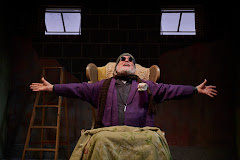
Our Richard III began with a scene which is not in the play. This moment from Henry VI, Part 3, was interpolated into our production of R3, to make it clear that the Yorkists achieved the English throne through bloody actions. David DeWitt delivered a majestic deathbed speech as the last Lancaster king. While this moment clarifies how Richard's family won the throne, it also robs the audience of any surprise regarding the character of Richard.  In the first 2 minutes of the play, we know he is a cold-blooded killer, so when he orders the murder of his own brother, and his own nephews, nobody's surprised.
Richard III, about which I wrote a few weeks ago, provided the bookend to my earlier summer gig, Taming of the Shrew, which opened on Memorial Day, usually considered the beginning of summer. 
The role of Lady Anne is sometimes thought
unplayable, as it contains one of the most
outrageous reversals in the canon.
Amanda Renee Baker made
me believe it.

Other than those two gigs, not much happened in between, but I'm not complaining.  It's been years since I did two shows in a single summer, my career does not run that way, and the symmetry of opening a show on summer's opening weekend, and closing one on summer's final weekend, is kind of fun.
Hastings, Buckingham, and Rivers. No, it's not a law firm, they are all victims of our anti-hero.
Since it's so freshly minted, it's only natural that R3 is uppermost in my thoughts at the moment. 
Our dressing room was also the audience's lobby. We
dropped trou as the audience exited.

We had terrific weather for our run, interrupted only twice by rain.  Most evenings were balmy with a nice breeze coming off the river, and I was very surprised that our audiences sat still for two hours, on the hard cement steps which served as our auditorium. 

Valerie O'Hara's Duchess of York recalled the Queen Mum,
and Bruce Barton's Archbishop wins for Best Voice in Show.


We played by natural light, and when we opened a month ago, Mother Nature proved a good designer and technician. 

I was not fond of the sun setting in my face, but can't deny
it looks swell.

In those first weeks, we had a warm sunset in our faces through much of the show, and as the sun finally disappeared and darkness set in, the ghosts of Richard's victims were just coming out to haunt.  Following that scene, the big battle took place, and the play was done.
Richard is haunted by the ghosts of his victims, in a scene which is enhanced by the natural dusk.
Nick DeVita's Catesby handled several of the props which
enhanced the show, including the one and only table.
"You can't go to war without a table," he quipped.

But it's late August, so the sun's habits were changing drastically, and the last week or so, darkness set in about half-way through our performance.  Lit only by three streetlamps (one of which turned itself on and off at irregular intervals), some scenes played better than others. 
The Royals bask in sunlight which is all-too-fleeting.

This is the first year Hudson Warehouse has performed this late in the season, and we were at the mercy of the significant change in the natural light which happens in late August.  Personally, I could tell a difference in the way the Mayor's scenes, which are comedic, were playing. 
The Mayor begs Richard to assume the throne.

When there was lots of light, there were lots of laughs;  when the light was dim, so was the laughter.  (This is not news to anybody: comic moments usually come off better in bright light.)

No matter the lighting, I had a fun time with the Mayor.  Initially, I was cast only in this small role, but less than a week before we began rehearsal, the gent scheduled to play the Duke of Clarence bowed out, and I jumped at the chance to play Richard's hapless brother. 
Clarence ascends to the Tower. He won't
emerge. But I'll get a new audition piece.

I was pleased that I could play this largely dramatic role, in addition to the comical Mayor;  it gave me much more to do, and provided a nice contrast.  And Clarence's famous "dream speech," which was truncated in our production but I hope still effective, is a great audition piece for me in the future.

Before Richard III, I had performed outside only once, in a production of Much Ado About Nothing in South Carolina, many years ago. 
Ryan Ervin's Brakenbury owned those steps.

That show was also performed in a space built for non-theatrical endeavors.  It became one of the charms of our R3 that our space was not secured from outside forces. 


This sight gag was enjoyed by the first row
or two. But Vince Phillip's
ferocious performance was enjoyed by all.

Early on, we had a drunken fool interrupt a scene, and later, when our houses were quite full, I occasionally collided with an audience member during my Big Death Scene.  (That sequence became my favorite moment in the show.)
The Money Shot. Clarence's death became my favorite moment in the show. There were more gruesome murders to come. "You can't do Richard III without blood," someone said, but you actually can.  In Shakespeare's original text, only one murder occurs onstage, that of Richard himself.  All other assassinations occur off stage. Nowadays, though, we won't accept such delicacy.  We want to see all the blood and guts, which caused laundry concerns, as all the men were in business suits. The solution was to have each victim abandon his jacket for his death scene, which caused our Buckingham, Timothy Reynolds, to advise, "Keep your coat on, and you'll be safe."
Throughout our run, I was pleasantly surprised that our audiences seemed to be following the story. 

Mad Margaret, Dowager Queen of England, is sometimes removed from the show completely, as she does not serve the foreword thrust of the action (the Duchess of York is also sometimes dumped). Margie Catov's curses on the Yorks, though fierce, could not keep Drew Rosene, at left, from dozing off. He would become the uncrowned Edward V, before falling victim to his Uncle Dickie.

Matt Ebling as the young Duke of York provided some comic relief.

Shakespeare's history plays are notoriously hard for American audiences to follow, we can't tell Henry VI from Henry VII, even if the Brits can.  And the original text is Shakespeare's second longest play (right behind Hamlet), so cutting this monster down to two hours was a feat. 


George Wells as Richmond, at left, remains on the outskirts of the play for two hours, then steps up to deliver a call-to-arms which rivals Henry V's. Once everybody's dead, he will ascend the throne as that first and most buff Tudor king, Henry VII.
 
Our director, at right, also adapted the script. And played
the part of Lord Hastings. And is the group's
Producing Artistic Director. And he bagged all the blood.

The man with the buzz saw was our director, Nicholas Martin-Smith, who mercilessly cut the text;  he didn't bother much with maintaining the poetry, his intention seemed to be to tell the story cleanly and efficiently.  So, lots of embroidery disappeared, but as it turns out, you CAN see the forest, if you cut down enough trees.
This is the last we see of Edward IV, whose death opens the floodgates.
 
Myles and Ian reminded me of Cruella DeVil's henchmen,
Horace and Jasper. They enjoyed killing me
 and everyone else.

Fall will soon be upon us, and with it, my next project, yet another Shakespearean effort, which begins rehearsal in late October.  Between now and then, I'll be spending more time in my DC branch, which I have ignored through most of this Shakespearean Summer. Hmm: "My Shakespearean Summer"- could be a chapter in my memoir. Stay tuned.
The final image of R3, as the carnage of the Wars of the Roses ends. There is something very right, when scenes which Shakespeare placed outside are actually performed outside.

Friday, August 31, 2012

Friday Dance Party: Moonstruck

It's been a week concerned with lunacy, in its original sense.  The first human to walk on the moon died, as everyone knows.  It's been so long since that first moon walk that I honestly cannot remember if I was watching it as it happened or not. 

Those first few moments of Neil Armstrong gently stepping where no man had stepped before are so ingrained in my memory, I'm not sure if they are the result of having seen the clip so often, or of having seen it happen live.  But it really doesn't matter. 

Armstrong has my respect for the fact that, after his career as an astronaut peaked, he retired to private living, becoming a teacher and lecturer, and declined to capitalize on his worldwide fame with lucrative endorsement deals and whatnot.  Anybody think that would happen today?

The moon is also on everyone's mind because today, Friday, is a full one.  The moon is my birthsign's guiding planet (yes, I know it's not a planet, but don't blame me). 
For a while, we Cancers were
known as Moonchildren. ugh.

I am usually not affected much by celestial occurrences, but every once in a while, when the Full Moon coincides with my exact birthday, look out.  I could tell some stories of one or two of those instances, where my hormones were racing and there was trouble afoot, but I'll leave that for my new segment, AAvist After Dark.
Designing Women devoted an episode to the Full Moon, during which Julia flashed the mayor at a fashion show, Suzanne misused a semi-automatic, Anthony starred in a play about Alcatraz, Charlene dabbled in subliminal messaging, and Mary Jo tailed her daughter on a date. Plus Noelle the Pig caught the flu. They were all arrested.
Anyway, today's lunar position is being called a Blue Moon, and while that is not strictly accurate, it has become one of those beliefs which everyone has had for so long that it's become accepted. 

But a Blue Moon, according to the strict astrological definition, is not the second full moon in a calendar month, a common conception.  The original Blue Moon only occurs when there are four full moons in a single "tropical" season (rather than the "calendar "season). 
When one of the three month (or so) periods between the various solstices (solti?) and equinoxes (equinoxen?) contains four full moons rather than the usual three, a Blue Moon occurs.  Today's full moon, though the second one in the month of August, does not meet that qualification.

Originally, a blue moon was named for the third moon appearing in a tropical season which will have four full moons. 
Mame's Vera Charles informed us that the man in the moon
is a lady.

A little confusing, but wait for it.  The tropical year, which astrologists prefer to use, contains four seasons with three full moons occurring in each.  In ye olden tymes, every full moon had a name, usually corresponding with a big event happening around the time.  So, we always had a Harvest Moon, a Lenten Moon, and a Moon both Before- and After- "Yule."  When, however, a fourth moon popped up in a season which only had three named moons in it, the extra moon was called Blue.  But making it more confusing, the Blue Moon is the third, not the fourth, of those moons, simply so that the regularly scheduled moons would still occur during their usual time frames.  Who wants a Harvest Moon happening in November, or the Moon Before Yule happening after Christmas?

This tome is still used to identify full moons.
But its definition of Blue Moon is ignored.

This understanding of the Blue Moon was in effect until the late 1930s, when some joker misinterpreted the Farmer's Almanac for 1937, and identified a Blue Moon as the second full moon in a calendar month.  That explanation spread like a house on fire, and these days, it is the one accepted by almost everybody.  I'll accept it too, of course, since that's what everybody believes, so it must be true. (The GOP has operated under that system for quite a while, and it seems to work for them.) The same phenomenon (of SO many people believing something wrong that it becomes accepted fact) happened at the turn of the millennium, when the whole planet celebrated the start of the new era a year early (the 21st century actually began January 1, 2001, NOT 2000).  But pointing out such errors brings condemnation;  one is considered, at best, a party-pooper, and at worst, a know-it-all. 

So, in honor of today's Full Moon, be it Blue or not, this week's Dance Party fittingly features that most famous titular tune.  Our star needs no introduction. 


The film is At The Circus, and his brother received his own dance party from this film a while back, singing what became one of his signature tunes (go here to see that one).  I have never seen At The Circus, so I don't know why Harpo is playing only for a black audience, but who cares?  It's nice to hear his expertise. 

Friday, August 24, 2012

Friday Dance Party: Fair Weather Phenom

This week's Dance Party features one of our repeat offenders. 

Gene Kelly's birthday was yesterday, so it's only natural we revisit him.  If the clip below is not enough for you, enjoy his dance duet with Judy Garland in Summer Stock here, and his solo number with a newspaper from the same film here.  My favorite Kelly clip, though, was featured several years ago, and comes from a Julie Andrews TV special, rather than a film.
 

This week's clip is from one of Gene's lesser known works, It's Always Fair Weather.  The piece began its life in the minds of writer/lyricists Comden and Green, who were prepping it for Broadway as a sequel to their earlier smash, On The Town.  Kelly was only interested in it as a film, however, so MGM took over.  The studio brass balked at hiring On The Town's original co-stars Frank Sinatra (who had begun causing trouble on sets) and Jules Munshen (who by 1955 was considered a has-been). 
Gene's costars from On The Town did not make the cut.

Gene, who was to co-direct the film, chose hoofer Dan Dailey and dancer-choreographer Michael Kidd to costar, and the concept of a sequel was abandoned. 
Cyd Charisse was our leading lady.

The finished product is darker than most musicals of the time, and concerned three WWII buddies who meet ten years later and discover their dreams have not come true.  The film was not a success in its original release, but the clip below has become historical, as some claim it is Gene Kelly's last great dance solo captured on film.
This number with the trash can lids is also fairly well-known.
I'm not such an expert as to know if that claim is true, but Kelly surely proves himself adept on roller skates. 
Everyone agrees Xanadu was a sad ending to a
stellar film career.

So much so, that I wonder if anyone suggested he don skates for his final film appearance in Xanadu decades later.  Maybe that would have saved that dismal failure.  Happy Birthday, Gene!

Monday, August 20, 2012

Sunday In The Park With George, Duke Of Clarence

Richard's brother is cuffed and clueless.
Two weekends ago, we opened Richard III in Riverside Park, and I officially made my Manhattan Debut.  Regular readers of these pages may recall that I made my official New York City Debut in the Spring, in Taming of the Shrew, about which I wrote here.

The Hudson Warehouse production of R3 (as we classically-trained aesthetes casually call the play) is performing outside.  We also rehearsed outside.  We even change our clothes outside.  I think my boxer-briefs are being discussed by the joggers who run by. 

Our stage is actually a cement terrace built as part of a monument to the armed forces;  our audience sits on the steps leading up to the statuary.  This may be the oddest place I have ever performed an actual play.


This previous Hudson Warehouse production gives a very good idea of what our performances look like.  Except that our audiences run the risk of being splattered with blood.
Well, I have performed in some odd places, it's true.  One year, I worked with a murder mystery troop in L.A., where we did environmentally specific shows. 
This murder mystery, from 1993, was performed in a burned
out WWII building.
That year, I did a show in a ladies' tea shop, and another in a railroad car.  But those are stories for another time.  For now, let me just say that performing on the steps of this monument in Riverside Park in NYC has its challenges.
Director Nicholas Martin-Smith gives notes to the cast, sprawled out on the steps of the monument.
The biggest challenge I have had with my current project is the heat.  From our first read-through until our Opening Night and beyond, we have conducted every rehearsal on the steps of this concrete monument.  Now, usually, actors are anxious to rehearse in the space where their show will actually be performed;  to be allowed to rehearse each and every day in the performance space is an unusual treat for a stage actor. 
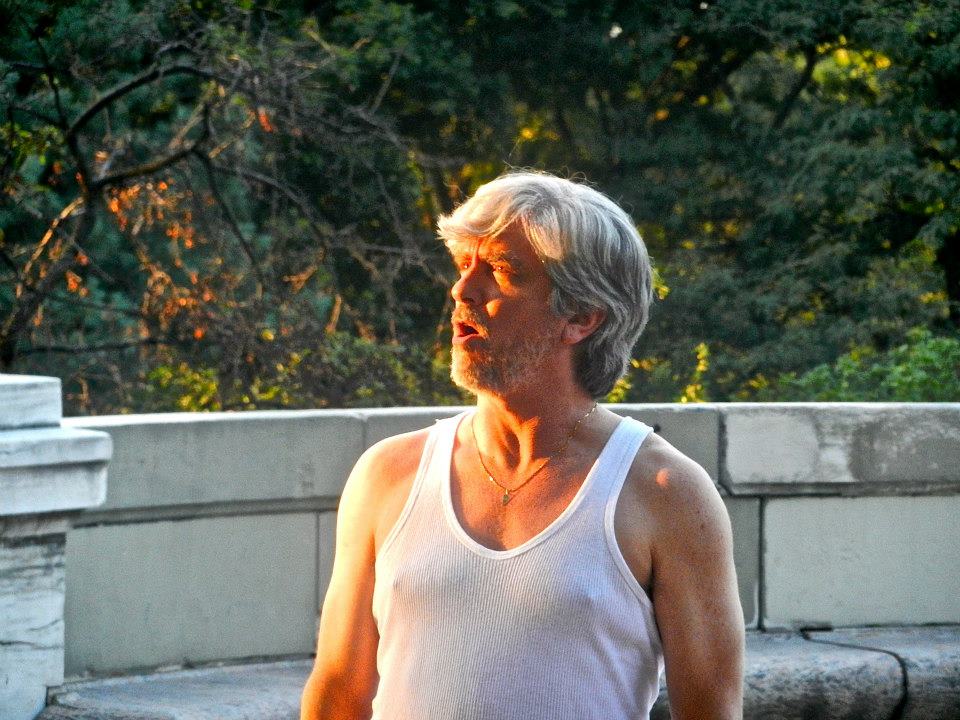
Two goofballs are hired by Richard to off his brother.  That's me wandering around in the background in my undershirt.
In this case, however, I had some trouble.  July and August in NYC are similar to July and August in DC: hot and humid.  Despite having grown up in the Deep South, I have never acclimated to such a climate.  Our first week of rehearsal, out on the concrete monument, was pretty hellish for me.  I would begin my trek to rehearsal by walking two blocks to the subway, not a difficulty in and of itself. 
Director Nicholas found some shade.
And the train itself was not a difficulty either, as it is air conditioned.  But the subway platforms are not, and it takes only about 15 seconds of standing on one of those hellplanks to become drenched in your own sweat.  The train ride (and the changing of the trains, which requires another few minutes on another hellplank waiting and wetting) was never enough time to dry out.  Then there was the four block walk from the station to our venue, so by the time I arrived at our rehearsal, I was ready for a shower and some re-hydration. 
The Duke of Clarence needs a Gatorade.  Or a beer.
Of course, none were forthcoming, as we rehearsed outside, with no cover except the occasional shady tree.  So, from start to finish, this production has been rehearsed wet.
A sudden downpour affects the steps to the subway platform. You can only imagine the hot, sticky mess you become as you emerge from such a commute.
And another difficulty became apparent right away:  our performance venue was not built, in any way, shape, or form, to accommodate the art of the spoken word. 

The Greek Theater of Dionysus, at the foot of the Acropolis, seated thousands more than our little space.  And the acoustics were better.
In lay terms, our acoustics are for shit. So, from our first rehearsal to our last, major concern was placed on vocal projection.  Frankly, I spent the first weeks of rehearsal feeling that I was simply shouting at the other actors.  (And they were shouting at me.)
Howling at the setting sun is a good way to warm up for the
shoutfest which is our show.

But about a week before we opened, a funny thing happened.  That shouting turned into actual communication.  I was actually talking to other actors, and listening to their responses.  At full volume, of course, but communication was taking place. Woo hoo!  Or rather, WOO HOO!

After weeks of rehearsing, communication actually started
to happen.

And now our run has begun, and so has the fun.  Performing this show is much easier than rehearsing it (that is not always the case).  I play two...um..."compact" roles.  The first is that of George, Duke of Clarence (hence the title of today's entry).  Clarence, as he is known in the play, is the middle brother of the Yorks, who, at this point in English history, have won the Wars of the Roses and gained the English throne. 
Eldest brother Edward's wheelchair is a dead giveaway:
he's not long for this world.

Elder brother is Edward IV, king at the start of the play, and younger brother is You Know Who. 
"What hump?" Our leading man, Vince Phillip, is giving a
bravura performance. (Or is that bravuro?)
My role, middle child Clarence, has some nice moments in the first half-hour or so of R3, including a semi-famous speech about a dream which, in our adaptation, has been cut to about 12 lines.  Still, it's a fun role to play, and I get a swell death scene involving blood and a cement wall.
No, it's not an interpretive dance. It's my death scene. The photo was snapped from the audience during performance, so forgive the fact that all the actors and even the audience are facing upstage.
A few minutes after Clarence meets his maker, I reappear onstage in the small role of the Mayor of London. 
This guy became a media star leading
up to the Olympics. 
He continues the tradition of comical
Mayors of London.
Nobody ever remembers this character, as he pops into only three scenes, and never has the focus.  But I'm told I am making this little part memorable, and the Mayor provides some of the very few laughs in this otherwise gruesome tragedy.

Hudson Warehouse, our producing organization, has been presenting free Shakespeare in Riverside Park for nine summers, and calls itself "the Other Shakespeare In The Park."  After our opening weekend, I have begun to see the attraction of appearing here. 
There is something a little mystical about performing
outside in the elements, something those
inventors of theatre, the Greeks, knew.

The acoustics are bad, the cement steps are hard, and the other park visitors often stroll right across our playing space in the middle of the action, but there does seem to be something special about performing on this terrace as the sun goes down.  Our show is performed by natural light, so once the sun sets, we are playing in the dark.  Luckily, the final few minutes of R3 take place in the darkness of battle, and even include a ghost sequence, so Mother Nature's lighting design helps rather than hurts.
The late afternoon sun spills visual treats onto our playing space.
And now that we are settling into our run, I'm allowing some of my anxiety to drift away.  With that release comes a wonderment.  As I stand at the top of the steps of this monument, ready to make my entrance with the other royals down the stairs, through the audience, and onto the playing space below, I've begun to marvel a bit. 
The sun sets on our playing space and, at the same time,
on the poor Duke of Clarence.

When I was a kid, growing up in Atlanta, I was fascinated by the theatre, but thought I would one day be a journalist or a lawyer or a teacher;  acting was never an option.  By the time I was in college in Los Angeles, I was sure I would remain in L.A., knocking around the film industry and paying my bills by waiting tables.  Years later, even while I was in grad school, earning my MFA in Acting, I could not imagine that I would one day be spending a month performing raw and rustic Shakespeare, in a park on the Upper West Side of Manhattan, along the banks of the Hudson River, in that most theatrical of cities, New York, NY.  I wonder how all this happened?