Monday, August 20, 2012

Sunday In The Park With George, Duke Of Clarence

Richard's brother is cuffed and clueless.
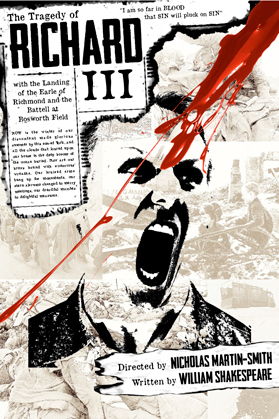
Two weekends ago, we opened Richard III in Riverside Park, and I officially made my Manhattan Debut.  Regular readers of these pages may recall that I made my official New York City Debut in the Spring, in Taming of the Shrew, about which I wrote here.

The Hudson Warehouse production of R3 (as we classically-trained aesthetes casually call the play) is performing outside.  We also rehearsed outside.  We even change our clothes outside.  I think my boxer-briefs are being discussed by the joggers who run by. 

Our stage is actually a cement terrace built as part of a monument to the armed forces;  our audience sits on the steps leading up to the statuary.  This may be the oddest place I have ever performed an actual play.


This previous Hudson Warehouse production gives a very good idea of what our performances look like.  Except that our audiences run the risk of being splattered with blood.
Well, I have performed in some odd places, it's true.  One year, I worked with a murder mystery troop in L.A., where we did environmentally specific shows. 
This murder mystery, from 1993, was performed in a burned
out WWII building.
That year, I did a show in a ladies' tea shop, and another in a railroad car.  But those are stories for another time.  For now, let me just say that performing on the steps of this monument in Riverside Park in NYC has its challenges.
Director Nicholas Martin-Smith gives notes to the cast, sprawled out on the steps of the monument.
The biggest challenge I have had with my current project is the heat.  From our first read-through until our Opening Night and beyond, we have conducted every rehearsal on the steps of this concrete monument.  Now, usually, actors are anxious to rehearse in the space where their show will actually be performed;  to be allowed to rehearse each and every day in the performance space is an unusual treat for a stage actor. 
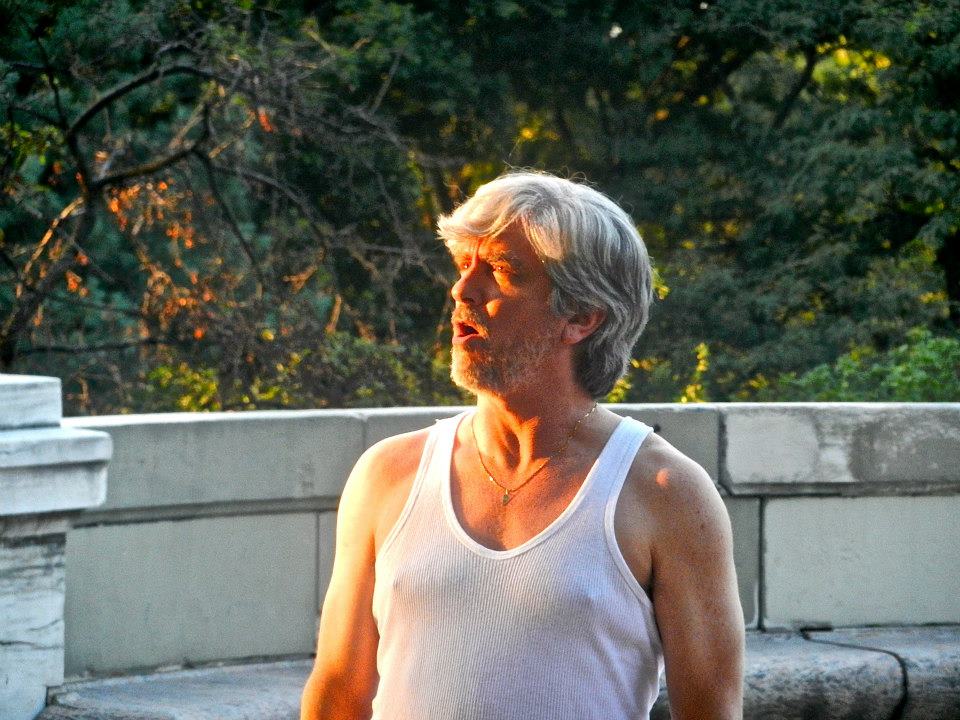
Two goofballs are hired by Richard to off his brother.  That's me wandering around in the background in my undershirt.
In this case, however, I had some trouble.  July and August in NYC are similar to July and August in DC: hot and humid.  Despite having grown up in the Deep South, I have never acclimated to such a climate.  Our first week of rehearsal, out on the concrete monument, was pretty hellish for me.  I would begin my trek to rehearsal by walking two blocks to the subway, not a difficulty in and of itself. 
Director Nicholas found some shade.
And the train itself was not a difficulty either, as it is air conditioned.  But the subway platforms are not, and it takes only about 15 seconds of standing on one of those hellplanks to become drenched in your own sweat.  The train ride (and the changing of the trains, which requires another few minutes on another hellplank waiting and wetting) was never enough time to dry out.  Then there was the four block walk from the station to our venue, so by the time I arrived at our rehearsal, I was ready for a shower and some re-hydration. 
The Duke of Clarence needs a Gatorade.  Or a beer.
Of course, none were forthcoming, as we rehearsed outside, with no cover except the occasional shady tree.  So, from start to finish, this production has been rehearsed wet.
A sudden downpour affects the steps to the subway platform. You can only imagine the hot, sticky mess you become as you emerge from such a commute.
And another difficulty became apparent right away:  our performance venue was not built, in any way, shape, or form, to accommodate the art of the spoken word. 

The Greek Theater of Dionysus, at the foot of the Acropolis, seated thousands more than our little space.  And the acoustics were better.
In lay terms, our acoustics are for shit. So, from our first rehearsal to our last, major concern was placed on vocal projection.  Frankly, I spent the first weeks of rehearsal feeling that I was simply shouting at the other actors.  (And they were shouting at me.)
Howling at the setting sun is a good way to warm up for the
shoutfest which is our show.

But about a week before we opened, a funny thing happened.  That shouting turned into actual communication.  I was actually talking to other actors, and listening to their responses.  At full volume, of course, but communication was taking place. Woo hoo!  Or rather, WOO HOO!

After weeks of rehearsing, communication actually started
to happen.

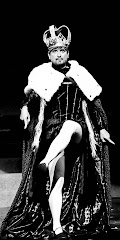
And now our run has begun, and so has the fun.  Performing this show is much easier than rehearsing it (that is not always the case).  I play two...um..."compact" roles.  The first is that of George, Duke of Clarence (hence the title of today's entry).  Clarence, as he is known in the play, is the middle brother of the Yorks, who, at this point in English history, have won the Wars of the Roses and gained the English throne. 
Eldest brother Edward's wheelchair is a dead giveaway:
he's not long for this world.

Elder brother is Edward IV, king at the start of the play, and younger brother is You Know Who. 
"What hump?" Our leading man, Vince Phillip, is giving a
bravura performance. (Or is that bravuro?)
My role, middle child Clarence, has some nice moments in the first half-hour or so of R3, including a semi-famous speech about a dream which, in our adaptation, has been cut to about 12 lines.  Still, it's a fun role to play, and I get a swell death scene involving blood and a cement wall.
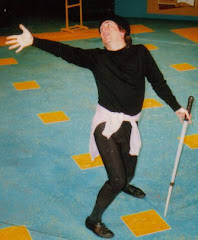
No, it's not an interpretive dance. It's my death scene. The photo was snapped from the audience during performance, so forgive the fact that all the actors and even the audience are facing upstage.
A few minutes after Clarence meets his maker, I reappear onstage in the small role of the Mayor of London. 
This guy became a media star leading
up to the Olympics. 
He continues the tradition of comical
Mayors of London.
Nobody ever remembers this character, as he pops into only three scenes, and never has the focus.  But I'm told I am making this little part memorable, and the Mayor provides some of the very few laughs in this otherwise gruesome tragedy.

Hudson Warehouse, our producing organization, has been presenting free Shakespeare in Riverside Park for nine summers, and calls itself "the Other Shakespeare In The Park."  After our opening weekend, I have begun to see the attraction of appearing here. 
There is something a little mystical about performing
outside in the elements, something those
inventors of theatre, the Greeks, knew.

The acoustics are bad, the cement steps are hard, and the other park visitors often stroll right across our playing space in the middle of the action, but there does seem to be something special about performing on this terrace as the sun goes down.  Our show is performed by natural light, so once the sun sets, we are playing in the dark.  Luckily, the final few minutes of R3 take place in the darkness of battle, and even include a ghost sequence, so Mother Nature's lighting design helps rather than hurts.
The late afternoon sun spills visual treats onto our playing space.
And now that we are settling into our run, I'm allowing some of my anxiety to drift away.  With that release comes a wonderment.  As I stand at the top of the steps of this monument, ready to make my entrance with the other royals down the stairs, through the audience, and onto the playing space below, I've begun to marvel a bit. 
The sun sets on our playing space and, at the same time,
on the poor Duke of Clarence.

When I was a kid, growing up in Atlanta, I was fascinated by the theatre, but thought I would one day be a journalist or a lawyer or a teacher;  acting was never an option.  By the time I was in college in Los Angeles, I was sure I would remain in L.A., knocking around the film industry and paying my bills by waiting tables.  Years later, even while I was in grad school, earning my MFA in Acting, I could not imagine that I would one day be spending a month performing raw and rustic Shakespeare, in a park on the Upper West Side of Manhattan, along the banks of the Hudson River, in that most theatrical of cities, New York, NY.  I wonder how all this happened?

Friday, August 17, 2012

Friday Dance Party: We're Gonna Need A Bigger Rooftop

I don't know if it was invented by Animal Planet or Discovery or The Big Fish Channel, or what, but that annual celebration of underwater carnivores is upon us, Shark Week.  I don't see the attraction.  Americans have been fascinated by those creatures ever since somebody in Jaws mentioned they might need a bigger boat.

In honor of Shark Week, a big number from MY favorite Sharks, the ones who sing and dance. 
This is a shark week I can get behind.
The Puerto Rican gang from West Side Story does not get stage or screen time equal to the Jets, sorry to say, as I find them much more interesting than the white boys.  But when they do show up, andele!!  The gang appeared on the Dance Party once before, several years ago at the sockhop, so it's time to present the moment during which they really shine.
This sequence was shot on location in NYC, in the neighborhood which now houses Lincoln Center. A few naysayers dislike West Side Story, as they cannot accept ballet-dancing gang members. I can, and do.
Taken from the well-regarded film version of the show, "America" had a checkered history.  The original score reflects that it was meant to be sung only by the ladies, one group arguing with another.  That version is still occasionally used.  Film director Robert Wise and his associates recognized the limitations of that scenario, and included the gents in the number, turning it into the guys vs. the girls.  Seems obvious that it should always have been so, and it is that observation which has given way to a theatrical legend of sorts.
When "America" was first sung on Broadway, it was entirely female.  What an improvement was made with the addition of the men in the film, and subsequent stage productions.
It's now said that the authors meant for the song to be coed all along, even in the original Broadway version. 
Jerome Robbins rehearses the original.

There was a scheduling mixup (so goes the legend) the day the show's director/choreographer, Jerome Robbins, wanted to stage the number, and the boys were not called to rehearsal.  (Maybe stage management thought they were doing "I Feel Pretty" that day instead?)  In a fit of pique, Robbins blamed the actors, and removed them from the number, staging it only with the girls instead. 
George Chakiris in the chorus of White Christmas.

This tale is fun to think about, but even taking Robbins's notorious temper into account, it doesn't really ring true to me.  Such a huge adjustment (completely removing the men from the number) would surely have to be approved by the songwriters, Sondheim and Bernstein.  I think this lore has sprung up to justify the fact that, in the original, the writers simply didn't think to put the men in the number.

Anyway, the guys are there now, and most revivals, professional and amateur, play it that way. 
These Sharks clean up good,
especially when winning awards.

It certainly proved to be a showcase for the two leading Sharks, played by George Chakiris and Rita Moreno, as they both won Oscars for their efforts.  West Side Story, in fact, holds the record for winning the most Academy Awards of any film musical (10, out of 11 nominations.  Only the screen adaptation lost that night).  Chakiris and Moreno are undoubtedly the success stories of the film, as Natalie Wood and Richard Beymer are pretty dull as the romantic leads (and neither of them sang their own songs). 
Romeo and Juliet's balcony scene inspired West Side Story's big hit, "Tonight." Neither of these leading players could sing it.
In fact, when WSS made the leap from stage to screen, none of the four leading players who had created the roles went with it.  By the time the film was shooting, Larry Kert and Carol Lawrence were both around 30, and producers did not feel they could play teenagers on film convincingly.  I agree with them, but Chakiris and Moreno don't look like teenagers, either, but whatever. 
Chita Rivera's breakout role did not
lead to a film career. 
But she's done just fine.

I love Rita's work here, but still would have liked to have seen Chita Rivera's performance preserved on film (what a different trajectory her career would have taken, if Chita had been allowed to recreate her roles in WSS and Bye Bye Birdie for their respective films!). 
Moreno had a supporting lead
in The King And I. A Latina
playing Asian: non-traditional
casting!

But Moreno is far from a letdown, and would eventually become the first performer to win the Oscar, Tony, Grammy, and Emmy.  As for Chakiris, he had been connected to the stage version of WSS in London, where he had played Riff, the leader of the Jets.  In the years leading up to WSS, he had been knocking around Hollywood as a chorus boy.
George Chakiris was often in the chorus in films from the 50s, including Gentlemen Prefer Blondes.

In honor of Shark Week, enjoy some rooftop dancing:

Friday, August 10, 2012

Friday Dance Party: We're Playing His Song

Lesley Gore's role as protegee to Batman's
Catwoman required a song. Hamlisch provided
"California Nights".
Everybody already knows this award-winning composer, arranger, and conductor died this week.


Marvin Hamlisch
1944-2012

Marvin's first stage gig was as accompanist/straight man
for Groucho's one-man show.

He seemed at home on the classical stage (he entered the Julliard school of music at the ripe age of 7) but made his lasting contributions in the world of pop, and of course, that monster contribution A Chorus Line
The night I saw A Chorus Line's original production on Broadway remains one of the most thrilling I've spent in the theatre.  A fuzzy but powerful clip from the night they swept the Tony Awards appeared on the Dance Party here.
He is one of fewer than a dozen people to win the Emmy, Grammy, Oscar, and Tony awards, and his Pulitzer Prize (for A Chorus Line) partners him with Richard Rodgers as the only two people to win that quintet. 


Marvin's first pop hit, "Sunshine, Lollipops, and
Rainbows," provided Lesley Gore a song for the
bus ride to a Ski Party.

Hamlisch had a stage charisma which most composers do not share, though he was willing to fade into the background when necessary. 
This recording has become so iconically
connected to its singer, you can't really enjoy
anyone else's version. It's one of those songs
which immediately brings to mind
the original.

He conducted high-profile concerts and tours with the likes of Johnny Mathis and Linda Ronstadt;  his friendship with Barbra Streisand dated back to her Funny Girl days, when he was the rehearsal pianist for the Broadway production.  Decades later, she trusted him to conduct and arrange her hugely successful comeback tour, which broke records all over the country.  He rescued the legacy of little-known ragtime composer Scott Joplin by adapting his music to the score of The Sting, as a result of which that long-forgotten musician landed at the top of the Billboard charts (with "The Entertainer"). 
Marvin had a big night at the Oscars in 1973.

Marvin won an Oscar in that bargain, and the same night in 1973, became a triple winner when his work on the film The Way We Were was also recognized. 

Marvin adapted "Pachelbel's Canon"
for his hauntingly lonesome score
to Ordinary People.
His film scores include Ordinary People, Sophie's Choice, Three Men And A Baby, and The Swimmer, and he provided one of the smash hits to come out of the James Bond franchise when he co-wrote "Nobody Does It Better" for The Spy Who Loved Me. 
This smash was the first James Bond theme
song which differed from the actual film's title.
His writing partner on that hit was Carole Bayer Sager, with whom he had a long personal relationship.  It is that relationship which formed the inspiration for Hamlisch's other hit Broadway musical, They're Playing Our Song.
Original stars Lucie Arnaz and Robert Klein attended the concert staging of They're Playing Our Song, starring Sutton Foster and Seth Rudetsky, in 2010. The show remains under most people's radar, though its small cast, minimal technical requirements, and accessible pop score would seem very desirable to regional musical theaters.
The show was Marvin's stage follow-up to the massive hit A Chorus Line, and concerned the ups-and-downs in the romance of a composer and lyricist. 
The score is filled with pop-sounding niceties, none very memorable but all quite presentable.  The presence onstage of "the voices," three men and three women expressing the characters' inner thoughts and acting as a Greek chorus of sorts, is the only thing keeping this little musical from being a two-person show. 
The Goodbye Girl provided another star turn for
another gent known primarily for comedy,
Martin Short. Despite Bernadette Peters in the cast,
the show had a very short life.

But the focus most assuredly is on the two leads (there are no big production numbers), and with a book by Neil Simon, the show had a lengthy run of over 1000 performances. 
A recent reunion of our stars. Marvin's pop
musical provided Robert Klein with a Tony nod, but
Lucie Arnaz was ignored for her Broadway debut.

It's original cast, seen in this week's Dance Party clip, included Robert Klein, who was primarily known at the time as a stand-up comic, and Lucie Arnaz, who was primarily known at the time as the daughter of famous people.  Klein was nominated for a Tony for this performance, Arnaz was not.  The clip, presented on the 1979 Tony Awards, is a bit blurry, but is a good reflection of the style of the show.  Before ever seeing clips of They're Playing Our Song (and I've NEVER seen a full production), I owned the Broadway Cast Album, and could swear Lucie was being dubbed by Helen Reddy, their sound is so similar. 
An attempt to turn the indie flick Smile into a musical
bombed.

Marvin Hamlisch's score, by the way, must have been catnip to various producers and recording execs at the time, as there are cast albums from the London, Australian, and Argentinian productions available as well as the original.

Hamlisch had more than a few misfires on stage, including Jean Seberg, a musical about you know who, The Goodbye Girl, an adaptation of the hit film, and The Sweet Smell of Success, which provided John Lithgow a Tony in 2002 but which failed at the box office.  At the time of his death last week, his latest project was opening in Tennessee, a musical adaptation of The Nutty Professor, directed by the original film's star, Jerry Lewis. 
The Nutty Professor, the Musical, opened last week in Tennessee.  There was a strong review from the local paper, but Marvin Hamlisch's unexpected death puts the show's professional future in some doubt.
Despite his occasional failures, Marvin knew a little something about the musical theatre.  The marquee lights on Broadway would have been dimmed for him, as they were last week, even if his only contribution had been the landmark A Chorus Line. 
Marvin's determination that "What I Did
For Love" remain in A Chorus Line
was spot on.
The show's mastermind, Michael Bennett, always maintained that the soaring melody of Marvin's "At The Ballet" was the true soul of the musical.  When all the creative powers, including Bennett, wanted to cut the 11:00 number, Hamlisch stood his ground and the song stayed in the show.  "What I Did For Love" went on to become an anthem to the sacrifices made when following one's dream.

This week's Dance Party, the title song from They're Playing Our Song, does not carry such a universal message.  It's really about the egotism of the artist, which Hamlisch also knew a little something about.

Friday, August 3, 2012

Friday Dance Party: Alive, King, and Fifty All At Once.

Actually he's 80, having become an octogenarian only yesterday.  But I would submit that, even in his advanced years, Peter O'Toole remains Actor Royalty.  His film performances are plentiful and memorable, beginning with his breakout role as Lawrence of Arabia in 1962. 
Marlon Brando and Albert Finney both turned it down, and Anthony Perkins, Montgomery Clift, and Alec Guinness were also considered, but in the end, Lawrence of Arabia went to O'Toole.
The film turned Omar Shariff into a matinee idol, but catapulted O'Toole onto the A-list. 
O'Toole's good looks prompted Noel
Coward to quip, "It should have been
Florence of Arabia."

He remained the go-to guy for historical epics and top shelf stage-to-screen adaptations, including the film from which the title of this entry is plucked, The Lion In Winter
The Lion in Winter is not my favorite
film, but the chemistry between
Hepburn and O'Toole makes it
worth the effort.

When Peter was nominated for the Oscar for that performance, he became the only actor to receive Best Actor Oscar nods for playing the same character in two different films (he played England's Henry II in both Becket and The Lion in Winter. Al Pacino has also received Oscar nominations for the same role in two films, namely Michael Corleone, but his nod in the first Godfather was as a supporting actor, while his performance in Godfather II was rightly classified as leading).  Speaking of those pesky Oscars, O'Toole holds another record:  the most performance Oscar nominations without winning a single competitive award (he was awarded an honorary statue in 2003).
As Henry II in Beckett.

In his middle and later years, Peter revealed a talent for lighter fare, and delivered pristine comic performances in The Stuntman, The Ruling Class, and My Favorite Year
Breezing in and out of The Stuntman in a
pint-sized helicopter, Peter saved the film.

When he announced his retirement last month, it was a surprise, as actors of his generation tend to simply fade out as they age.  O'Toole, though a bit frail, still seemed on top of things in recent performances in Venus and The Tudors.  Still, at age 80, perhaps he's had enough.  He certainly has lived a full and colorful life.
Troy was supposed to be the summer blockbuster of 2004, but did not live up to expectations. O'Toole as Trojan King Priam lent gravitas opposite Orlando Bloom's lightweight but pretty Paris.
This week's Dance Party comes from one of O'Toole's misfires.  In 1972, the originators of the Broadway hit Man of La Mancha were hired to film the piece, with the expectation that the show's original stars, Richard Kiley and Joan Diener, would recreate their roles.  The stage director was hired to direct the film.  He promptly botched his stars' screen tests and was fired.  The rest of the creative team went with him, and his replacement decided to dump the songs and make a non-musical film.  It was at this point that Peter O'Toole signed onto the project. 
Peter never stood a chance in La Mancha. As somebody once quipped, "If you don't have a man with the pipes to deliver 'The Impossible Dream', do No No Nanette.
The second director was soon fired as well, and Arthur Hiller took over the reins, restoring the songs but keeping his non-musical actors.  Peter O'Toole's vocals were too weak to sustain a score which included that aria "The Impossible Dream," and he was dubbed by Simon Gilbert. 
Peter's stage career included
Hamlet.

Everyone else sang their own numbers, and while James Coco as Sancho came off quite well, it's pretty difficult to get through Sophia Loren's Aldonza.  The finished film was a major flop, and has gained little respect in the intervening years.  This clip will illustrate why.  O'Toole is so heavily made-up that he looks like a marionette, and any emotion he displays is completely blanketed by the atrocious wig and facial hair.  Ah, well, at least he got a paycheck.

Friday, July 27, 2012

Friday Dance Party: Guilty As Charged

I do not care for puppets.  I must emphasize that I am not, as many people are, AFRAID of puppets.  But they are disconcerting to me;  I traced my discomfort with them here
My dislike for puppets began here, with the marionette boy
who was turned into a donkey. Frightening.

The most famous of the puppets of the modern era must surely be the Muppets.  While I can appreciate the creativity which went into the creation of the Muppet World, I have never been able to feel the slavish attraction to these figments that just about everybody else feels.  I'm sure it's my loss, but there it is.  Still, my unease around these creatures notwithstanding, the Muppets have appeared on the Dance Party several times. 
These are the only Muppets I can stand.

I willingly concede that the syndicated program which brought them to the attention of the adult world, a satire of the standard variety show called, appropriately, The Muppet Show, was creatively produced.  That program furnished this Dance Party starring Juliet Prowse, and this one starring Lynn Redgrave.  Considering my antipathy toward these annoying creatures, it's surprising that this week's Dance Party, once again, features the Muppets.  They return to the Dance Party because of this guy:
This is Dan Cathy, the current CEO of the fast food giant Chik Fil-A.  His father created the company, and now, Dan runs the organization.  He's been in the news this week, as I'm sure you know, because he has publicly confirmed his company's attitude toward marriage equality. 
Cathy with his father, the founder of the
company. Still family-held, they are unlikely
to change their stance until a board of directors
forces the issue,
as happened with Coors years ago.

This is old news to many of us;  it's been known for years that Chik Fil-A contributes buttloads of money to anti-gay causes.  But CEO Dan, bless him, significantly raised the profile of his company's prejudice this week, and now, everybody knows exactly where his company's profits are going.

The vast majority of the Chik Fil-A franchises are in the South;  as such, I have often lived in close proximity to one or more of them.  I have never given them my business.  If I want fast food chicken, it's KFC for me.  I was never even tempted to go into a Chik Fil-A. 
Standard ad for the company.
The company seems to have aimed its product toward Southern Crackers and Hillbillies, even basing the name of their restaurant on the assumption that their target constituency was illiterate.  Perhaps their misspelling of Chick can be deemed playful, but there is no doubt in my mind that they came up with "Fil-A" because they were sure their customers would recoil from an unusual word like "filet." Even in today's sophisticated world, their motto for years has been "Eat Mor Chiken." 
Another ad celebrating their
customers' illiteracy.

I'll pass on any corporation who, from their name to their advertising, ridicules the fact that, for decades, many southerners could not read nor write.

But back to those warhorses, The Muppets.  The Jim Henson Co. has publicly disassociated itself with Chik, while the franchise has yanked Muppet merchandise from their kids' meals, due to "safety issues."
The company's PR machine is lousy, and this feeble explanation as to why Muppet toys are no longer available at Chik Fil-A is laughable, not to mention a hypocritical slap in the face of the company's so-called Bible-based conscience.
The Henson Co has announced that all the proceeds they have received due to their unfortunate relationship with the bigoted company will be donated to GLAAD. 
The mayors of both Boston and Chicago have issued statements that Chiks are not welcome there;  in retaliation, Mike Huckabee and other right wing pols are staging a Support Chik Fil-A day next week. 
Paul Williams wrote "Rainbow Connection," and
sang it a number of times, including in an episode
of Picket Fences.

I feel perfectly comfortable with the position Dan Cathy has placed his company in, though it's said that any kind of boycott will likely harm them only slightly.  They already cater to citizens who agree with their principles regarding marriage, and boycotts don't tend to be as effective as the threats of boycotts do (I wrote about that a long while ago, and if you care to, check out that entry's comments as well, as a lively debate sprang up about "economic bullying").  Anyhoo, my admiration for the stance Jim Henson's caretakers have taken outweighs my distaste for his most famous creations, and I have a lot of respect for the Muppets these days.  So do others, of course, including the guy who edited this week's Dance Party, who also supplied the vocals.  Appropriately, the number in this clip is one of the most famous of the Muppet songs, and its message is pretty apropos.