Wednesday, April 21, 2010

City On Fire

Daryl Gates

1926-2010


I am very glad I was not in Los Angeles the past week. I imagine that the local airwaves were full of tributes to Gates, who died April 16. He may have been the most famous, and surely the most controversial, chief of the LAPD. He was a bigot and a bully, and rose steadily through the ranks of the Los Angeles Police Department despite (or perhaps because of) his racist attitudes. (When asked why so many black suspects were dying due to a chokehold his officers were using during arrests, he replied that blacks' arteries were "smaller than normal people.") He believed working with community leaders to prevent crime was an outdated, useless scenario, and during his watch, community policing diminished dramatically. He imprisoned hundreds of suspected gang leaders during the 1984 L.A. Olympics so they would not cause a blemish on the city, releasing them after the games were concluded.


In his early career, he had a hand in the investigations of the Manson family and the Hillside Strangler, which helped his ascendance through the ranks of the LAPD to become its chief in 1978. He demanded, and got, strict loyalty from his men, but clashed repeatedly with the public at large. He had a terrible working relationship with LA mayor Tom Bradley, who was black, but for some bizarre reason, the Mayor of Los Angeles was not authorized to fire the Chief of Police, making Gates answerable to no one (that governmental loophole has since been closed, a direct result of Gates's tenure as chief).

The Rodney King verdict was to be his well deserved downfall. You remember the story, right? King had been detained by police, after leading them on a car chase, and was beaten beyond senseless by four officers, a beating which was preserved on videotape. The incident caused a major sensation, forcing Gates to suspend the officers, who were later put on trial for assault. The atmosphere in LA was so incendiary regarding this incident that a change of venue was granted, and the cops' trial was held in the overwhelmingly white suburb of Simi Valley.

On the evening of April 29, 1992, I was attending a play at the Mark Taper Forum, only a mile or so from what was known as South Central L.A., an area of poverty and crime. The show was Richard II, and TV star Kelsey Grammer was strutting his Shakespeare in the title role. During the intermission, the audience went outside onto the concrete terrace of the theatre, where helicopters were circling overhead, shining bright spotlights onto the streets below. This kind of thing was not uncommon in downtown LA, and I assumed somebody was filming something. After the show concluded, and the curtain applause had subsided, a spokeswoman for the theatre scrambled onto the stage to announce that there was a major disturbance happening downtown, and we were all advised to steer clear of the area on our way home.

At the time, I was living in Silverlake, a few miles in the opposite direction, so I didn't think too much about the incident as I drove home. It wasn't until I turned on the news the next morning that I discovered that, the afternoon before, the Simi Valley jury had acquitted the four cops of all major charges, and Los Angeles had erupted into a full-scale riot.

Chief Daryl Gates had been at a fundraiser the night the riots ignited, and subsequent investigation proved that he remained at the party even after being alerted that there was major trouble on the streets. The next day, downtown L.A. was ablaze with fire and rampant looting; Gates's police could not even begin to handle the uprising. I remember sitting on the deck of my apartment, watching the billows of smoke rise up from the downtown skyline, and wondering how such a thing could be happening in a civilized city.


It was several days before any kind of order was restored; Gates's police department and even the national guard could not contain the violence, so the first President Bush ordered the 7th Infantry Division of the US Army onto the streets.

In the end, 53 people had died and hundreds more were injured, including Reginald Denny. Remember him? He was the white truck driver who was in the wrong place (the intersection of Florence and Normandy in South Central LA) at the wrong time (barely minutes after the King verdict was announced). With news helicopters overhead catching the thing on tape, Denny was dragged from his truck by several black teens, beaten to a pulp, and left for dead.


The city was under heavy curfew for days, and when it was finally over, I walked a block and a half south, to my favorite Korean diner for breakfast. It had been torched by the rioters.


Subsequent investigations laid much of the blame for the riots squarely on Gates and his management of the police department. Two months later, he resigned in disgrace.

In the years since the riots, the tarnish on Gates's reputation was cleaned up, as he became a businessman in the security surveillance area, and was a frequent talk show guest whenever the topic centered on police matters. His autobiography, Chief: My Life in the LAPD was published before the LA riots, and he did not bother to update further editions to include his massive failure to contain the violence. He died last week at the age of 83 from bladder cancer.

Tuesday, April 20, 2010

A Parade in Town

In DC, just about every week there is some kind of parade celebrating something. You probably didn't hear about the one in which I participated last week.

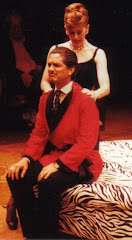
It was a staged reading of the musical called Parade. The event was produced by Ford's Theatre, which used to call itself Historic Ford's Theatre, which made it sound very stuffy; they've gotten away from that a bit lately, what with their current offering of Little Shop of Horrors, about which I recently wrote. (Ford's has grown less stuffy, I haven't). This reading was actually similar to a backer's audition. The theatre's artistic staff, headed by Paul Tetreault and Mark Ramont, wants to produce Parade in a couple of years, but the cost of doing so apparently requires more funding than the theatre normally gets. So, the Powers That Be decided to pull together a staged reading of the piece and present it in front of a bunch of DC's Big Pockets, in hopes that they will step up and fund the production.

I have never worked at Ford's, and have only recently popped up on their casting radar, I'm not sure why. I was excited to get a callback for their upcoming musical Liberty Smith a month or so ago, then missed the damn thing because of some kind of food poisoning or something. I just could not justify going into the audition and barfing all over the director, so I had to bale on the audition, to my regret (if you are twisted enough to want to know more, I wrote about it all here). But I was fully fit and ready to work when Mark Ramont, who is the theatre's associate artistic director and acts as their local casting director, invited me to participate in this reading of Parade.

Most actors in town participate in staged readings at one time or another, DC is lousy with them. I've written more than once about the 16, count 'em SIXTEEN readings I did with the Washington Stage Guild during the period in which they were not producing fully. I enjoy doing them, despite the lack of remuneration, as it gives me the chance to experiment with a wide range of characters I may not otherwise come across.

Though part of the same species, the musical staged reading is a different animal. I've done a couple previously, both of them requiring about a week's worth of rehearsal, after which several performances were given. One Touch of Venus, produced by American Century Theatre a good while back, was great fun, and was even reviewed by an online theatre critic. I also had a swell time in 1776, which was sponsored by the Smithsonian, and anchored the inaugural festivities surrounding the reopening of the National Portrait Gallery.

Parade, as I said, was a bit different, in that it was to be performed only once, before an invited audience of wealthy muckity-mucks. We did all of our rehearsing on the third floor of the Church of the Epiphany, several blocks away from the theatre, in a creaky but roomy space which Ford's uses for such purposes. (Ford's has recently completed a multi-million dollar renovation, but as inevitably happens when theatre construction is put in the hands of non-theatre folk such as the Dept of Parks or whoever it is that funded that renovation, they overlooked a CRUCIAL element of producing live theatre: a rehearsal space. So all Ford's productions begin life in the attic of a church.)

This reading was important enough that the theatre imported several New York types to lead the Parade. Steve Rosen and Jill Paice headed the cast, playing the husband and wife at the center of the story. They are both accomplished actors with substantial credits; Steve recently played Benny in the Broadway revival of Guys and Dolls, and Jill ended a successful run in The 39 Steps. If we had undergone a full rehearsal process, there would have been time to chat up these two; I would love to hear, for example, some stories of Jill's experience playing Scarlett in the disastrous musical version of Gone With the Wind which happened in London a few years ago. Anyway, our director here was Jeff Calhoun, one of the major musical theatre director/choreographers in the country (among other work, he was responsible for that Big River with the sign language).


Parade is a true story, and takes place in Atlanta in 1913-15. I grew up in Atlanta and had never heard this story, but it is apparently a darkly kept part of the city's history. It concerns a Brooklyn-born accountant, Leo Frank, who settled in Atlanta for a job, and married a local girl. He felt like an outsider, as he was Jewish as well as a Yankee. (This play was written by the same guy who wrote Driving Miss Daisy and Last Night of the Ballyhoo, so he knows a bit about being Jewish in the South.) A teenaged factory worker (a girl named Mary Phagan) is found dead, and Leo is convicted of her murder. Sentenced to hang, his appeals reach the Georgia governor, who becomes suspicious of the testimony given at the trial, and after investigation, commutes Frank's sentence to imprisonment, rather than execution.

The locals will have none of it, and they abduct him from prison one night, and lynch him.

Happy story, eh? Somehow, this period of American history was overlooked by my teachers in suburban Atlanta.

Anyway, we spent five days in the barn-like rehearsal hall, which was ringing with some of the best musical voices in town. Our cast of 16 was peppered with Helen Hayes award winners and nominees, including Eleasha Gamble, who just won this year's award for her performance in The Civil War (a production directed by our leader Jeff Calhoun, who also received a nom for his work, as did the ensemble and the production; I wrote about what I learned from seeing The Civil War a while back). Chris Sizemore was also in that show, and he kicked off our reading with an opening number which took the roof off the joint. My cohort from Man of La Mancha, Tom Simpson, lent his bass-baritone to the role of the prosecuting attorney, and Kevin McAllister handled a string of showstoppers.

I was pretty outclassed by this group of legitimate voices, but I tried to hold my own as the week of rehearsals progressed. I was playing a couple of nice roles: the cop who arrested Leo Frank, and Leo's defense attorney. It was that last role that placed me center stage for the climactic courtroom scene, where I could watch the dynamic work Steve Rosen was doing in the role of Mr. Frank.


As is common with staged readings, the whole cast sat onstage throughout the performance. We were placed in a semi-circle, and approached the free-standing mics whenever we had a scene or song to deliver. I was seated next to another HH award winner, Stephen Gregory Smith, who was stealing his scenes (in a good way) as a reporter whose career takes off due to the Frank trial, and on my other side was Jenna Coker-Jones, who is going to win next year's HH award for her performance in Ford's current Little Shop (her husband Chris might win, too; he also participated in our reading, delivering a couple of numbers in a clear, crisp tenor which makes raspy baritones like me want to get a gun).

On Sunday, we had a final runthrough at the rehearsal hall before walking over to the theatre to give our 4 PM performance. Now, I've been in Ford's many a time, even after the recent renovation, but always as an audience member. I had never stepped on the stage. Until Sunday.

As I sat and faced the audience, I felt a thrill which I used to feel every single time I stepped onstage. I don't know if it's age or experience or what, but I have not felt that true elation about being on a stage in quite a while.

Sunday, that feeling was back. I was performing on one of the most famous stages in the world, with Lincoln's box, decorated in flags, looking down upon us.

I'm going to try to remember that feeling the next time I step out onto the stage of a dinky little black box theatre to perform for a few dozen people. It is the reason I chose this life.

Friday, April 16, 2010

Friday Dance Party: Sigh No More


I have thought for years that Emma Thompson and Kenneth Branagh can do no wrong. They are equally at home in comedy, drama, classical and contemporary works, and even tackle musicals when the need arises. This last talent, the ability to sing and dance, comes as news to me, but I'm not all that surprised. I think those Brits can do just about anything when asked. Thompson made a major splash in the West End in the mid-80s in a revival of Me and My Girl, proving her musical chops, and Branagh, perhaps ill-advisedly, turned one of Shakespeare's romances into a movie musical.
Stateside, we don't know either of them for musicals. In fact, for a long while there, we knew them primarily as a team. The two were married for over 15 years, and worked together often during that period. The two of them came to American attention playing husband and wife in the mini-series Fortunes of War, which was broadcast on PBS's Masterpiece Theatre in 1987.


Around that time, Branagh formed his own theatre troupe, the Renaissance Theatre Company, and presented a season of Shakespeare, directed by some of his famous friends such as Judi Dench and Derek Jacobi. The company was made up of close friends and colleagues of Branagh and Thompson, and unlike other British theatrical companies, received no public funds. They had much critical success, and even launched an international repertory tour, but disbanded after only 6 years, when Branagh's film directing career gained traction.

That international tour came to Los Angeles while I was living there, and I saw both productions presented in rep. A Midsummer Night's Dream had Kenneth in the supporting role of Peter Quince, and Emma in the scene-stealing role of Helena. (I must wander onto a side street here. Despite the attention always paid to the actor playing Bottom in Midsummer, I have never seen a production which was NOT stolen by the actress playing the tall, gangly ingenue, Helena. Christine Baranski stole it from William Hurt when Joe Papp presented the show in Central Park, and the hilarious Stephanie Burden did the same a few years ago when DC's Folger Theatre did the play. And naturally, Emma Thompson swiped the show on tour. It's time for people to stop believing the comic tour de force in Midsummer is Bottom; it's Helena.)

Forgive the digression. Running in rep with Midsummer, the Renaissance Theatre Company presented King Lear. Branagh was playing Edgar, and Thompson was completely unrecognizable as the Fool:
Yes, that's Ken in the loincloth, and Emma in whiteface. This is the only production of Lear I've seen in which the death of the Fool made me weep.


These two stage performances, as Helena and the Fool, proved to me that Emma Thompson is one of the finest actresses I have ever seen. And Kenneth Branagh is one of the finest directors out there.

Branagh and Thompson played well together in a variety of projects, including the film adaptation of Much Ado About Nothing, in which they both starred:


Under Kenneth's direction, Emma Thompson's Beatrice is absolutely luminous. I think there should be a special fund set up to allow Branagh to adapt, direct, and film all Shakespeare's plays.

Since going their separate ways in 1995, the duo continue to have individual success. They both have been to the Oscars more than once; Kenneth has four nominations under his belt, though he has never won, and Emma won the statuette as an actress for Howards End and as a writer for Sense and Sensibility. They both won Emmys: Branagh for a television film called Conspiracy, and Thompson for a hilarious guest shot on Ellen DeGeneres's old sitcom. I just gotta include this clip from that episode, in which Emma plays herself, but with a secret. Well, two secrets. One: she's a lesbian. Two: well, take a peak at this clip (it's short and a scream):


At some point in their careers, both these actors have been accused of shameless self-aggrandizement. Branagh's film version of Hamlet, which he directed and headlined, was virtually uncut, so it ran about 4 hours, and there were those who claimed it was indulgent. I think it's the best filmed Hamlet out there, better than Olivier and Burton and Williamson and Kline and Gibson and Hawke. For a while there, it looked like Branagh was becoming his generation's Olivier, due to his Shakespeare films, but that part of his career was derailed by his disastrous adaptation of Love's Labour's Lost, into which he interpolated famous songs, turning the thing into a musical.
(It's been ten years since that debacle; I wish Ken would get back on that horse, as his films of Henry V, Hamlet, Much Ado, and As You Like It are all wonderful.)

As for Emma, she was eviscerated early in her career for her 6-episode sketch comedy TV show, Thompson. We don't think of Emma Thompson as a comedienne along the lines of Tracey Ullman, and I have not seen any full episodes of this series. But several clips are available online, and Thompson has a cult reputation. Our Emma was at Cambridge with Hugh Laurie and Stephen Fry, and co-starred with them in an early series called Alfresco, so she knows her way around sketch comedy. But Thompson bombed with British audiences and critics in 1988, and has never been repeated, despite Emma's subsequent success.

This week's Dance Party comes from that series. Branagh guest starred in about half of the show's episodes (the duo would marry the next year), and I find the clip below to be quite charming. It's not the best work from either of our stars; it's probably a good thing that their careers did not include a lot of singing and dancing. But here they give a glimpse of what may be in their future, and it's a sweet few minutes. Enjoy!


Emma Thompson turned 51 years old yesterday.

Monday, April 12, 2010

Trying To Get To Heaven

DIXIE CARTER


1939-2010


The above clip is very good illustration of a diatribe of Julia Sugarbaker, one of Television's Designing Women, and the role for which Carter was best known. In many episodes of the long-running series, Julia would mouth off with one of these extended speeches, sometimes about personal matters, such as the one above, but more often about political or societal issues. She was the mouthpiece for the views of the show's creator, Linda Bloodworth-Thomason, and our Dixie delivered these monologues with vigorous expertise. (This despite the fact that Julia's portrayer and her writer were on opposite sides of the political aisle; Carter was a Libertarian/Republican, while Bloodworth-Thomason was a Liberal/Democrat. Over time, Dixie's Republican sentiments softened.)

Here's a much more political clip, from an episode in which Julia is running for city council, and debates a right-winger on the requirement of school prayer and the pledge of allegiance:


Carter made a deal with her bosses, that anytime she was required to spout a largely liberal diatribe, she be allowed to sing on another show. I wrote about this arrangement almost exactly a year ago, when Dixie turned 70 and was the star of the Friday Dance Party. At that time, I also wrote of my first sighting of this very special performer, back in the 70s on The Edge of Night. She was a very unusual presence on a soap opera, and remained in daytime only a few years before graduating to prime time.

The 70s marked a return to acting for Carter, who had some nice New York stage credits (including some Shakespeare for Joe Papp) before leaving the business for a while to raise two daughters. Two husbands later, she was to meet and marry Hal Holbrook, who was 14 years her senior. The two became one of Hollywood's most enduring couples, and worked together more than once.

Here's a fun clip which includes a brief glimpse of Carter and Holbrook together (the other two men in the clip, Richard Gilliland and Gerald McRaney, were also playing boyfriends; Richard was, and still is, Jean Smart's husband, and Gerald was soon to wed Delta Burke. It was a regular love-fest!). In the history of Designing Women, the creators made a running gag of the four ladies and their men-folk going on vacation and having a miserable time.


Carter worked often after Designing Women left the air, costarring in Family Law for several years, and appearing in a guest arc on Desperate Housewives, in a role created for her.

It was this role which brought her her lone Emmy nomination (she lost the award to Elaine Stritch's guest turn in 30 Rock). It's astonishing that the ladies of Designing Women were so ignored for their work, but the stars of The Golden Girls, whose run roughly coincided with DW's, routinely upstaged our Atlanta belles. During its seven seasons, Delta Burke was the only star to receive an Emmy nomination (during the season in which she gained all the weight), and supporting star Alice Ghostly received a nod in one of the show's final years. Both women lost their awards and Carter, as I said, was never even nominated.


On stage, she stepped into several high-profile roles on Broadway, and was thus ineligible to compete for the Tony. She was the third and final Maria Callas in the original Master Class, and was the final Mrs. Meers in Thoroughly Modern Millie. She was well-regarded for her cabaret work, becoming a fixture at the swanky Cafe Carlyle. She worked a bit regionally, including two well-received stints here in DC at The Shakespeare Theatre Company (Holbrook appeared here, too, but not at the same time). Carter was due to appear here this spring in Mrs. Warren's Profession, but withdrew a month or so ago due to health reasons. In the late 90s, she published a chatty book revealing her opinions on a variety of subjects, called Trying to Get To Heaven: Opinions of a Tennessee Talker. In 2005, Carter and Holbrook became the figureheads of the new Dixie Carter Performing Arts Center in Huntingdon, TN, located in Carter's home county.


To me, and probably everybody else, she will always be Julia Sugarbaker. It's hard to explain the attraction I felt for Designing Women; there was something very familiar about these four iron butterflies, whose sassy independence and easy femininity reminded me a bit of my mother and her friends. When I was out on tour a while back, a small group of us made a trip to see the house which served as the show's main address, which was in Arkansas I think. None of the show was shot there, of course, but we played around a bit outside, taking pictures, and generally acting like big ol' donkey girl scouts. There is no doubt there is more than a bit of Sugarbaker in me.


This final clip illustrates the style and grace which was a big part of the series, and a big part of Dixie Carter's life. Dash Goff (don't you love Southern names?), the writer and former husband of one of our gals, spent this episode overcoming his writer's block. He leaves a thank you note to the women who have inspired him.


Dixie Carter died from cancer on Saturday. She would have turned 71 next month.

Friday, April 9, 2010

Friday Dance Party: A Good Lynching


I absolutely love it when a talented, well-trained performer, who has paid her dues, finally hits the big time. The star of this week's Dance Party has done just that. After earning an advanced theatre degree at Cornell, and after years and years of cameo work on episodic television and on the big screen, Jane Lynch has become a celebrity.


She's known primarily for her comedic work, but has delivered some nice dramatic moments as well. She gave a lovely performance as Julia Child's sister in last year's Julie and Julia, and there was even some talk of an Oscar nod.


That did not happen, but come Emmy time this year, Lynch will be the one to beat. She spent a lot of time in Chicago in her early career, with Second City, and toured as Carol Brady in the Real Live Brady Bunch. Her performance as a dog handler, opposite the equally hilarious Jennifer Coolidge, in Best in Show landed her in the Christopher Guest repertory; she also appeared in his A Mighty Wind and For Your Consideration.


A list of her credits would be lengthy and unnecessary for anyone who has seen her work on Glee. I am not an avid fan of the show, though I admit I watch every episode. I find the show itself very uneven, one week terrific, the next week weak. I am not one who is overly enamored of the young cast, most of whom are not dynamic musical performers, though the rest of the country seems to think so. While on their winter hiatus, the Glee kids have been on tour, filling arenas with their lip-sync music and awkward dance moves (they were such a hit at Radio City Music Hall, extra performances had to be added).


Ah, well, best of luck to them. Their program has clearly attracted a following which does not just include those of us who were actually performers in high school. Pretty much everyone, it now seems, felt out of place and unusual in high school. It must be that chord which is being struck in the viewers which have made Glee the hottest show of the season.


After a long break, Glee is back next week, and I'm sure I'll be taping. The main reason will be to see how the writers take the further adventures of butch cheerleading coach Sue Sylvester into new directions. There are lots of clips of the Glee kids out there, but FOX has been quite stingy with the clip below, allowing it on Youtube for a very short while, then yanking it. But I love it, as it shows the exuberance which Jane Lynch gives to her performances. It's a rare scene in which she is getting along with our hero, played by Matt Morrison (he is one of the few on the show with real stage cred, as he created the role of Lt. Cable in the recent South Pacific revival, and has been a Broadway chorus boy for years).


Watch this clip of couple of times if you like, it's short, sweet, and great fun. Jane Lynch is clearly having a great time, both in the clip, and in her life. Happy Dance Party!