Monday, June 2, 2008

I Told Them So

...if only they had listened to me. I could have saved them millions.


Exactly one year ago, I predicted this was the worst idea since mayonnaise, but they went ahead and did it. They produced another lavish musical version of Gone with the Wind. Can you believe it's actually been tried twice??


And just as I predicted so many months ago, it flopped. It will be closing after only 79 performances.


Why won't they ever listen to me?


Burning Backlots


When Universal Studios went up in flames over the weekend, did anybody else notice the eerie similarity to another studio fire from the past? Take a look at these shots to the left and below, of the weekend's raging inferno...


Now take a peek at another studio flamer, from the late 1930s, ignited by David O. Selznick on his own backlot. The scene remains the centerpiece of one of the most popular films of all time:


Yep, that's Clark Gable driving a horse-drawn wagon through the burning streets of Atlanta in Gone With the Wind (actually through the burning wreckage of the Selznick backlot). The film seems to have fallen out of favor with movie enthusiasts of today, and rarely appears on anybody's top ten lists, but for decades, everybody loved it. And back then, everybody knew this little tidbit: the above scene was the first of the long, 4-hour film's to be shot, and the role of Scarlett had yet to be cast. That's a photo double riding in the back of the wagon with Butterfly McQueen. Hollywood lore has it that producer Selznick was introduced to Vivian Leigh that very night during the shoot, by her then husband Laurence Olivier, and in the fiery light of those burning sets, a star was born.


I wonder if anyone's career was made during this weekend's studio blaze...


Sunday, June 1, 2008

Bad Press


Theatre J has announced it will be shuttering its current world premiere production of David in Shadow and Light a week early. This occasionally happens with the commercial shows around here, and sometimes with the smaller, itinerant companies who pay rental fees for their spaces. But it is a highly unusual occurrence with a subscription house like Theatre J. I did not see the show, though two friends who did disliked it. And the press, to quote one of the show's stars, "clobbered" it. I am sorry that this show had such a hard time of it, as a world premiere is never easy to produce, and when it's a musical, it's doubly difficult to get the thing right. I've been directed by Nick Olcott, who helmed this show, and can attest that he is a director of skill and insight. He surely knows how to get things to work, theatrically, but I guess sometimes, the material just can't be effectively staged.


Theatre J is not the only local house to be hit with problematic reviews lately. School for Scandal, currently at the Folger Shakespeare Library, received mixed to poor reviews, though none of the local critics are eager to discredit the leading players, as they include local favorites Kate Norris, David Sabin, and Catie Flye. But everyone seems confused by the directorial decision to cast a man, Tom Story, as Lady Sneerwell. Placing the play a century or so later than originally written has also raised concerns. But I have it on good authority that the audiences usually have a ball.


NOBODY is prepared to criticize theatrical icon Chita Rivera, who is currently headlining Kander and Ebb's The Visit at Signature. Reactions to the show have been mixed, but don't appear to be strong enough to sustain the planned transfer to New York. According to the Washington Post, there are eight, count 'em eight, Tony winners connected to this production, and the involvement of so many high-powered talents seems to suggest that a New York engagement was a given. The press may have other ideas.


I recognize that we in the theatre can't do what we do without press coverage, and I've been a victim of crummy reviews myself, beginning with a performance I gave in Los Angeles during the Dark Ages, in which one critic proclaimed I was "acting a lot...or something." See how we remember the bad notices? But it's disappointing when the critical analysis of a show, sometimes written by someone not qualified to judge artistic worth, can bury a show before its time.

Saturday, May 31, 2008

Theatre Droppings: New York, 1996

I've written in previous posts about my trips to New York specifically to see live theatre, in 1975, '76, '77, '78, and 1991. Those were all vacation trips from Los Angeles, where I lived during those years. Once I moved to the East Coast, I had neither the time nor the funds to spend a full week in Manhattan attending theatre. But that does not mean I gave up visiting Broadway altogether. I have attended more than a half dozen plays over the past decade, usually in conjunction with a trip to New York for an audition of my own.


I earned my MFA in the spring of 1996, after which I began a routine of traveling to New York to seek work. In each of my trips that year, I popped into a show or two.


I've already mentioned my admiration for Bill Irwin, a fascination which dates back to his stage performances in Fool Moon and The Regard of Flight, telecast on PBS. In 1996, Irwin was contracted by the Roundabout Theatre Company to create a new adaptation of the commedia dell'arte piece, Scapin. He played the title character, as well as directing and adapting the play. I have to admit that I was just a little disappointed in the show, for several reasons. Predominantly, I still had very vivid images of Jim Dale's adaptation of the play, Scapino, in my memory, and Irwin's version seemed more sedate than the over-the-top hilarity which Dale's production created. Irwin's performance as Scapin never seemed to catch fire, and I came away from the theatre thinking that he should confine himself to appearing in pieces he had created for himself from the ground up. (I have since changed my mind on that, having seen his exceptional performance as George in Who's Afraid of Virginia Woolf?). My program tells me I saw an unknown Kristin Chenoweth in one of the ingenue roles.


I saw two more straight plays in '96, both with bona fide divas heading the cast. Terence McNally's second love letter to opera (his first was The Lisbon Traviata) provided one of the showiest roles for an actress in modern times. Master Class revolved around the master classes opera diva Maria Callas gave at Julliard at the end of her career. By the time I caught up with the show, the original Tony winners Zoe Caldwell and Audra MacDonald had moved on, but I was not in the least disappointed. Patti LuPone had assumed the role of Callas, and she was mesmerizing. It was purely a dramatic role (all the singing in the show was done by the young students), and LuPone proved to me that she is a hugely talented actress with heart, brains, comic timing, and guts. It remains one of the best stage performances I have ever seen.


Later in 1996, I saw another of my favorite stage performances, in the all-star revival of Edward Albee's A Delicate Balance. The cast included RSC vet (and future Spiderman star) Rosemary Harris, George Grizzard (who won the Tony for this role), and one of my favorite unsung stage actresses, Rosemary Murphy (you might remember her as FDR's mother in the TV film Eleanor and Franklin, for which she won the Emmy). But the main attraction for me was Elaine Stritch, playing a supporting role, but swiping the show from everybody in sight. I've previously mentioned my admiration for Stritch, which only increased after seeing this performance, in which she landed every laugh, even while torturing us with the terrible sadness of her alcoholic character (according to her one-woman show, she was sober while playing it).


The last show I saw in New York in 1996 was an Off-Broadway musical in the second year of its run, When Pigs Fly. Actually, the show was officially titled Howard Crabtree's When Pigs Fly, and therein the production has attained a true uniqueness. Who is Howard Crabtree, you may wonder? No, he was not the producer, nor the director, nor the composer, nor the lyricist, nor the book writer. He wasn't even in the thing (though the leading character was named Howard). In what has got to be a first and only, Howard Crabtree received over-the-title billing as the costume designer. As outlandish as this sounds, if you saw the show, you would agree that he deserved his star treatment. He is credited, along with Mark Waldrop, with "conceiving" the piece, which possibly meant, he dreamed up a bunch of truly outlandish costumes, and then a show was created around them. With a decidedly gay sensibility, When Pigs Fly concerned the journey a young man takes on his way to artistic fulfillment. This Off-Broadway show was a feast for the eyes, and included a centaur, a tribute to the hidden gayness of Bewitched, and an astonishing number in which furniture became hoop skirts (believe me, you had to be there). The evening was absolutely hilarious, though it included a poignant 11:00 ballad sung by cabaret artist Jay Rogers. In it, he reminded us that, amid the vast cruelty of the modern world, Laughing Matters. It was only after the show that I read the program and discovered the true poignancy of that message. The man behind the conception of this piece, the afore-mentioned Howard Crabtree, had died of AIDS at age 41, five days after finishing work for the show. He did not live long enough to see the big success his designs would create.


It's a fitting credo that I try, often without success, to remember every day.

Laughing matters.

Friday, May 30, 2008

Held Hostage

Remember when cellphones were supposed to be a convenience? Well, the ability to be accessible to everybody in the world every moment of the day has lost its allure. Nobody even complains about them anymore, or rather, their obnoxious users. But allow me. I can't count the number of times I have been held hostage to some idiot's phone call. At the supermarket, when one inevitably comes upon somebody yapping into their phone, oblivious to others around them, at least you can move away. But standing in line at the bank or the DMV or the post office, there is no escape. I am held hostage by the inconsiderate ramblings of strangers who feel no hesitation in forcing me to eavesdrop onto their private lives.


I often feel like a hostage on our metro (subway) system. Sometimes, it's the cellphone abuser described above. But just as often, I am held hostage by DC teen-agers who feel completely entitled to show off to each other by shouting, cursing, and otherwise demonstrating the total failure of the DC public school system. I suppose I should be more charitable in my reactions to their rude, obnoxious behavior; they are only acting the way they have observed their parents behaving. And when I am finally released from their presence, and am making my way up the escalator to the outside world, I sometimes wonder what that outside world has in store for these children. What will happen to these woefully uneducated youngsters who will have a high school diploma but will certainly not have a high school education? Where will they find jobs, when they cannot speak their native English language?


I'm being held hostage by this city, too. I've lived in DC almost 13 years, and have come to the realization that I don't really like it here. Much of the time, I actively hate it here. I hate the long, sweaty summer weather, I hate the mismanagement of the city's government, I hate the invasion of the tourists, which happens every year from March through October. I even hate my mail man. He yaps on his cellphone while sorting the mail for our 22 unit condo complex, and because of his inattention to the job I am paying him for, our mail is consistently misdirected.


I should move, of course, but, once again, I am being held hostage. I get just enough work in my chosen career to keep me here. At this point in my life, I don't feel up to the challenge of starting all over in a new city, so, as long as the occasional acting gig pops up, I'm stuck here in DC.


Held hostage by my own decisions.

Thursday, May 29, 2008

Harvey Korman


1927-2008


Television's top Second Banana has split. He was a quadruple Emmy-winner for his contributions to The Carol Burnett Show.


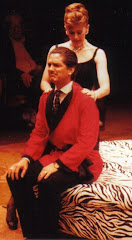
...as Rhett Butler


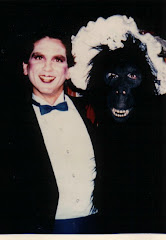
...as Norma Desmond's Max


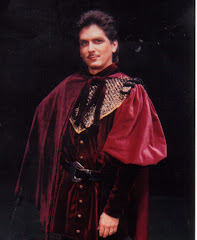
...as Prince Phillip


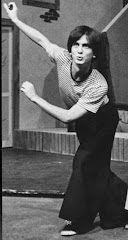
...as Will Shakespeare


...with another Emmy winning banana in the bunch


If St. Peter needs a sidekick, Korman's got a gig at the pearly gates.

Monday, May 26, 2008

Sydney Pollack


1934-2008


For The Way We Were and They Shoot Horses, Don't They? and Out of Africa and Absence of Malice and Three Days of the Condor and The Firm and Michael Clayton and even Will and Grace, you will be remembered.


But don't don't don't don't don't panic.
You are going to a very special place in heaven,
for Tootsie.